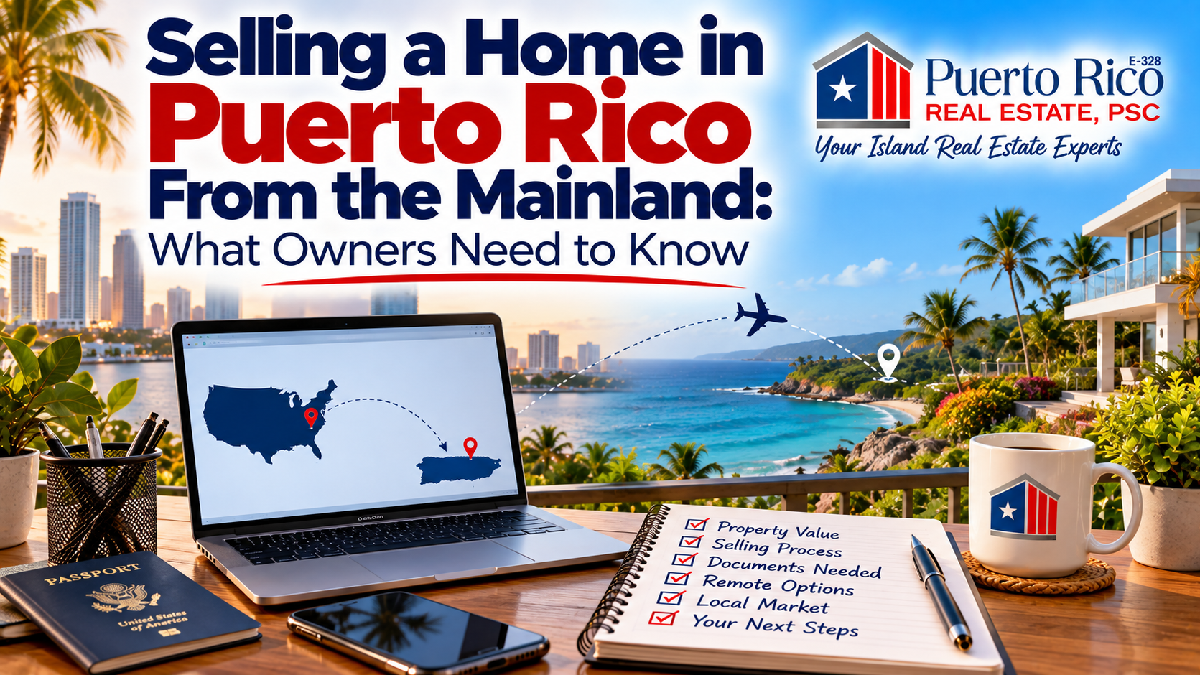
There's a house in Puerto Rico with your name on the title.
But you're sitting in Florida.
Or New York.
Texas.
Pennsylvania.
New Jersey.
Connecticut.
Chicago.
Maybe somewhere even farther away.
Every once in a while you think:
"I really need to figure out what I'm going to do with that property."
Then reality gets in the way.
Work.
Family.
Airfare.
Schedules.
Repairs.
Paperwork.
Finding someone trustworthy in Puerto Rico.
And suddenly another six months passes.
If this sounds familiar, you're definitely not the only property owner facing this situation.
Puerto Rico has strong connections with communities throughout the United States, and it's common for property ownership to remain on the Island even after an owner relocates.
Some properties are inherited.
Some were once primary residences.
Some are second homes.
Some were purchased as investments.
And sometimes a family simply reaches the point where keeping the property no longer makes sense.
The distance can make selling seem overwhelming.
But the first thing you should know is this:
Living outside Puerto Rico doesn't necessarily prevent you from beginning the selling process.
Before worrying about how to sell remotely, there's another question worth answering.
Why do you still own it?
There may be an excellent reason.
Maybe your family uses the house every summer.
Perhaps you plan to retire there.
Maybe it generates rental income.
Perhaps it's appreciating and fits your investment strategy.
Maybe it's the family home and you're simply not ready to let it go.
If the property continues serving a purpose, keeping it may make perfect sense.
But sometimes the answer is different.
"I've just never gotten around to selling it."
That's when it's worth looking more closely.
Because a property doesn't stop requiring attention simply because the owner moved away.
Ask anyone who has maintained a property remotely.
At first, it seems manageable.
Then someone calls because the grass is overgrown.
There's a leak.
The electricity needs attention.
A neighbor noticed something.
The air conditioner stopped working.
A storm passed nearby and you're wondering whether everything is okay.
A tenant needs something repaired.
A family member has to drive over and check the house.
Suddenly you're managing a small operation from another state.
Puerto Rico's climate adds another layer.
Heat, humidity, rain, vegetation, insects, intense sunlight and salt exposure in coastal areas can all affect properties.
Something minor can become expensive when nobody notices it for months.
So when deciding whether to continue holding a Puerto Rico property, don't consider only its possible future value.
Also consider the financial and practical cost of continuing to own it remotely.
This is where many owners get stuck.
They assume the first step requires booking a flight.
It doesn't necessarily.
The first step can simply be a conversation.
Where is the property?
What type of property is it?
How large is it?
What's the approximate land size?
How many bedrooms and bathrooms?
Is anyone currently living there?
What condition is it in?
When was the last time you visited?
Do you have photographs?
What improvements have been made?
Do you know anything about the title?
Once we understand the basic situation, we can begin discussing what needs to happen next.
Depending on the circumstances, a local real estate professional may be able to visit the property, evaluate its condition, take preliminary photographs and begin researching comparable properties.
That allows the owner to start gathering information before deciding whether to travel at all.
One of the biggest mistakes a remote owner can make is choosing an asking price based on outdated information.
Maybe a neighbor told you their property sold for $400,000.
Maybe someone offered you $200,000 two years ago.
Perhaps an online website generated a value.
Or maybe a family member said:
"Don't sell it for less than $500,000."
None of those automatically establish market value.
A property's likely market position depends on factors such as:
This is why a Comparative Market Analysis (CMA) can be particularly helpful.
For a remote owner, it provides something extremely valuable:
Context.
Instead of wondering what the property might be worth from 1,500 miles away, you can begin making decisions using current local information.
Later this month, we'll take an even deeper look at this subject in:
"What Is My Puerto Rico Property Worth? Why Online Estimates Don't Tell the Whole Story."
This sounds obvious.
But it isn't always.
We've seen situations where an owner hasn't physically visited a property in years.
The image in their mind may be completely different from the property's current condition.
Maybe a relative has been checking on it.
Maybe a tenant has lived there.
Maybe it's been vacant.
Before deciding how to sell, you need to know what you're actually selling.
A local property visit can help identify obvious issues.
Does the exterior need cleaning?
Is vegetation overgrown?
Are there visible signs of moisture?
Does the property appear secure?
Are there belongings inside?
Does it need cleaning?
Are repairs obviously necessary?
Has the surrounding area changed?
Sometimes the owner discovers the property is in better condition than expected.
Sometimes the opposite happens.
Either way, information is better than guessing.
Remote owners often struggle with this question.
"Should I fix the house before selling?"
The temptation is to think:
"If I remodel everything, I'll get more money."
Maybe.
But spending more doesn't automatically mean making more.
Suppose you spend $35,000 remodeling a property.
If buyers are only willing to pay $20,000 more because of those improvements, that renovation didn't necessarily improve your financial outcome.
And managing a renovation from another state creates its own challenges.
Contractors.
Payments.
Materials.
Schedules.
Inspections.
Changes.
Delays.
For some properties, repairs make sense.
For others, cleaning, landscaping, paint and a few targeted improvements may be enough.
And sometimes the best decision is to market the property honestly as-is to buyers who understand the opportunity.
We'll address this question directly later in our October series with:
"Should You Renovate Before Selling Your Puerto Rico Home—or Sell It As-Is?"
Before spending significant money, understand what buyers in that specific market are likely to value.
Remote sellers can save themselves significant frustration by beginning the document process early.
The documents required can vary depending on the property and transaction, but sellers may need records related to ownership, property identification, taxes, mortgages, permits, inheritance, condominium matters or other property-specific issues.
This is especially important if you haven't dealt with the property for years.
Don't wait until there's a buyer ready to close before discovering that something needs to be located, updated, corrected or resolved.
If you aren't sure what you have, start by gathering whatever documents are already in your possession.
Create a folder.
Digital is even better for remote owners.
Scan what you have.
Organize it.
Then the appropriate professionals involved in the transaction can help identify what else may be necessary.
Our Selling Real Estate in Puerto Rico – Complete Seller Guide provides a broader overview of the selling process and can help you begin preparing.
This is where remote selling can become more complicated.
Imagine this situation:
Your parents owned a home in Puerto Rico.
You live in Florida.
Your brother lives in New York.
Your sister lives in Texas.
The property has remained in the family, but nobody really uses it.
Everyone agrees that selling might make sense.
But who owns what?
Who has authority to sign?
Has the inheritance process been completed?
Is the title properly reflected?
Are there outstanding matters that need to be addressed?
These questions can require assistance from attorneys, notaries, CPAs, tax professionals or other appropriate professionals depending on the circumstances.
A real estate broker cannot substitute for those professionals.
But from a practical real estate perspective, identifying these issues before a buyer is waiting can make an enormous difference.
That's why we'll devote Article #6 of our October series entirely to:
"Selling an Inherited Property in Puerto Rico: What Families Should Know."
When you're living outside Puerto Rico, you're relying heavily on your local real estate company to represent the property.
That means you should understand how the property will actually be marketed.
Ask questions.
How will the photographs look?
Will there be video?
How will the property be described?
Where will it be promoted?
Who is the likely buyer?
How will inquiries be handled?
How will showings be coordinated?
How will you receive feedback?
At Puerto Rico Real Estate, PSC, we believe a property shouldn't simply be placed online with a few photographs and forgotten.
We want to understand the property's story.
A mountain property with acreage should feel different from a beach home.
A two-unit property should communicate its flexibility.
A fixer-upper should communicate opportunity rather than pretending it's something it isn't.
A home near an airport may appeal to someone who travels frequently.
A large backyard may matter tremendously to a family.
Marketing should help buyers understand why the property may matter to them.
Twenty years ago, selling a property from another state could feel far more disconnected.
Today, communication can happen almost instantly.
Video calls.
Email.
Digital documents.
Property videos.
Photographs.
Messaging.
Virtual discussions.
Online marketing.
A seller in Florida can see photographs of their Puerto Rico property within minutes.
An owner in New York can review marketing materials without getting on an airplane.
Someone in Texas can discuss an offer by phone or video.
This doesn't mean every transaction can be completed entirely remotely.
Specific documents, signatures, notarizations, legal requirements, lender requirements, closing procedures or individual circumstances may affect what is possible.
But technology can make communication and coordination dramatically easier.
And for an absentee seller, communication may be one of the most important things to look for when choosing a real estate company.
This is another common concern.
If you're in Orlando and the property is in Aguadilla, who's going to show it?
That's one of the reasons you hire local representation.
Once appropriate access arrangements have been made, your real estate professional can coordinate property showings with prospective buyers and other real estate professionals.
The exact arrangement depends on whether the property is:
Vacant.
Owner-occupied.
Tenant-occupied.
Occupied by family.
Used as a vacation rental.
Or otherwise restricted.
The important part is establishing a clear showing procedure from the beginning.
Who has keys?
How much notice is required?
Are there alarm instructions?
Does a tenant need advance notice?
Are pets present?
Are there gates?
Is access difficult?
The fewer surprises we have once the property is on the market, the smoother the showing process can be.
Communication.
It sounds simple, but for a remote seller it's critical.
You shouldn't feel like your property disappeared into a black hole after signing a listing agreement.
You should have a way to understand what's happening.
Are buyers asking questions?
Are people viewing the listing?
Are showings occurring?
What feedback are we receiving?
Are buyers reacting to the price?
Are they concerned about condition?
Is there something they consistently like?
Has competing inventory changed?
Does the marketing need adjustment?
Good communication helps a seller make better decisions.
And when you're thousands of miles away, it also gives you confidence that someone is actively paying attention to your property.
Receiving an offer is exciting.
But the highest number isn't automatically the best offer.
Remote sellers should evaluate the entire package.
That can include:
Purchase price.
Deposit.
Cash or financing.
Type of financing.
Inspection provisions.
Requested repairs.
Contingencies.
Proposed closing timeline.
Items included or excluded.
Buyer qualifications.
Other conditions.
A strong real estate professional should help you understand the practical differences between offers so you can make your own informed decision.
You shouldn't simply receive a message saying:
"Here's an offer. Sign here."
You should understand what you're considering.
This is one of the first questions remote sellers ask.
And the correct answer is:
It depends on the transaction and your circumstances.
Puerto Rico real estate transactions can involve attorneys/notaries, lenders, title-related documentation and other requirements that vary depending on the property and transaction.
Some aspects may potentially be handled remotely depending on the circumstances and the professionals involved.
Others may require particular forms of execution, authorization, notarization or physical presence.
This is an area where sellers should rely on the attorney/notary and other qualified professionals handling the specific transaction rather than assuming that one answer applies to every sale.
The important thing is to raise the question early.
Tell your real estate professional from the beginning:
"I live outside Puerto Rico and would like to minimize travel if possible."
Then the transaction can be planned with that circumstance in mind.
This may be one of the most valuable pieces of advice in this article.
A buyer makes an offer.
Everyone is excited.
The buyer begins financing.
Then someone discovers a title issue.
Or an inheritance matter.
Or missing documentation.
Or another problem that should have been addressed months earlier.
Now everyone is under pressure.
Remote owners can reduce that risk by investigating the property before or early in the listing process.
You may not be able to solve every possible issue in advance.
But discovering known problems early gives you time to address them without a buyer and closing date waiting on the other side.
Preparation isn't glamorous.
But it can save enormous frustration.
Tax treatment can depend on many factors, including residency, ownership structure, how the property was acquired, how it was used, gains, applicable Puerto Rico and federal rules, and the seller's individual circumstances.
This is not an area where sellers should rely on general Internet advice.
If you're selling Puerto Rico real estate while living elsewhere, speak with a qualified CPA, tax attorney or other appropriate tax professional about your specific situation.
Your real estate broker can help coordinate the transaction, but shouldn't pretend to replace individualized tax advice.
Knowing that before the sale is generally much better than discovering an unexpected issue afterward.
Remote property owners can sometimes receive unexpected calls, texts, letters or emails from people claiming they want to purchase their Puerto Rico property.
Some may be legitimate.
Others may not be.
Don't allow distance—or excitement over receiving an unsolicited offer—to cause you to skip normal verification.
Be cautious with anyone who refuses to provide identification, proof of funds or financing information; refuses reasonable video communication; pressures you to act immediately; asks you to send money; proposes unusual payment arrangements; or tries to move the transaction outside normal professional channels.
A legitimate sale should withstand reasonable verification.
When you're selling from outside Puerto Rico, having trusted local professionals involved becomes even more important.
Sometimes the biggest obstacle isn't logistics.
It's emotion.
Maybe the property belonged to your parents.
Maybe you grew up there.
Maybe every room contains a memory.
You can be sitting in Florida and still picture exactly what the house looked like during Christmas when you were ten years old.
Selling that property can feel like closing a chapter.
There's nothing wrong with acknowledging that.
But keeping the property and keeping the memories aren't the same thing.
You can sell a house without selling what happened inside it.
For some families, selling allows a property that has been sitting unused to become someone else's home.
And sometimes that's a better ending than watching it slowly deteriorate from thousands of miles away.
When you live outside Puerto Rico, you're not simply hiring someone to advertise your property.
You're choosing the people who will become your eyes, ears and local representation on the Island.
At Puerto Rico Real Estate, PSC, we understand how important communication becomes when the owner isn't physically here.
Our approach can include:
When legal, tax, title, financing or other specialized matters arise, we'll encourage you to work with the appropriate qualified professionals.
We don't believe good service means pretending to know everything.
It means knowing how to help keep the process organized and moving.
If you've been thinking about selling a Puerto Rico property from Florida, New York, Texas, Pennsylvania, New Jersey, Connecticut or anywhere else, don't let the distance automatically stop you.
You don't need to begin with an airline ticket.
Begin with information.
Where does the property stand today?
What condition is it in?
What might it realistically be worth?
What documentation is available?
Are there issues that should be addressed?
What would it cost to continue holding it?
Who is the likely buyer?
What would a selling strategy look like?
Once you know those answers, you can decide whether selling makes sense.
Maybe you keep it.
Maybe you sell it.
Maybe you prepare it now and sell later.
But at least the decision is based on information rather than distance.
And if you decide it's time to sell, you don't have to figure out the Puerto Rico side of the process alone.
Let's start with a conversation about the property.
You don't have to commit to selling simply to learn what your options may be.
Puerto Rico Real Estate, PSC
Lic. E-328
📞 787-244-6364
📧 [email protected]
🌐 ThePuertoRicoRealEstate.com
Your Island Real Estate Experts
For a complete overview of selling property on the Island:
Selling Real Estate in Puerto Rico – Complete Seller Guide
Legal, tax, inheritance, title, notarization and closing requirements depend on the individual property and transaction. Sellers should obtain advice from the appropriate Puerto Rico attorney/notary, CPA, tax professional or other qualified professional when needed.
#PuertoRicoRealEstate #SellPropertyPuertoRico #SellFromTheMainland #PuertoRicoProperty #AbsenteeOwner #PuertoRicoHomes #SellingPuertoRico #PuertoRicoRealtor #SellMyHousePuertoRico #PuertoRicoLiving #RealEstatePuertoRico #PuertoRicoRealEstatePSC
Your satisfaction guides our every step. Thanks for choosing PRRE. View all.
"Thank you for your service great teamwork I completely appreciate your time and all your effort thanks again"
You were so much help. Thank you for staying on top of things with me.
The closing was straightforward and completed without incident. The buyers were wonderful. Thank you.
The closing was straightforward and completed without incident. The buyers were wonderful. Thank you
I received your listing in email and just wanted to thank you for the EXCELLENT information. You included not only the correct location, but good, quality video/photos, everything. It's not exactly what I need but: A rare thing to get such a quality listing information, just wanted to say thank you.
Everything went smooth and great at closing, you were such a great help in the process. I will refer you to a friend that needs your help. Thanks alot for all you did for me.
Thanks to all of you, super attention, you explained everything very kindly and the Lcda was also super kind. All excellent more than grateful for everything!!
Everything super good, they treated us very well and everything went well with the closing. Everyone was very nice and the Lcda was very kind to us. Thanks to you and your team who treated us very well and never let us go. I will recommend you and hope to call you soon to find a property.
Closing Done, only took an hour.No problems it went smooth. Thanks again for everything! Having a drink to celebrate.
Very Smooth Transaction. Your Team was very supportive and they helped me alot during the transaction.