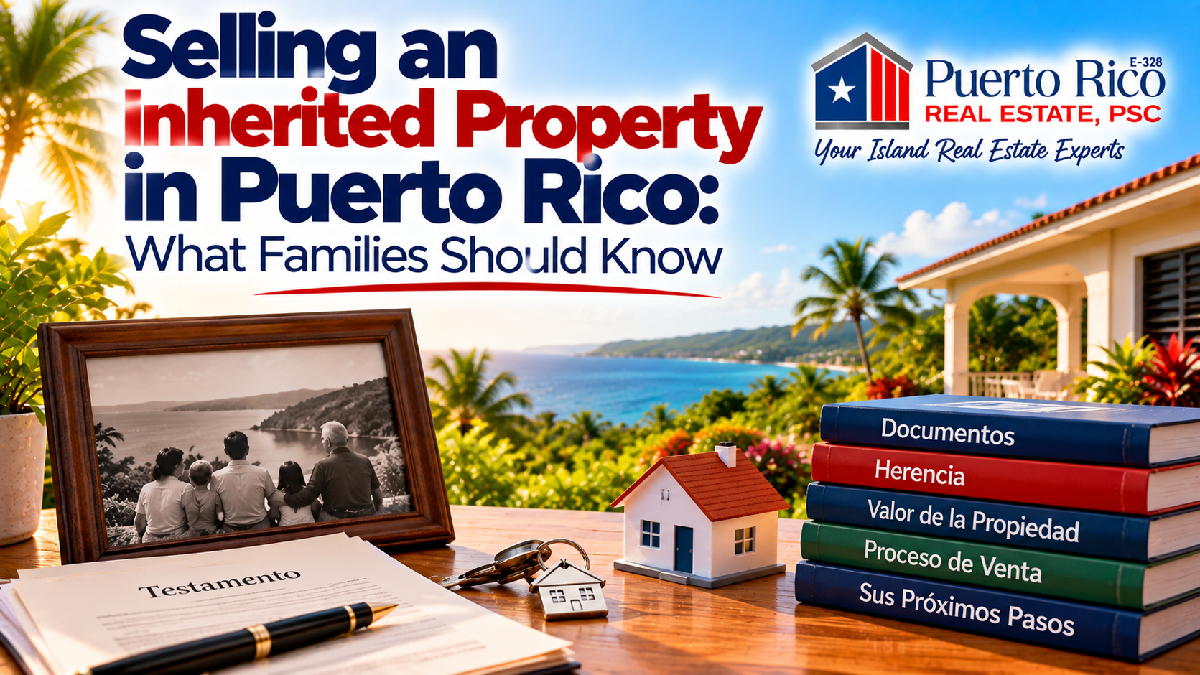
"We inherited a house in Puerto Rico. Now what?"
It's a simple question.
The answer isn't always simple.
Perhaps your mother or father passed away and left the family home behind.
Maybe the property belonged to your grandparents.
Perhaps several relatives inherited land that has been in the family for generations.
One sibling wants to keep it.
Another wants to sell.
Someone lives in Puerto Rico.
Someone else lives in Orlando.
Another family member is in New York.
And while everyone is trying to decide what to do, the property still needs attention.
The grass continues growing.
The house needs maintenance.
Property-related expenses don't disappear.
A leak doesn't wait for the family to reach an agreement.
And an empty property can slowly deteriorate while everyone keeps saying:
"We'll figure it out later."
If your family is considering selling an inherited property in Puerto Rico, the process becomes much easier to understand when you separate it into two sides:
First, is the property legally and practically ready to be sold?
Second, once it is ready, how should it be priced, prepared and marketed?
Those are related questions.
But they aren't the same question.
Before discussing asking prices, photographs or buyers, families should have an honest conversation.
What does everyone actually want?
One heir may want to keep the property because of its emotional importance.
Another may want to use it as a vacation home.
Someone might believe it should become a rental.
Another family member may need their share of the proceeds.
And someone else may simply want to stop dealing with the maintenance.
None of those positions is automatically unreasonable.
Inherited real estate can be emotionally difficult precisely because the property may mean something different to every person involved.
The house isn't just a house.
It may be where everyone gathered for Christmas.
Where your grandmother cooked Sunday dinner.
Where you spent summers as a child.
Where your parents lived for 40 years.
Recognizing that emotional connection can make the practical conversation easier.
Selling a property doesn't erase the family's history.
But the family still needs to determine whether continuing to own the property makes sense.
This is one of the most important steps.
A family may say:
"We inherited the house."
But from a transaction standpoint, more specific questions may need to be answered.
Who are the heirs?
What legal process has been completed?
How is ownership currently reflected?
Is the property still recorded under the deceased owner's name?
Are there multiple heirs?
Are there wills or other relevant estate documents?
Are there unresolved title or inheritance matters?
The answers can affect what needs to happen before a sale can move forward.
This is also where it's important to understand the limits of a real estate broker's role.
Puerto Rico Real Estate, PSC can assist with the real estate side of the transaction, but we are not a substitute for an attorney/notary, CPA, tax professional or other professional whose expertise may be required to resolve inheritance, title or tax matters.
If there are questions about who has authority to sell or what legal steps are required, those questions should be addressed by the appropriate qualified professional.
The earlier they're identified, the better.
Imagine this.
Your family puts the property on the market.
The photographs look great.
A buyer falls in love with it.
An offer is accepted.
The buyer begins financing.
Everyone starts planning around the closing.
Then an issue involving the title or inheritance process appears.
Suddenly the transaction slows down—or potentially can't proceed on the timeline everyone expected.
This is why preparation matters.
Whenever possible, families should begin investigating the ownership and documentation situation before a buyer is waiting.
It may not be possible to predict every issue.
But discovering a known problem early gives the family time to work with the appropriate professionals without the added pressure of a pending closing.
Our Selling Real Estate in Puerto Rico – Complete Seller Guide provides a broader look at the overall selling process and is a useful starting point for families unfamiliar with selling property on the Island.
This is extremely common.
And sometimes the real challenge isn't the house.
It's getting everyone on the same page.
Imagine four siblings inherit a property.
One lives in Puerto Rico.
One lives in Florida.
One lives in New York.
One lives in Texas.
One wants to sell immediately.
One thinks the property will be worth more next year.
One wants to renovate it first.
The fourth hasn't responded to the family group chat in three weeks.
Meanwhile, someone is paying for the electricity.
Someone else is paying for landscaping.
And nobody is quite sure who's responsible for the roof repair.
This can become frustrating very quickly.
Before moving toward a sale, families should establish clear communication.
Who will be the primary contact?
Who will communicate with the real estate broker?
What decisions require everyone's participation?
Who is coordinating with the attorney/notary or other professionals?
Who has access to the property?
Who has the documents?
The clearer those responsibilities are, the easier it becomes to move forward.
Once the family begins considering a sale, one of the first questions will usually be:
"How much is the property worth?"
And this can become surprisingly emotional.
One family member may remember what a neighbor sold for.
Another may have checked an online estimate.
Someone may have received an unsolicited cash offer.
Another relative may say:
"There's no way we should take less than $500,000."
But none of those things automatically establishes the property's market value.
Our previous October article, "What Is My Puerto Rico Property Worth? Why Online Estimates Don't Tell the Whole Story," explains why property valuation in Puerto Rico requires looking beyond a computer-generated number.
A Comparative Market Analysis may consider factors such as:
For more detail, families can review our guide to using a Comparative Market Analysis to price a property effectively.
Having a market-based discussion can also help remove some of the emotion from disagreements about price.
Instead of:
"I think it's worth $600,000."
versus
"I think it's worth $400,000."
the conversation becomes:
"What does the available market information support?"
That's a much more productive starting point.
Inherited properties sometimes attract unsolicited interest.
A neighbor may approach the family.
An investor might send a letter.
Someone may call saying they buy houses for cash.
A distant relative may know someone who's interested.
There's nothing inherently wrong with receiving an unsolicited offer.
It could even become a legitimate opportunity.
But families should understand what the property may be worth before deciding whether an offer is attractive.
If someone offers $200,000 and the family has no idea whether the property could reasonably sell for $175,000 or $350,000, how can they evaluate the offer?
Information creates leverage.
Before accepting a quick offer simply because it feels convenient, understand what you're selling.
Inherited homes are sometimes properties the heirs haven't visited recently.
Maybe Mom lived there alone.
Perhaps Dad maintained everything himself.
Maybe the property has been empty since the owner passed away.
One sibling may remember the house as it looked five years ago.
But what does it look like today?
Walk through it—or have someone trustworthy do so.
Look at the exterior.
The roof.
Walls.
Windows.
Doors.
Kitchen.
Bathrooms.
Electrical components.
Plumbing concerns that may be visible.
Air-conditioning.
Yard.
Vegetation.
Signs of moisture.
Security.
Personal belongings.
The purpose isn't to perform a professional inspection yourself.
It's simply to understand the property's general current condition.
Before developing a selling strategy, the family needs to know what it's actually working with.
This can divide families quickly.
One person says:
"Let's renovate the entire house. We'll get much more money."
Another says:
"I'm not putting another dollar into that place. Sell it the way it is."
Both may have legitimate arguments.
The answer depends on the property.
Some improvements can improve presentation significantly without requiring a huge investment.
Cleaning.
Removing unnecessary belongings.
Pressure washing.
Cutting vegetation.
Minor painting.
Repairing obvious small issues.
Improving curb appeal.
Those changes may help buyers see the property more positively.
But a major renovation is a different decision.
If the family spends $50,000, will buyers pay at least enough additional money to justify that expense, time and risk?
Not necessarily.
That's why we're dedicating another October article specifically to whether Puerto Rico sellers should renovate before selling or sell as-is.
Don't renovate simply because you assume renovated automatically means more profit.
Analyze the numbers first.
This is one of the most emotional parts of an inherited-property sale.
The house may still contain decades of family belongings.
Furniture.
Photographs.
Documents.
Jewelry.
Artwork.
Tools.
Old letters.
Family records.
Clothing.
Collectibles.
Items that may look insignificant to one person but mean everything to another.
Before hiring someone to empty the property, give family members a reasonable opportunity to identify important belongings.
Create a process.
Perhaps photograph rooms and larger items.
Let heirs identify what they want.
Separate important documents.
Protect valuables.
Then determine what will be donated, sold, discarded or left with the property if appropriate.
Once something is thrown away, it may be impossible to recover.
Take the time to do this carefully.
Don't automatically assume everything must disappear before contacting a real estate professional.
Sometimes sellers think:
"We can't call an agent until the house is completely empty."
That's not necessarily true.
We can look at the property first.
Then determine what should happen before photographs and marketing begin.
Perhaps everything needs to be removed.
Maybe only certain rooms need attention.
Perhaps furniture actually helps buyers understand the space.
Or maybe the property would show better empty.
The correct answer depends on the house.
Call before doing unnecessary work.
A conversation could potentially save the family time and money.
This is another major issue for inherited properties.
It's common for Puerto Rico families to be spread across the United States.
Florida.
New York.
New Jersey.
Pennsylvania.
Texas.
Connecticut.
Massachusetts.
And many other places.
The person coordinating the sale may not live anywhere near the property.
Our October Article #4, "Selling a Home in Puerto Rico From the Mainland: What Owners Need to Know," addresses this situation directly.
We also have a dedicated resource for owners who live elsewhere: Sell Your Puerto Rico Home While Living Off-Island.
The important point is that heirs don't necessarily have to begin by flying to Puerto Rico simply to explore their options.
A local real estate professional may be able to help evaluate the property, provide photographs or video, research the market and explain the practical real estate steps.
Specific legal documents, signatures, notarizations and closing requirements should be discussed with the appropriate attorney/notary and professionals handling the transaction.
This question is often overlooked.
Suppose the family decides:
"Let's just keep it another year."
Okay.
What does another year cost?
Potential expenses may include:
Maybe the total carrying cost is modest.
Maybe it isn't.
But the family should know.
Our article on the cost of selling property in Puerto Rico can help sellers understand expenses associated with a sale, while our guide to taxes, fees and closing costs when selling Puerto Rico property provides additional context.
And our October Article #3, "Should You Sell Your Puerto Rico Property Before the End of the Year?", discusses the often-overlooked cost of continuing to hold a property.
Inherited-property taxation can depend on the specific facts.
How and when the property was inherited, the owner's and heirs' circumstances, residency, basis and other factors can affect the tax analysis.
This is an area where general Internet advice can cause problems.
Don't assume.
Speak with an appropriate CPA, tax attorney or other qualified professional who can review the family's specific situation.
Puerto Rico Real Estate, PSC can help with the real estate transaction, but we don't replace individualized legal or tax advice.
Knowing the potential financial implications before agreeing to a sale allows the family to make a much better-informed decision.
Sometimes the best solution isn't selling to an outside buyer.
One heir may genuinely want the property.
If everyone agrees, the family might explore whether that person can acquire the other heirs' interests.
Whether that's practical depends on the family's circumstances, financing, ownership structure, valuation and the legal requirements involved.
Again, this is something to discuss with the appropriate legal, tax and financial professionals.
But from a family perspective, it's worth considering.
Selling on the open market isn't automatically the only possible outcome.
The goal should be finding the solution that works for the family.
This happens more than people admit.
Everyone knows the house probably needs to be sold.
Nobody wants to say it.
Selling Grandma's house feels disrespectful.
Selling Dad's land feels like giving away part of the family.
So nobody makes a decision.
Years pass.
The house deteriorates.
Expenses accumulate.
Family members become frustrated.
And eventually the property may become a larger problem than it needed to be.
Selling a property doesn't mean the family didn't value it.
Sometimes selling is precisely how a family responsibly handles an asset that no longer serves the next generation.
There's nothing wrong with having an emotional attachment.
But emotion and responsibility sometimes need to coexist.
This depends on the property.
A beautifully maintained family home should be marketed differently from a house that needs complete renovation.
A large rural property should be positioned differently from an urban apartment.
A two-unit home may appeal to buyers interested in flexible living arrangements.
A property near the beach may attract second-home or lifestyle buyers.
A fixer-upper may attract investors or buyers looking for a renovation project.
Good marketing doesn't try to turn every property into something it's not.
It identifies the property's strengths and presents them to the buyers most likely to appreciate them.
At Puerto Rico Real Estate, PSC, that can include professional presentation, photography, video, online marketing, social media exposure, search-focused content and direct communication with potential buyers.
The story matters—but so does the strategy.
Inherited-property sellers may genuinely not know everything about a house.
That's different from knowingly hiding an issue.
If you're aware of a significant problem, discuss it with your real estate professional and the appropriate professionals involved.
Trying to hide an obvious issue can create much larger problems later.
A property doesn't necessarily have to be perfect to sell.
There are buyers willing to purchase properties that need work.
But the transaction should be approached responsibly.
Sometimes the property's imperfections are part of the opportunity.
There isn't one universal timeline.
The actual marketing period is only part of the process.
Before a property can be ready to sell, the family may need to address:
Inheritance matters.
Ownership questions.
Title matters.
Documents.
Personal belongings.
Repairs.
Cleaning.
Family decisions.
Pricing.
Access.
Then, after an offer is accepted, the transaction itself can involve inspections, financing, title work, legal documentation and closing coordination.
This is why beginning early is valuable.
Even if the family isn't ready to put the property on the market tomorrow, it can begin identifying what needs to happen.
Our step-by-step guide to selling property in Puerto Rico provides additional guidance on the overall process.
Inherited-property sales can require more communication than a typical transaction.
Sometimes we're speaking with several family members.
Sometimes the primary contact lives outside Puerto Rico.
Sometimes the house hasn't been occupied for months.
Sometimes the family isn't sure what condition it's in.
Sometimes there are legal or title matters that need to be handled by other professionals before we can move forward.
Our job isn't to pretend those complications don't exist.
Our job is to help the family understand the real estate side of the situation, develop a practical selling strategy and coordinate effectively with the appropriate professionals when needed.
At Puerto Rico Real Estate, PSC, we can help with:
And perhaps most importantly:
We understand that we're not simply selling a building.
We're often helping a family make a decision about a property that represents decades of memories.
That deserves patience, communication and professionalism.
If your family inherited property in Puerto Rico, you don't have to know every answer today.
Start with the questions.
Who owns the property?
What legal or inheritance matters remain?
What documents are available?
What condition is the property in?
What does everyone in the family want?
What does it cost to keep?
What might it realistically be worth?
Does it need work?
Who would likely buy it?
Can the process be coordinated if some heirs live outside Puerto Rico?
Once you understand those things, the decision usually becomes clearer.
Maybe the family keeps the property.
Maybe one heir acquires it.
Maybe you renovate it.
Maybe you sell it as-is.
Maybe you place it on the market.
The important thing is that the decision comes from information rather than confusion.
You don't need to have every document organized or every family decision finalized simply to begin asking questions about the real estate side of the property.
Tell us what you know.
We'll help you understand what the next practical steps may look like.
Puerto Rico Real Estate, PSC
Lic. E-328
📞 787-244-6364
📧 [email protected]
🌐 ThePuertoRicoRealEstate.com
Your Island Real Estate Experts
Inheritance, succession, title, tax, notarization and legal requirements vary by situation. Puerto Rico Real Estate, PSC provides real estate brokerage services and does not substitute for individualized advice from an attorney/notary, CPA, tax professional or other qualified professional.
Complete Puerto Rico Seller Guide
Selling Real Estate in Puerto Rico – Complete Seller Guide
Selling While Living Outside Puerto Rico
Sell Your Puerto Rico Home While Living Off-Island
Determining the Right Asking Price
How to Determine the Right Asking Price for Puerto Rico Property
Comparative Market Analysis
Using a CMA to Price Your Home Effectively
Cost of Selling Property
How Much Does It Cost to Sell Property in Puerto Rico?
Taxes, Fees & Closing Costs
Taxes, Fees & Closing Costs When Selling Property in Puerto Rico
Step-by-Step Selling Process
How to Sell Property in Puerto Rico Step-by-Step
#PuertoRicoRealEstate #InheritedPropertyPuertoRico #SellPropertyPuertoRico #InheritedHome #PuertoRicoProperty #SellingPuertoRico #PuertoRicoHomes #PuertoRicoRealtor #PuertoRicoPropertyValue #RealEstatePuertoRico #SellInheritedProperty #PuertoRicoRealEstatePSC
Your satisfaction guides our every step. Thanks for choosing PRRE. View all.
"Thank you for your service great teamwork I completely appreciate your time and all your effort thanks again"
You were so much help. Thank you for staying on top of things with me.
The closing was straightforward and completed without incident. The buyers were wonderful. Thank you.
The closing was straightforward and completed without incident. The buyers were wonderful. Thank you
I received your listing in email and just wanted to thank you for the EXCELLENT information. You included not only the correct location, but good, quality video/photos, everything. It's not exactly what I need but: A rare thing to get such a quality listing information, just wanted to say thank you.
Everything went smooth and great at closing, you were such a great help in the process. I will refer you to a friend that needs your help. Thanks alot for all you did for me.
Thanks to all of you, super attention, you explained everything very kindly and the Lcda was also super kind. All excellent more than grateful for everything!!
Everything super good, they treated us very well and everything went well with the closing. Everyone was very nice and the Lcda was very kind to us. Thanks to you and your team who treated us very well and never let us go. I will recommend you and hope to call you soon to find a property.
Closing Done, only took an hour.No problems it went smooth. Thanks again for everything! Having a drink to celebrate.
Very Smooth Transaction. Your Team was very supportive and they helped me alot during the transaction.