There are certain things about Puerto Rico that are difficult to explain to someone who has never experienced our island.
It's the sound of a coquí singing at night.
The smell of freshly brewed coffee in the morning.
The feeling of walking through a town plaza where generations of families have gathered.
The music that makes you smile before you even realize you're tapping your foot.
And the way someone can mention a familiar town, a traditional meal, or a childhood memory and instantly make you feel connected.
That's Puerto Rico.
Not simply a place on a map.
Not just another Caribbean destination.
But an island filled with history, pride, resilience, and traditions that continue to shape who we are.
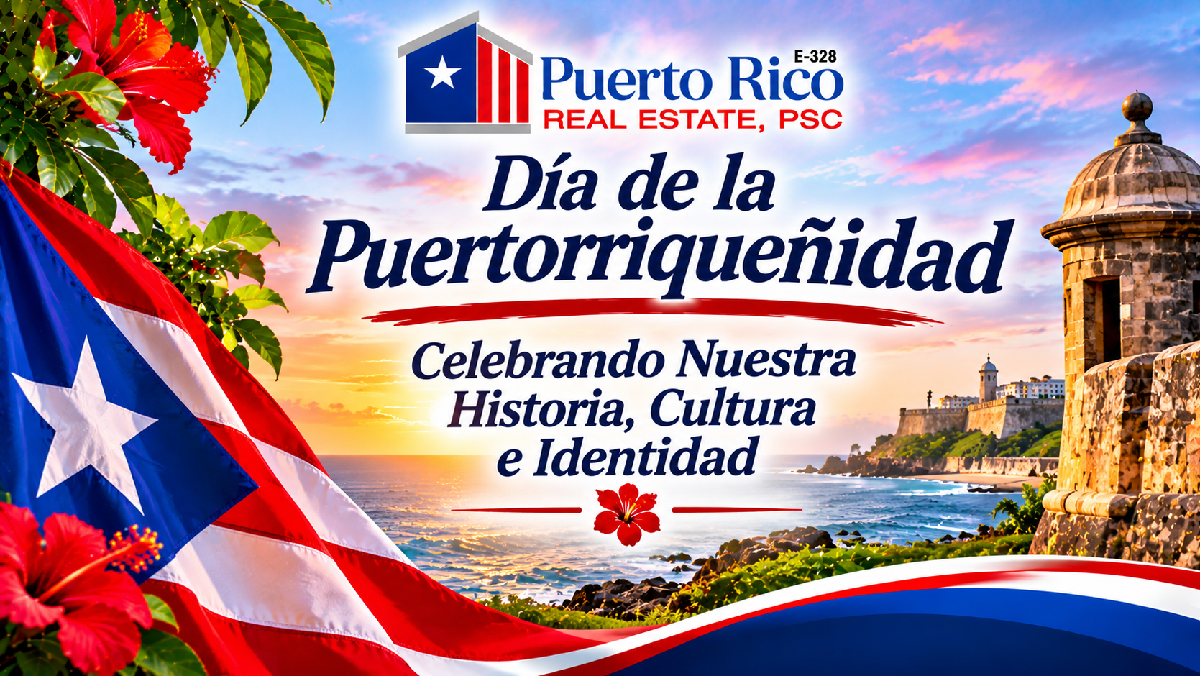
Día de la Puertorriqueñidad, or Puerto Rican Identity Day, offers an opportunity to celebrate that connection.
In Puerto Rico, the observance is associated with the anniversary of the discovery of Puerto Rico by Christopher Columbus on November 19, 1493, although the historical meaning of that date is more complex than the traditional description suggests.
Today, conversations about Puerto Rican identity can encompass much more than a single historical event.
They invite us to recognize our Indigenous Taíno heritage, African roots, Spanish influences, and the generations of Puerto Ricans who have contributed to the island's evolving culture.
At Puerto Rico Real Estate, PSC, we believe understanding the island means appreciating more than its beautiful properties and spectacular landscapes.
It means appreciating the people, neighborhoods, and traditions that make Puerto Rico feel like home.
So let's explore what Día de la Puertorriqueñidad represents and why our island's identity remains so meaningful, whether you live in Puerto Rico today or carry it in your heart from somewhere else.
Día de la Puertorriqueñidad is an observance centered on celebrating Puerto Rican identity, history, and cultural heritage.
It is commonly associated with November 19, a date historically recognized in connection with Columbus's arrival in Puerto Rico in 1493.
Over time, the day has also become an opportunity to reflect on what it means to be Puerto Rican.
Schools and cultural organizations may organize educational activities, presentations, traditional dress events, music, and discussions about the island's heritage.
The specific activities vary by community and institution.
For some, the observance emphasizes cultural pride.
For others, it provides an opportunity to discuss the island's complex history, including Indigenous communities, colonization, slavery, and the development of Puerto Rican society.
These conversations are important because Puerto Rico's identity cannot be reduced to one event or one cultural influence.
Our history is layered.
Our traditions are diverse.
And our identity continues to evolve.
Día de la Puertorriqueñidad encourages us to appreciate those complexities while celebrating the cultural connections that unite so many Puerto Ricans.
Long before Europeans arrived in Puerto Rico, the island was home to Indigenous communities, including the Taíno people.
They developed settlements, agricultural practices, social structures, artistic traditions, and spiritual beliefs connected to the land and surrounding waters.
The Taíno name Borikén, often associated with Puerto Rico, remains a powerful symbol of the island's Indigenous heritage.
From that name comes Boricua, a word that Puerto Ricans proudly use to describe themselves.
Our Indigenous heritage is also reflected in words, place names, foods, and cultural traditions.
Words such as hamaca, huracán, and barbacoa are connected to Indigenous Caribbean languages.
Cassava, or yuca, continues to be an important ingredient in Caribbean cuisine.
And archaeological sites throughout Puerto Rico help preserve evidence of the island's precolonial history.
It's important to recognize that Indigenous history did not simply disappear after European colonization.
Although Taíno communities suffered devastating consequences from disease, forced labor, violence, and colonial policies, Indigenous ancestry and cultural connections remain part of Puerto Rico's story.
For many Puerto Ricans, learning about this history creates a deeper appreciation for the island's roots.
It reminds us that our identity began long before modern political boundaries and institutions.
And that the land we call home carries stories extending back many centuries.
Puerto Rico's identity was also profoundly shaped by Africans brought to the island through the transatlantic slave trade and by their descendants.
Their contributions helped shape Puerto Rican music, cuisine, language, religious traditions, and community life.
One of the most recognizable examples is bomba.
Bomba is a traditional Afro-Puerto Rican musical and dance expression that developed through African-descended communities.
Its rhythms, singing, percussion, and dance reflect an extraordinary cultural legacy.
The interaction between dancers and drummers makes bomba especially distinctive.
Rather than simply following a predetermined rhythm, dancers can communicate movements that the lead drummer responds to.
It's a powerful artistic expression rooted in history, community, and cultural continuity.
African influences are also present in Puerto Rican food traditions, percussion instruments, and other cultural practices.
Recognizing this heritage is essential to understanding Puerto Rican identity.
Our culture was not created from a single source.
It emerged through encounters, exchanges, resistance, creativity, and the experiences of generations.
Celebrating Puerto Rican identity means recognizing the people whose contributions have not always received the attention they deserve.
Spanish colonization brought profound changes to Puerto Rico.
The Spanish language, Catholic religious institutions, colonial architecture, and numerous social customs became influential parts of island life.
Many of Puerto Rico's historic town centers reflect the planning patterns established during the colonial period.
Central plazas, churches, government buildings, and surrounding streets became focal points of community life.
Today, visitors can see examples of Spanish colonial architecture in Old San Juan and other historic areas.
But the legacy of colonization also includes exploitation, displacement, and unequal systems of power.
Understanding that history requires acknowledging both the cultural influences that remain visible and the suffering experienced by many communities.
Puerto Rican identity developed through a complex process of adaptation and transformation.
Over generations, island residents created traditions that became distinctly Puerto Rican rather than simply reproductions of European customs.
Our language developed local expressions.
Our music acquired unique rhythms.
Our food incorporated ingredients and techniques from multiple cultures.
And our communities formed identities shaped by local geography and shared experiences.
This combination of influences helped create the Puerto Rico we recognize today.
Few symbols inspire as much emotion among Puerto Ricans as our flag.
Its red and white stripes, blue triangle, and single white star are recognized around the world.
You see it displayed during cultural festivals, sporting events, parades, and family celebrations.
You may find it hanging from a balcony in San Juan.
Painted on a wall in a mountain town.
Or carried proudly through the streets of New York during the National Puerto Rican Day Parade.
For many Puerto Ricans, the flag represents belonging.
It connects people who may live thousands of miles apart.
Someone born in Puerto Rico may see the flag and remember their hometown.
Someone raised in the diaspora may see it and feel connected to their family's heritage.
And someone who has returned to the island after years away may experience that connection in a deeply personal way.
The flag's historical development is also connected to Puerto Rico's political history and movements for self-determination.
Different people may interpret aspects of that history differently.
But its cultural importance extends across generations.
It remains one of the most recognizable expressions of Puerto Rican identity.
If you want to understand Puerto Rico, listen to our music.
Music has always been one of the most powerful ways Puerto Ricans express joy, sorrow, pride, faith, and community.
Traditional forms such as bomba and plena reflect important aspects of our history.
The cuatro puertorriqueño contributes its unmistakable sound to jíbaro music and holiday celebrations.
Salsa became an important expression of Puerto Rican and broader Caribbean musical culture, both on the island and among communities abroad.
And modern genres such as reggaetón have brought Puerto Rican artists and cultural influences to international audiences.
The styles may differ.
The generations may have different favorites.
But the connection between music and identity remains strong.
Think about the last time you heard a song that reminded you of home.
Maybe it was a Christmas aguinaldo.
Perhaps it was a salsa classic your parents loved.
Or a song that played at every family celebration when you were growing up.
Music has the ability to preserve memories.
And in Puerto Rico, those memories often connect us to specific people, neighborhoods, and moments in our lives.
Food is another beautiful expression of Puerto Rican identity.
And if you've ever attended a Puerto Rican family gathering, you know that food is rarely a minor detail.
It's often at the center of the celebration.
Traditional dishes such as arroz con gandules, mofongo, pasteles, asopao, and lechón reflect the island's diverse culinary heritage.
Ingredients and preparation methods reveal influences from Indigenous, African, Spanish, and broader Caribbean traditions.
But food is also deeply personal.
One family may prepare pasteles using a recipe passed down for generations.
Another may have a special seasoning mixture that nobody outside the family knows.
And someone will almost certainly insist that their grandmother makes the best arroz con gandules in Puerto Rico.
These traditions are more than recipes.
They're stories.
They're memories.
They're ways of preserving connections between generations.
A familiar meal can remind someone of childhood.
A holiday gathering.
Or a family member who is no longer here.
And for Puerto Ricans living abroad, preparing traditional food can be a meaningful way to maintain their connection to the island.
When we talk about Puerto Rican cultural identity, we cannot overlook the jíbaro tradition.
Historically associated with rural life and agricultural communities, the jíbaro became an important cultural symbol in Puerto Rico.
The image of the jíbaro often represents hard work, simplicity, independence, and a connection to the land.
Of course, rural life has always been more complex than any romanticized image.
Agricultural communities have faced economic challenges, changing industries, and difficult living conditions.
But the cultural significance of the jíbaro remains strong.
Traditional music, clothing, storytelling, and festivals continue to celebrate this heritage.
Puerto Rico's mountain municipalities offer opportunities to appreciate the landscapes and communities connected to that history.
Places such as Adjuntas, Utuado, Jayuya, Lares, and Orocovis have distinct local identities shaped by their geography and historical development.
For many people, exploring these communities reveals a side of Puerto Rico that differs from the beaches and metropolitan areas.
You discover scenic mountain roads.
Local bakeries.
Small businesses.
Historic plazas.
And communities where generations of families have maintained strong connections to their hometowns.
These experiences help us appreciate the island's cultural diversity.
Almost every Puerto Rican has memories connected to a town plaza.
Maybe you attended a festival there as a child.
Perhaps you remember visiting with your grandparents.
Or you enjoyed an evening walking through the town center while music played nearby.
Puerto Rico's plazas have long served as gathering places.
They are often surrounded by churches, municipal buildings, restaurants, shops, and historic architecture.
Some host festivals and cultural events.
Others provide peaceful spaces where residents sit, talk, and enjoy the afternoon.
Although each town has its own personality, the plaza often represents the heart of the community.
It's where people meet.
Where traditions are celebrated.
And where the history of a municipality becomes part of everyday life.
For people exploring different areas of Puerto Rico, visiting the town plaza can be a wonderful way to begin understanding a community.
Spend some time walking around.
Visit a local business.
Observe the architecture.
And learn about the town's history.
A community is more than the properties available for sale.
It's the people, institutions, traditions, and shared spaces that give it character.
Puerto Rican identity doesn't disappear when someone moves away.
In fact, for many people, distance can make their connection to the island feel even stronger.
Puerto Rican communities have established deep roots in places such as New York, Florida, Pennsylvania, and many other parts of the United States.
They have contributed to music, art, literature, education, business, and public life.
And they continue to preserve Puerto Rican traditions across generations.
A child growing up outside Puerto Rico may learn family recipes from their grandparents.
Hear stories about a hometown they've never visited.
Celebrate Three Kings Day.
Or learn the meaning of the word Boricua.
For many families, these traditions create a bridge between generations and locations.
The Puerto Rican diaspora also maintains important personal and economic connections with the island.
Families travel back and forth.
Relatives remain in different municipalities.
And some Puerto Ricans eventually consider returning to live on the island.
Our article How to Attract Relocating Buyers to Your Puerto Rico Home discusses how sellers can communicate property features to people considering a move or return to Puerto Rico.
But whether someone returns permanently or continues living elsewhere, their cultural identity can remain a meaningful part of their life.
There's something special about the word home.
It can refer to a physical place.
A house.
An apartment.
A neighborhood.
Or a town where you grew up.
But it can also mean something much deeper.
Home may be where your family gathers.
Where you feel understood.
Where familiar traditions bring comfort.
And where your memories connect you to a community.
For some Puerto Ricans, home is a house in the mountains.
For others, it's an apartment in San Juan.
A residence near the coast.
Or a family property that has been passed down through generations.
These homes may look completely different.
But they can carry equally meaningful stories.
That's one reason real estate decisions can be emotional.
Selling a property isn't always simply a financial transaction.
Sometimes it means leaving the place where your children grew up.
Or making decisions about a home that belonged to your parents.
For families navigating those circumstances, our article Selling an Inherited Property in Puerto Rico: What Families Should Know explores important considerations.
Understanding the emotional significance of a property doesn't replace the need for careful financial and legal planning.
But it reminds us that every home has a history worth respecting.
Puerto Rico's identity has never been completely static.
Our communities have changed.
Our economy has evolved.
New generations have introduced different ideas, artistic expressions, and ways of living.
Technology has changed how we communicate.
Migration has connected families across great distances.
And our towns continue to adapt to new circumstances.
But cultural preservation doesn't mean resisting every change.
It means recognizing what matters and finding ways to carry those traditions forward.
We can support local artisans.
Visit museums and historical sites.
Learn about Indigenous and African heritage.
Attend cultural festivals.
Support local musicians.
And teach younger generations about the stories that shaped our communities.
We can also preserve our heritage by caring for historic buildings, respecting neighborhood character, and participating in community life.
For homeowners, that may mean maintaining a family property with attention to its history and condition.
For buyers, it may mean learning about the community before deciding to move there.
And for everyone, it means recognizing that Puerto Rico's cultural identity is a shared responsibility.
Puerto Rico attracts attention for many reasons.
Beautiful beaches.
Warm weather.
Mountain landscapes.
Historic architecture.
And opportunities to experience a distinctive Caribbean lifestyle.
But people considering relocating to Puerto Rico should understand that living here involves more than enjoying the scenery.
Every municipality has its own characteristics.
Different communities may have different transportation needs, services, infrastructure, and local customs.
A person who enjoys an active urban environment may prefer a different location from someone seeking a rural lifestyle.
And a buyer interested in a historic neighborhood may face different maintenance considerations from someone purchasing a newer residence.
Cultural appreciation should be part of the relocation process.
That means respecting local traditions, learning about community expectations, and recognizing the importance of Puerto Rico's history.
A meaningful connection to the island develops through participation and understanding.
Not simply through purchasing property.
For homeowners preparing to sell, accurately describing the property's location and lifestyle features can help prospective buyers evaluate whether it meets their needs.
But marketing should avoid exaggerated claims or assumptions about what every buyer values.
The goal is to provide useful information that supports informed decisions.
Many Puerto Rican families have properties that carry generations of memories.
A home may have belonged to grandparents.
A small parcel of land may have been part of a family's agricultural history.
Or a residence may have served as the gathering place for holidays, birthdays, and family milestones.
Over time, circumstances change.
Families grow.
Relatives move.
Maintenance becomes more difficult.
And some properties may eventually need to be sold.
These decisions can be complicated, especially when multiple family members are involved.
A property may have emotional significance while also carrying financial obligations, repair needs, or unresolved documentation.
That's why thoughtful preparation matters.
Owners should understand the property's legal status, condition, and potential selling expenses.
Our article Documents Needed to Sell Property in Puerto Rico provides an overview of common documentation considerations.
And How Much Does It Cost to Sell a House in Puerto Rico? explains expenses that may affect the transaction.
At Puerto Rico Real Estate, PSC, we believe that helping homeowners navigate these decisions requires both professional attention and respect for their personal circumstances.
Selling a family property doesn't erase its history.
The memories remain.
And the next chapter can begin with greater clarity.
You don't have to wait for Día de la Puertorriqueñidad to celebrate our culture.
There are meaningful ways to appreciate Puerto Rican identity throughout the year.
Visit a local museum.
Explore a historic town.
Attend a traditional music performance.
Support a neighborhood restaurant.
Learn about the history of a community.
Speak with older relatives about their childhood memories.
Teach children the stories behind our traditions.
And take time to appreciate the places that make Puerto Rico special.
Sometimes cultural pride is expressed through major festivals and public celebrations.
Other times, it's found in simple everyday moments.
A family preparing dinner together.
Neighbors helping one another.
A musician performing in the plaza.
Or someone sharing a story about the town where they grew up.
These experiences remind us that Puerto Rican identity isn't limited to symbols or holidays.
It's something we live.
Something we pass on.
And something we continue shaping every day.
Día de la Puertorriqueñidad is an opportunity to celebrate the extraordinary cultural identity of Puerto Rico.
It's a chance to remember our history.
Honor the contributions of different generations.
Recognize our diverse cultural roots.
And appreciate the communities that make our island unique.
Our identity is reflected in our music.
Our food.
Our language.
Our traditions.
And the countless stories connected to the places we call home.
Puerto Rico has experienced challenges throughout its history.
But its people have continued to create, preserve, adapt, and celebrate their culture.
And whether you live in San Juan, Aguadilla, Ponce, a mountain municipality, or thousands of miles away, that connection can remain deeply meaningful.
At Puerto Rico Real Estate, PSC, we're proud to serve the island and its communities.
We understand that homes are more than structures.
They're places where families grow, traditions continue, and memories are created.
Because being Puerto Rican isn't simply about where you live. It's about the history you carry, the people you love, and the connection to an island that will always be part of your story.
Whether you're preparing to sell a family home, considering a relocation, or managing an inherited property, Puerto Rico Real Estate, PSC can help you explore your options.
Our team focuses on understanding your property, discussing appropriate pricing, preparing effective marketing, and helping you navigate the selling process.
Puerto Rico Real Estate, PSC
Puerto Rico Real Estate License E-328
Phone: 787-244-6364
Email: [email protected]
Website: https://www.thepuertoricorealestate.com
Contact us to discuss your property and the next steps toward your real estate goals.
1. How to Attract Relocating Buyers to Your Puerto Rico Home
https://thepuertoricorealestate.com/article/how-to-attract-relocating-buyers-to-puerto-rico-homes
2. Selling an Inherited Property in Puerto Rico: What Families Should Know
https://thepuertoricorealestate.com/article/selling-inherited-property-puerto-rico-family-guide
3. Documents Needed to Sell Property in Puerto Rico
https://thepuertoricorealestate.com/article/documents-needed-sell-property-puerto-rico-guide
4. How Much Does It Cost to Sell a House in Puerto Rico?
https://thepuertoricorealestate.com/article/cost-to-sell-house-puerto-rico-fees-guide-2026
#DiaDeLaPuertorriquenidad #PuertoRicanPride #OrgulloBoricua #PuertoRicoCulture #PuertoRicoHistory #Boricua #PuertoRicanHeritage #DiscoverPuertoRico #PuertoRicoTraditions #PuertoRicoRealEstate #PuertoRicoRealEstatePSC
Your satisfaction guides our every step. Thanks for choosing PRRE.