In Puerto Rico, selling real estate is not just a financial transaction — it is a formal legal act.
Because:
Closings are conducted before an attorney-notary
Sales must be recorded in the Registry of Property
Tax authorities require compliance
Banks and buyers scrutinize documentation closely
Proper documentation is essential to protect both buyer and seller.
Many sales fail not because of price or interest — but because sellers are not document-ready.
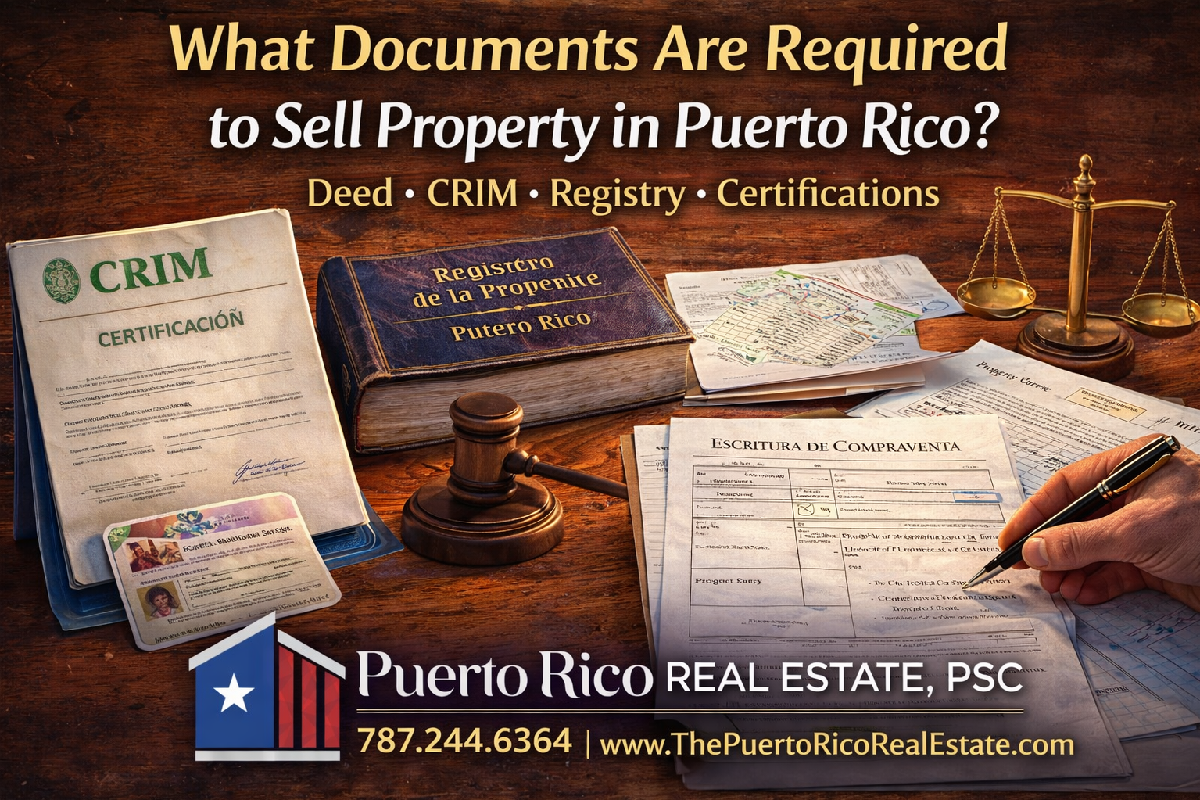
The escritura is the most important document in any Puerto Rico real estate transaction.
It:
Establishes legal ownership
Contains the property description
Reflects prior transfers
Is required to prove the right to sell
If the escritura:
Is missing
Is incorrect
Was never registered properly
the sale cannot proceed until the issue is resolved.
This is one of the first documents we review when working with sellers.
Puerto Rico has a centralized Registry of Property that records ownership and encumbrances.
Before selling, the property must:
Be properly registered
Reflect the correct owner(s)
Show accurate property boundaries
Disclose liens or mortgages
Common registry issues include:
Unregistered inheritances
Old mortgages still appearing
Name discrepancies
Incorrect property measurements
These issues can take time to fix — which is why early review is critical.
The CRIM (Centro de Recaudación de Ingresos Municipales) certification confirms that:
Property taxes are paid
The property is in good standing
No outstanding municipal balances exist
This certification is mandatory for closing.
CRIM issues are one of the most frequent causes of closing delays, often due to:
Outdated ownership records
Incorrect property classification
Unpaid balances
At Puerto Rico Real Estate, PSC, we guide sellers step-by-step through the CRIM process to avoid surprises.
A property survey is often required to:
Confirm boundaries
Validate lot size
Resolve discrepancies
Satisfy lender requirements
Surveys are especially important for:
Land sales
Rural properties
Inherited properties
Older homes with outdated records
When surveys don’t match registry records, corrections may be required before closing.
If the property has an existing mortgage, the seller must provide:
A payoff letter
Confirmation of remaining balance
Instructions for cancellation
The mortgage must be properly canceled after closing and reflected in the Registry of Property.
Failure to handle this correctly can create future title issues.
If the property is part of a condominium or homeowners association, sellers must provide:
HOA dues certification
Confirmation of no outstanding balances
Association approval (if required)
These documents protect buyers from inheriting unpaid obligations.
Buyers and notaries often require:
Water and electricity account status
Confirmation of no outstanding balances
Meter information
These details help ensure a clean transition after closing.
Sellers must provide:
Valid government-issued ID
Marital status information
Power of attorney (if applicable)
Marital status matters in Puerto Rico, as spousal consent may be required depending on ownership structure.
Many sellers live outside Puerto Rico. In these cases, a power of attorney may be required to:
Sign documents
Coordinate closing
Represent the seller locally
Power of attorney documents must meet specific legal requirements to be accepted in Puerto Rico.
Inherited properties require extra documentation, such as:
Declaration of heirs
Proof of inheritance
Registry updates
Multiple owner consent
These transactions are common — and complex — in Puerto Rico, making experienced guidance essential.
Depending on the property, additional documents may be required:
Construction permits
Usage permits
Zoning confirmations
Environmental clearances
Failure to disclose or address permit issues can delay or derail a sale.
Many sellers wait until they receive an offer to gather documents — this is one of the biggest mistakes.
By the time an offer is accepted:
Buyers expect quick progress
Lenders impose deadlines
Delays reduce confidence
Deals fall apart
Preparing documents before listing puts sellers in control.
We don’t just list properties — we manage the entire preparation process.
We help sellers:
Identify required documents early
Coordinate with CRIM and Registry
Communicate with attorneys and notaries
Avoid common paperwork errors
Stay ahead of deadlines
Our proactive approach saves time, stress, and money.
Buyers pay attention to documentation.
A property that is:
Legally clean
Fully documented
Ready to close
often:
Sells faster
Commands stronger offers
Faces fewer concessions
Experiences smoother closings
Prepared sellers negotiate from strength.
Missing escritura
CRIM balances
Registry discrepancies
Incomplete inheritance filings
Incorrect surveys
Expired certifications
Avoiding these mistakes can save months.
In Puerto Rico, documentation is not paperwork — it is power.
The better prepared you are, the smoother and faster your sale will be.
If you’re considering selling, let Puerto Rico Real Estate, PSC help you prepare, position, and close your property with confidence.
Puerto Rico Real Estate, PSC
📞 787.244.6364
📧 [email protected]
🌐 www.ThePuertoRicoRealEstate.com
#PuertoRicoRealEstate
#SellPropertyPR
#CRIMPuertoRico
#Escritura
#RegistroDeLaPropiedad
#PuertoRicoHomes
#PuertoRicoRealEstatePSC
Your satisfaction guides our every step. Thanks for choosing PRRE. View all.
"Thank you for your service great teamwork I completely appreciate your time and all your effort thanks again"
You were so much help. Thank you for staying on top of things with me.
The closing was straightforward and completed without incident. The buyers were wonderful. Thank you.
The closing was straightforward and completed without incident. The buyers were wonderful. Thank you
I received your listing in email and just wanted to thank you for the EXCELLENT information. You included not only the correct location, but good, quality video/photos, everything. It's not exactly what I need but: A rare thing to get such a quality listing information, just wanted to say thank you.
Everything went smooth and great at closing, you were such a great help in the process. I will refer you to a friend that needs your help. Thanks alot for all you did for me.
Thanks to all of you, super attention, you explained everything very kindly and the Lcda was also super kind. All excellent more than grateful for everything!!
Everything super good, they treated us very well and everything went well with the closing. Everyone was very nice and the Lcda was very kind to us. Thanks to you and your team who treated us very well and never let us go. I will recommend you and hope to call you soon to find a property.
Closing Done, only took an hour.No problems it went smooth. Thanks again for everything! Having a drink to celebrate.
Very Smooth Transaction. Your Team was very supportive and they helped me alot during the transaction.