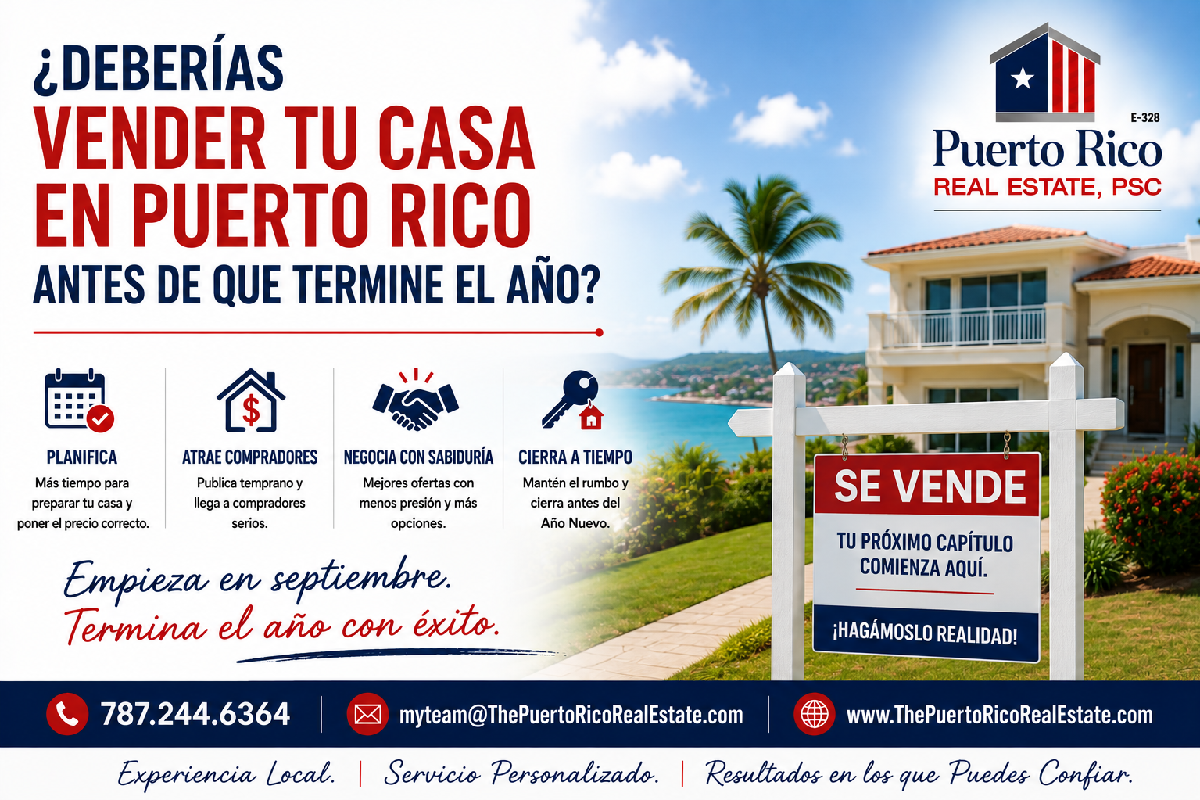
Search online for the best time to sell a house and you'll find plenty of advice.
Sell in spring.
List before summer.
Wait until inventory drops.
Avoid the holidays.
Don't list during hurricane season.
The problem?
Much of that advice was written for real estate markets thousands of miles from Puerto Rico.
Puerto Rico is different.
We don't have snow-covered winters that dramatically restrict showings.
Our lifestyle and climate attract buyers throughout the year.
We have people moving to the island for work, retirement, family, investment and lifestyle reasons.
We have Puerto Ricans living elsewhere who want to return home.
We have investors evaluating opportunities regardless of the month.
And we have buyers who may spend months researching Puerto Rico online before ever boarding a plane.
So while seasonality can influence the market, the calendar alone should never determine whether you sell.
If you're beginning to explore your options, our complete guide to selling real estate in Puerto Rico explains the broader process from preparation through closing.
September sits in an unusual position.
Summer is ending.
Families have largely returned to their school-year routines.
The holidays are approaching but haven't taken over everyone's calendar yet.
People who began considering a move earlier in the year may now be ready to act.
And buyers hoping to purchase before the end of 2026 still have time to make that happen.
For sellers, that can create opportunity.
September also gives you time to test the market before the holiday season becomes a larger factor.
If your property attracts strong attention quickly, great.
If buyers respond differently than expected, there's still time to evaluate the strategy before November and December arrive.
That's much better than waiting until the final weeks of the year and suddenly trying to accomplish everything at once.
Yes.
September is within Atlantic hurricane season, and tropical weather is a legitimate consideration when selling property in Puerto Rico.
But hurricane season doesn't mean the entire real estate market closes.
Properties are still marketed.
Showings still happen.
Buyers still make offers.
Transactions still move toward closing.
What matters is preparation.
Properties should be maintained.
Storm protection should be accessible.
Important documents should be organized.
Insurance information should be available.
Vacant properties should have someone who can check them if necessary.
Weather can potentially affect inspections, appraisals, travel, insurance and closing timelines, so sellers should remain flexible.
The existence of hurricane season is something to plan around—not automatically a reason to abandon your selling plans.
One of the biggest mistakes sellers make is thinking only about buyers physically located in Puerto Rico.
Imagine someone sitting in an apartment in New York.
They're tired of winter.
They're thinking about moving closer to family.
They open their laptop and begin searching for homes in Puerto Rico.
Or consider a Puerto Rican couple living in Florida.
They've been talking about coming home for years.
Their children are getting older.
They're finally serious.
They begin searching.
Or perhaps it's an investor in Texas.
A retiree in Pennsylvania.
A remote worker in North Carolina.
A family already living in San Juan that wants more land in another municipality.
All of these people could become buyers.
And none of them care that someone once told you September wasn't the “perfect” month to list.
They care whether the right property appears.
Your property can't be found if it isn't available to find.
This is another reason generic advice can be misleading.
A beachfront condominium may attract one type of buyer.
A three-bedroom home near schools may attract another.
A farm in the mountains may appeal to someone completely different.
A multi-unit property may be primarily evaluated for its income potential.
A commercial building follows another set of considerations.
Vacant beachfront land has its own audience.
There isn't one Puerto Rico real estate buyer.
There are many.
That's why your selling strategy should begin with identifying the likely audience for your particular property.
At Puerto Rico Real Estate, PSC, one of the first questions we ask isn't simply:
“How much is the house worth?”
It's also:
“Who is most likely to buy this?”
Because the answer affects pricing, presentation and marketing.
Not everyone searching today intends to move next week.
Real estate decisions—particularly relocations—can take months.
Someone planning to move to Puerto Rico in January may begin searching in September.
A buyer considering retirement next spring may already be watching properties.
An investor planning their next acquisition may be analyzing opportunities today.
This is particularly important for properties likely to attract off-island buyers.
The marketing work you do now may create the buyer who visits later.
That's why online visibility matters so much.
Professional photography.
Video.
Detailed descriptions.
Location information.
Search visibility.
Social media.
All of these help your property become part of a buyer's research process.
Selling isn't always about finding someone who needs a house today.
Sometimes it's about becoming the property someone remembers when they're ready.
There is a huge difference.
Technically, almost anyone can put a property online.
Take some pictures.
Write the number of bedrooms.
Add a phone number.
Publish.
The property is now “for sale.”
But has it actually been marketed?
Good real estate marketing should help a buyer understand:
What makes the property different?
Who would enjoy living there?
What does the location offer?
What lifestyle does it provide?
What opportunities exist?
Why is the asking price justified?
How does someone living outside Puerto Rico understand where it is?
What practical features make the property attractive?
At Puerto Rico Real Estate, PSC, we want buyers to see more than a structure.
We want them to understand the opportunity.
Even if you aren't ready to list immediately, September is an excellent month to begin preparing.
Suppose you want the property on the market in October.
September gives you time to:
Evaluate the property.
Determine a pricing strategy.
Gather documents.
Handle appropriate repairs.
Clean and declutter.
Prepare landscaping.
Arrange professional photography.
Create video.
Develop the property description.
Organize digital marketing.
Resolve obvious questions before buyers begin asking them.
That preparation can make the actual launch much stronger.
Our guide on preparing your Puerto Rico home for sale covers practical steps homeowners can take before listing.
This may be the most important point in the entire article.
A well-priced property can attract attention during a supposedly “slow” month.
An overpriced property can struggle during the supposedly “best” month.
Imagine two similar properties.
One enters the market at a price buyers recognize as reasonable based on location, condition and comparable alternatives.
The other is listed significantly above what the market appears to support.
Which one is more likely to generate serious interest?
The calendar can't rescue a bad pricing strategy.
Buyers have access to information.
They compare listings.
They watch price reductions.
They see how long properties remain available.
And many buyers are willing to wait when they believe a seller's expectations are unrealistic.
Pricing doesn't mean giving your property away.
It means understanding where your property fits within the marketplace and positioning it accordingly.
Every real estate professional has heard this sentence.
“My neighbor sold for $400,000.”
That's useful information.
But it isn't the entire analysis.
Was the neighbor's property the same size?
Same condition?
Same lot size?
Same view?
Same number of units?
Same solar system?
Same access?
Same neighborhood appeal?
Was it renovated?
When did it sell?
Was it an arm's-length transaction?
Were concessions involved?
A nearby sale can be relevant without being identical.
Property value requires context.
That's why a Comparative Market Analysis looks at more than a single number.
The objective is to understand the market well enough to develop a pricing strategy we can defend.
Automated online valuations can be particularly challenging in Puerto Rico.
Properties here can vary dramatically even within a small geographic area.
One house may sit on 400 square meters.
Another nearby property may have three cuerdas.
One may contain a legal second unit.
Another may have an uncompleted structure.
One property has solar panels and batteries.
Another has none.
One has an ocean view.
Another is directly on the beach.
One has excellent road access.
Another requires traveling along a narrow rural road.
Algorithms don't always understand those differences well.
Use online estimates as one piece of information—not as the final answer.
Suppose your property needs significant repairs.
Should you list in September?
Maybe.
But perhaps the better strategy is to spend September preparing and launch in October.
Or perhaps the likely buyer is an investor who expects to renovate, meaning delaying the listing makes little sense.
This is why selling decisions shouldn't be made using generic formulas.
The condition of the property matters.
The likely buyer matters.
Your finances matter.
Your timeline matters.
Our recent guide on deciding whether to repair your Puerto Rico home or sell it as-is explores exactly this decision.
The important thing is not to automatically renovate—or automatically avoid repairs.
Make the decision based on what improves your overall selling position.
Sometimes the property is completely ready to sell.
The paperwork isn't.
Perhaps there's an inheritance issue.
Maybe ownership records need attention.
Perhaps there are questions involving permits.
Maybe information from CRIM needs to be addressed.
Or the seller lives outside Puerto Rico and needs to coordinate documents remotely.
These issues don't necessarily prevent a sale.
But they can affect timing.
This is why sellers should begin organizing documentation before receiving an offer.
Our guide to documents commonly needed to sell property in Puerto Rico provides a useful starting point.
The earlier you identify a problem, the more options you generally have for addressing it.
September gives sellers an important advantage if their goal is to sell before the holidays:
Time.
An accepted offer doesn't equal an immediate closing.
If the buyer needs financing, there may be an appraisal, lender requirements, documentation, inspections and other conditions.
Cash transactions can sometimes move faster, but they still require appropriate documentation and closing coordination.
That's why waiting until late November and saying:
“I need this sold before Christmas.”
can create unnecessary pressure.
Starting in September doesn't guarantee a closing before the holidays.
But it gives you a much more realistic runway.
There's a tendency to imagine buyers only searching during certain months.
But serious buyers search when they need or want to buy.
A family may need more space.
An investor may find an opportunity.
A retiree may finally be ready.
Someone may receive a job offer.
A couple may decide to move closer to family.
A Puerto Rican living elsewhere may decide it's finally time to return.
Those life decisions don't wait for spring.
That's particularly relevant in Puerto Rico, where our buyer pool can extend well beyond the island.
Even if certain periods produce fewer overall inquiries, that doesn't automatically mean fewer serious buyers.
Would you rather have 25 people casually look at your home?
Or five financially capable buyers who are actively trying to purchase?
Traffic is not the goal.
A successful closing is the goal.
Sellers sometimes become overly focused on views, clicks and showing counts.
Those numbers can be useful.
But they don't tell the entire story.
One qualified buyer can sell the house.
Once the property is listed, market feedback becomes valuable.
Are people viewing the listing?
Are they asking questions?
Are showings being scheduled?
Are buyers making offers?
Are multiple buyers making the same comment?
If the property receives strong attention but no offers, perhaps something about the condition or price is creating hesitation.
If almost nobody engages with the listing, the market may be telling us something else.
Good selling strategy isn't:
List it and forget it.
It's:
Launch. Observe. Evaluate. Adjust when necessary.
A listing strategy should respond to actual buyer behavior.
Not automatically.
First determine what's happening.
Has the property been properly exposed?
Is the photography strong?
Is the description effective?
Are buyers finding it?
Is the property easy to show?
Are there condition issues?
How does it compare with competing listings?
What feedback are buyers providing?
Price may be the issue.
But we shouldn't assume that without looking at the complete picture.
On the other hand, sellers shouldn't ignore obvious market feedback simply because they dislike what it says.
If comparable properties are selling while yours consistently receives no serious interest, something needs to be evaluated.
If you're considering selling, spend some time online looking at properties similar to yours.
Pretend you're the buyer.
What else could you purchase for your asking price?
Which properties look better?
Which have more land?
Which are renovated?
Which have solar?
Which have income potential?
Which have better photographs?
Which descriptions make you want to learn more?
Your property isn't competing against what you paid for it.
It isn't competing against what you owe.
And it isn't competing against the amount you want to receive.
It's competing against the other choices buyers have today.
That's the marketplace.
This is where a strong digital strategy becomes especially important.
A Puerto Rico property shouldn't only be marketed to people already living nearby.
Depending on the property, we may want to reach:
Local buyers.
Puerto Ricans living in the mainland United States.
People relocating to Puerto Rico.
Retirees.
Investors.
Vacation-home buyers.
Buyers looking for income-producing property.
People searching for beachfront homes.
People looking for farms or acreage.
Commercial buyers.
Different properties require different stories.
At Puerto Rico Real Estate, PSC, we combine property presentation with digital marketing, video, social media and search-focused content designed to give listings broader exposure.
Our step-by-step guide to selling property in Puerto Rico explains how these elements fit into the overall selling process.
For many Puerto Rico property owners:
It absolutely can be.
But not simply because it's September.
It can be a good time because:
You still have months remaining in the year.
Buyers continue searching.
Off-island buyers research Puerto Rico throughout the year.
You have time before the heart of the holiday season.
You can begin positioning the property for buyers planning moves in late 2026 or early 2027.
And if you start now, you have time to make thoughtful adjustments if necessary.
But September may not be right if your property isn't ready, major documentation issues remain unresolved or your personal circumstances make another timeline more practical.
That's why the answer needs to be specific to you.
Selling a property is a major financial decision.
You deserve more than someone putting your home online and hoping for the best.
At Puerto Rico Real Estate, PSC, our approach focuses on the complete selling strategy.
Property Evaluation — Understanding what you're selling and how it fits within the current marketplace.
Pricing Strategy — Using market information to develop a realistic and competitive position.
Pre-Listing Preparation — Helping identify what should—and shouldn't—be done before listing.
Professional Marketing — Photography, video, compelling descriptions, online exposure, social media and search-focused content.
Local and Off-Island Buyer Exposure — Recognizing that your buyer may be across town or thousands of miles away.
Offer Analysis and Negotiation — Evaluating more than the number at the top of the offer.
Transaction Coordination — Helping manage the moving pieces from accepted offer through closing.
We aren't interested in simply telling sellers what they want to hear.
We want to help sellers make informed decisions.
There's always a reason to wait.
Hurricane season.
The holidays.
An election.
Interest rates.
The economy.
Vacation.
School.
Next spring.
Next summer.
Next year.
Sometimes waiting is the right decision.
But sometimes homeowners spend years waiting for a perfect market that never actually exists.
Meanwhile, life keeps moving.
If you're considering selling, you don't need to commit today.
Start by learning.
What might the property be worth?
Who is the likely buyer?
What preparation would help?
What documents do you need?
What does the competition look like?
How long might the process take?
Once you understand those things, you can decide whether September is your month—or whether another timeline makes more sense.
If you've been considering selling a home, condominium, investment property, multi-unit building, beachfront residence, commercial property, farm or vacant land anywhere in Puerto Rico, we'd be happy to talk with you.
No generic answer.
No promise that every property will sell immediately.
No pretending the market doesn't have challenges.
Instead, let's look at your property, your goals and your timeline.
Because the best time to sell isn't determined by a calendar alone.
It's when your property, strategy and personal plans come together.
And for some Puerto Rico sellers, September may be exactly that time.
📞 787-244-6364
🌐 www.ThePuertoRicoRealEstate.com
Thinking about selling your Puerto Rico property? Contact us and let's determine whether now is the right time.
#PuertoRicoRealEstate #SellPropertyPuertoRico #PuertoRicoSellers #SellingInPuertoRico #PuertoRicoHomes #PuertoRicoProperty #SellMyHouse #PuertoRicoHomeValue #PuertoRicoRealtor #HomesForSalePuertoRico #MovingToPuertoRico #InvestInPuertoRico #PuertoRicoLiving #RealEstatePuertoRico #ThePuertoRicoRealEstate
Your satisfaction guides our every step. Thanks for choosing PRRE. View all.
"Thank you for your service great teamwork I completely appreciate your time and all your effort thanks again"
You were so much help. Thank you for staying on top of things with me.
The closing was straightforward and completed without incident. The buyers were wonderful. Thank you.
The closing was straightforward and completed without incident. The buyers were wonderful. Thank you
I received your listing in email and just wanted to thank you for the EXCELLENT information. You included not only the correct location, but good, quality video/photos, everything. It's not exactly what I need but: A rare thing to get such a quality listing information, just wanted to say thank you.
Everything went smooth and great at closing, you were such a great help in the process. I will refer you to a friend that needs your help. Thanks alot for all you did for me.
Thanks to all of you, super attention, you explained everything very kindly and the Lcda was also super kind. All excellent more than grateful for everything!!
Everything super good, they treated us very well and everything went well with the closing. Everyone was very nice and the Lcda was very kind to us. Thanks to you and your team who treated us very well and never let us go. I will recommend you and hope to call you soon to find a property.
Closing Done, only took an hour.No problems it went smooth. Thanks again for everything! Having a drink to celebrate.
Very Smooth Transaction. Your Team was very supportive and they helped me alot during the transaction.