In most U.S. states, real estate closings are handled by:
Title companies
Escrow agents
Closing attorneys (sometimes optional)
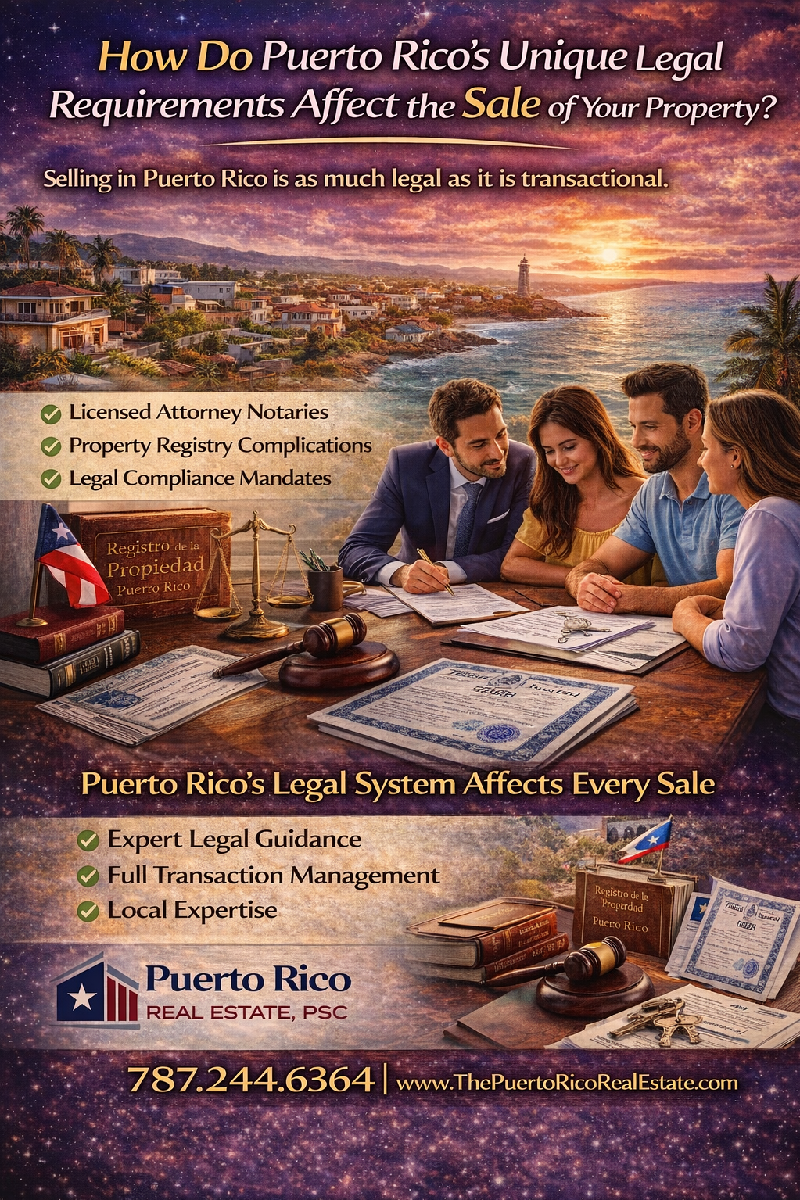
Puerto Rico operates under a civil law system, not common law. This means:
Every real estate transaction must be executed before a licensed Puerto Rico notary
That notary is also an attorney
The notary has legal responsibility for the transaction
This single difference changes the entire structure of a sale.
In Puerto Rico, a notary:
Is a licensed attorney
Has authority granted by the Supreme Court of Puerto Rico
Drafts and authorizes the public deed (“escritura”)
Verifies legality of the transaction
Submits the deed to the Registry of Property
The notary is not neutral paperwork staff — they are legally responsible for the validity of the transaction.
If something is wrong, the notary can:
Refuse to close
Delay the transaction
Require corrections before proceeding
This makes preparation absolutely critical.
Unlike many U.S. states where title updates happen quickly, Puerto Rico’s Registry of Property:
Is backlogged
Processes filings slowly
May take months (or longer) to reflect changes
A property can be owned legally but not yet fully recorded, which creates challenges during a sale.
Common registry issues include:
Inheritance not recorded
Old mortgages not cancelled
Prior deeds pending
Errors in property descriptions
These issues must be resolved before closing.
Sellers unfamiliar with Puerto Rico’s system often encounter:
Surprise legal requirements late in the process
Delays after accepting an offer
Buyers walking away due to uncertainty
Lost time and money
Many FSBO or inexperienced agent listings fail not because there is no buyer, but because the legal side wasn’t handled correctly.
In Puerto Rico:
You cannot “skip” the notary
You cannot close without an attorney-notary
The deed must be drafted and executed properly
This means:
Legal compliance is mandatory
Informal or rushed deals are risky
Professional coordination is essential
At Puerto Rico Real Estate, PSC, we coordinate directly with trusted notaries and attorneys to ensure the process stays on track.
Selling a property typically requires:
Title study
CRIM certifications
Registry certifications
HOA clearance (if applicable)
Municipal permits (when required)
Power of attorney (for off-island sellers)
Missing even one document can delay or stop a sale.
We ensure sellers know what is needed, when it is needed, and how to obtain it efficiently.
Puerto Rico has a high number of:
Inherited homes
Multiple-heir properties
Unregistered successions
These sales often require:
Declaration of heirs
Updated registry filings
Consent of all parties
Additional legal steps
Without experienced guidance, these sales can take years. With proper coordination, they can be resolved efficiently.
Many Puerto Rico property owners live:
In the mainland U.S.
Abroad
Are heirs who never lived in PR
For these sellers:
Power-of-attorney documents must be valid in Puerto Rico
Timing is critical
Communication with notaries is essential
Puerto Rico Real Estate, PSC specializes in representing remote sellers — managing the entire process locally.
In Puerto Rico, a real estate agent does far more than market a property.
We:
Identify legal issues early
Coordinate with notaries and attorneys
Prepare sellers before listing
Prevent last-minute surprises
Protect the transaction timeline
Without this coordination, sellers are often left navigating a complex legal system alone.
Not all brokerages understand Puerto Rico’s legal realities.
Sellers choose Puerto Rico Real Estate, PSC because we:
Understand civil law requirements
Work daily with notaries
Anticipate registry issues
Communicate clearly with sellers
Protect transactions from failure
This experience directly impacts whether a sale closes successfully.
Legal delays usually happen because:
Issues were discovered too late
Documents weren’t prepared early
Sellers were unaware of requirements
Our approach focuses on preparation, not reaction.
While complex, Puerto Rico’s system:
Provides strong legal protection
Creates enforceable public deeds
Reduces fraud when handled properly
The key is having professionals who know how to work within it.
FSBO sellers often:
Underestimate legal requirements
Rely on buyers to “handle it”
Discover problems after accepting offers
In Puerto Rico, this approach frequently leads to failed transactions.
Understanding the legal system gives sellers:
Better preparation
Stronger negotiating position
Faster closings
Fewer surprises
This is exactly what Puerto Rico Real Estate, PSC delivers.
If you are asking:
“How do Puerto Rico’s unique legal requirements affect selling my property?”
The answer is clear:
They affect every step of the process.
Selling successfully in Puerto Rico requires:
Legal awareness
Professional coordination
Local expertise
At Puerto Rico Real Estate, PSC, we manage these complexities so you can sell with confidence.
Puerto Rico Real Estate, PSC
📞 787.244.6364
📧 [email protected]
🌐 www.ThePuertoRicoRealEstate.com
#PuertoRicoRealEstate
#SellPropertyPR
#PuertoRicoNotary
#RealEstateLawPR
#PropertyRegistryPR
#PuertoRicoRealEstatePSC
Your satisfaction guides our every step. Thanks for choosing PRRE. View all.
"Thank you for your service great teamwork I completely appreciate your time and all your effort thanks again"
You were so much help. Thank you for staying on top of things with me.
The closing was straightforward and completed without incident. The buyers were wonderful. Thank you.
The closing was straightforward and completed without incident. The buyers were wonderful. Thank you
I received your listing in email and just wanted to thank you for the EXCELLENT information. You included not only the correct location, but good, quality video/photos, everything. It's not exactly what I need but: A rare thing to get such a quality listing information, just wanted to say thank you.
Everything went smooth and great at closing, you were such a great help in the process. I will refer you to a friend that needs your help. Thanks alot for all you did for me.
Thanks to all of you, super attention, you explained everything very kindly and the Lcda was also super kind. All excellent more than grateful for everything!!
Everything super good, they treated us very well and everything went well with the closing. Everyone was very nice and the Lcda was very kind to us. Thanks to you and your team who treated us very well and never let us go. I will recommend you and hope to call you soon to find a property.
Closing Done, only took an hour.No problems it went smooth. Thanks again for everything! Having a drink to celebrate.
Very Smooth Transaction. Your Team was very supportive and they helped me alot during the transaction.