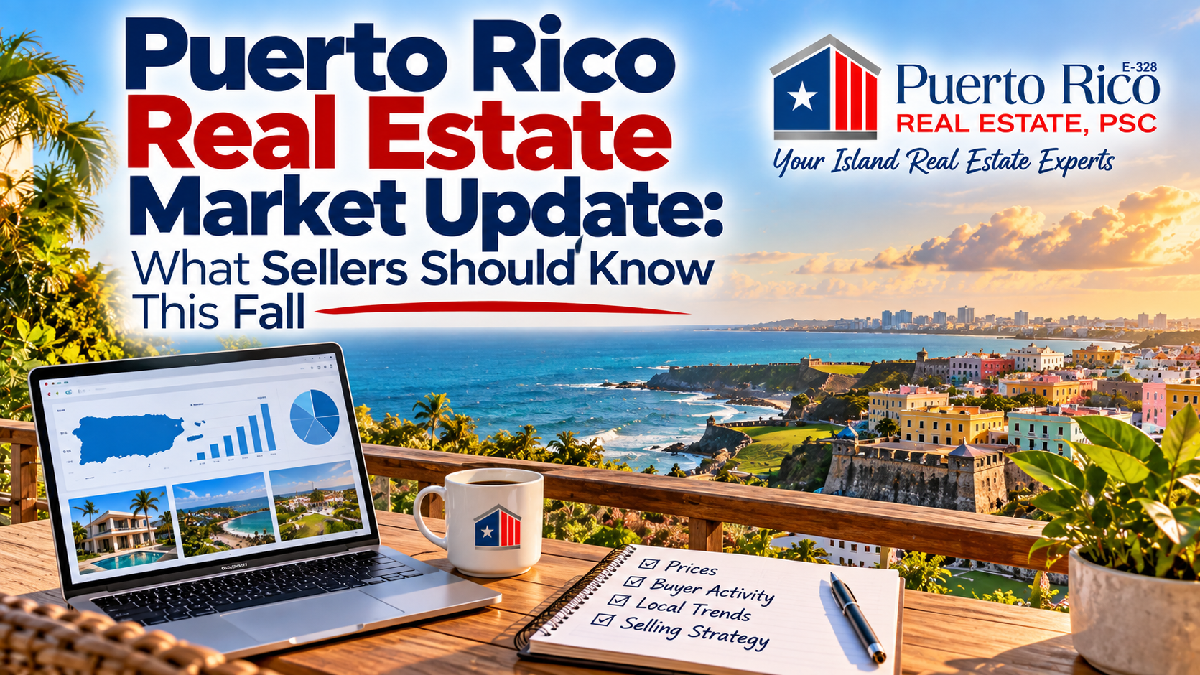
"How is the Puerto Rico real estate market right now?"
It's one of the first questions property owners ask when they're thinking about selling.
And it's a perfectly reasonable question.
But there's a problem with giving it a simple answer.
There isn't really one Puerto Rico real estate market.
A beachfront condominium in Condado isn't competing with a three-bedroom home in Moca.
A property near Crash Boat Beach in Aguadilla isn't being evaluated the same way as acreage in the mountains of Isabela.
A luxury residence in Dorado doesn't have the same buyer pool as a two-unit property in Mayagüez.
Even two homes located within the same municipality can perform differently because of condition, neighborhood, access, views, land, financing eligibility, improvements and asking price.
That's why broad statements such as "Puerto Rico real estate is booming" or "the market is slowing down" don't tell a property owner nearly enough.
As we move into fall 2026, sellers need something more useful:
An understanding of what buyers are doing, what the current numbers can—and cannot—tell us, and how to position an individual property accordingly.
Let's begin with a snapshot.
According to Realtor.com's Puerto Rico market data available in September 2026, the island had a median listing price of approximately $547,000, approximately 4,576 active listings, and a median 88 days on market. Realtor.com also reported an approximately 95% sale-to-list ratio, meaning homes represented in its dataset sold for roughly 5% below asking price on average.
Those numbers are useful—but sellers need to understand what they represent.
The median listing price is not the value of the typical Puerto Rico home.
It is the midpoint of properties being advertised within that particular dataset.
And Puerto Rico's inventory can include everything from relatively affordable homes and fixer-uppers to beachfront residences and multimillion-dollar luxury properties.
Likewise, an island-wide median of 88 days on market doesn't mean your property will sell in exactly 88 days.
Some homes sell much faster.
Others can remain available for months.
What determines the difference?
Often it comes down to the combination of:
Location + Condition + Price + Buyer Demand + Financing + Presentation + Marketing.
That's why we should use market statistics as context—not as a substitute for analyzing your individual property.
This may be one of the most important lessons for Puerto Rico sellers this fall.
You can ask almost anything for a property.
The market decides whether buyers agree.
Realtor.com's September data showed an island-wide sale-to-list ratio around 95% in its dataset.
That doesn't mean every seller should automatically discount their property by 5%.
It means pricing strategy matters.
If comparable homes indicate a likely market value around $300,000 and an owner lists at $425,000 simply because they "want room to negotiate," the extra $125,000 doesn't necessarily create negotiating room.
It may simply cause qualified buyers to skip the property.
Today's buyers can look at dozens of listings from their phones.
They compare photographs.
They compare locations.
They compare square footage.
They compare land.
They compare renovations.
They compare asking prices.
And when something appears significantly overpriced relative to competing properties, many buyers don't make a low offer.
They move on.
This is why one of the first things we recommend before selling is understanding how your property compares with other relevant properties.
A thoughtful Comparative Market Analysis (CMA) can help establish a realistic pricing range using available comparable market information rather than emotion or guesswork.
This is where island-wide numbers become especially interesting.
Realtor.com's September 2026 data showed substantial differences in median asking prices between Puerto Rico municipalities and markets represented on its platform.
For example, the reported median listing prices included approximately $497,500 in Aguadilla County, $467,500 in Isabela County, $394,608 in Cabo Rojo County, $225,000 in Mayagüez County, $709,500 in Rincón County and $1.9 million in Dorado County.
Those figures shouldn't be used to value a particular home.
But they illustrate something extremely important:
Puerto Rico is not one homogeneous real estate market.
Even within a municipality, there can be enormous differences.
Consider Aguadilla.
A property in Ramey near the airport, beaches and golf course may attract a different buyer than a rural property farther inland.
In Isabela, beachfront or ocean-view properties can occupy a very different segment from mountain acreage or a traditional residential neighborhood.
In Cabo Rojo, proximity to the coast can dramatically change the buyer profile.
And San Juan can contain everything from conventional residential properties to extremely high-priced luxury inventory.
For a seller, this means your real estate strategy needs to begin locally.
Fall can bring an interesting shift in buyer behavior.
During summer, Puerto Rico attracts plenty of visitors. Some fall in love with the island and begin casually looking at properties.
By fall, certain buyers may become more intentional.
They've had time to research.
They may have spoken with lenders.
They may be planning another trip.
They may have narrowed down municipalities.
Some are preparing for relocation.
Others are thinking about retirement.
Others want a second home.
Investors may be evaluating opportunities before year-end.
Puerto Ricans living stateside may be considering returning home.
And, of course, local buyers remain an important part of the market.
That's why we don't believe sellers should look at fall as a period when "nobody is buying."
The better question is:
Who is likely to buy this particular property—and how do we get their attention?
Today's buyer can research an enormous amount before ever contacting a real estate professional.
Within minutes, they can look at:
That changes the seller's job.
Years ago, simply putting a "For Sale" sign outside a property could generate considerable attention.
Today, your property may be competing with dozens of listings on the same screen.
You have seconds to give someone a reason to stop scrolling.
That's why presentation has become part of pricing strategy.
If two homes are priced similarly but one has bright, attractive photography, good video, clear property information and marketing that communicates the lifestyle while the other has dark photographs and a two-sentence description, which one do you think buyers will investigate first?
Marketing doesn't replace value.
But poor marketing can absolutely hide it.
Realtor.com's September snapshot placed Puerto Rico's median days on market at approximately 88 days.
Again, that does not mean every home should sell in 88 days.
But sellers should pay attention when a property receives little activity over an extended period.
A listing that isn't generating inquiries is giving us information.
A property getting online views but no showing requests is giving us information.
A property receiving showings but no offers is giving us information.
Repeated comments from buyers about price, condition or another issue are giving us information.
The worst response is to ignore all of it.
Good real estate marketing should involve watching how the market responds and adjusting when necessary.
Sometimes the photographs need improvement.
Sometimes buyers don't understand an important feature.
Sometimes the property needs minor work.
Sometimes access to financing is limiting the buyer pool.
And sometimes the price simply doesn't align with what buyers believe the property is worth.
The goal isn't to react emotionally to every showing.
It's to identify patterns.
This is particularly important in Puerto Rico.
A property that qualifies for conventional financing may have access to a different buyer pool than one requiring cash because of condition, title issues or other circumstances.
For example, imagine two properties priced at $180,000.
Property A is financeable.
Property B requires cash.
They may have identical asking prices, but they aren't necessarily competing for identical buyers.
Property A may be accessible to someone with sufficient income and financing approval but who doesn't have $180,000 sitting in a bank account.
Property B needs someone capable and willing to complete a cash purchase.
That difference can influence demand, marketing and potentially the time required to sell.
Sellers should understand these issues before putting the property on the market whenever possible.
A common misconception during strong markets is:
"Someone will buy it anyway."
Maybe.
But the question isn't simply whether someone will buy the property.
The question is:
At what price, under what terms, and after how much time?
Buyers notice deferred maintenance.
They notice roof issues.
They notice moisture.
They notice damaged windows.
They notice unfinished repairs.
They notice kitchens and bathrooms.
They notice whether the property appears cared for.
That doesn't mean every seller should renovate.
In fact, sometimes selling as-is makes more financial sense.
Later this month, we'll publish a complete article examining whether Puerto Rico homeowners should renovate before selling or sell the property as-is.
The important point for today's market update is that condition affects how buyers perceive value.
Luxury and higher-priced properties deserve their own strategy.
Look at San Juan as an example.
Realtor.com's August 2026 San Juan data reported a median listing price around $1.15 million and approximately 101 median days on market.
But even within San Juan, different ZIP codes showed dramatically different asking-price and market-time figures.
That reinforces our central point:
A broad Puerto Rico statistic should never be used as the only basis for pricing an individual property.
Luxury buyers may have different expectations.
Presentation becomes even more important.
Professional photography matters.
Video matters.
Lifestyle marketing matters.
Privacy may matter.
Views may matter.
Architecture, amenities and location can carry enormous weight.
And the pool of qualified buyers naturally becomes smaller as prices rise.
The marketing strategy needs to reflect that reality.
If you're considering putting your Puerto Rico property on the market this fall, don't begin with:
"What price do I want?"
Begin with:
"What is happening around my property?"
Look at comparable properties.
Look at what is currently competing with you.
Look at properties that have sold when reliable information is available.
Look at condition.
Consider whether financing is realistic.
Identify the likely buyer.
Think about how the property should be presented.
And then build your asking-price and marketing strategy around those facts.
This is also why we don't recommend relying exclusively on automated online valuations.
Puerto Rico's housing stock is simply too diverse.
A computer may see two three-bedroom homes.
A knowledgeable local analysis may see that one has a 300-square-meter lot and the other has two acres.
One has ocean views.
One doesn't.
One was renovated last year.
One hasn't been updated since the 1980s.
One has straightforward access.
Another is reached by a narrow mountain road.
Those aren't small details.
Those are value.
We'll explore that issue more deeply in our upcoming October article:
"What Is My Puerto Rico Property Worth? Why Online Estimates Don't Tell the Whole Story."
This is where market statistics alone can't answer the question.
Maybe selling this fall makes sense.
Maybe waiting makes sense.
It depends on the property and your circumstances.
If you're relocating, maintaining an unused home, dealing with an inherited property, selling an investment, simplifying your finances or simply ready to move on, waiting six months just because someone told you "spring is better" may accomplish nothing.
On the other hand, if there are unresolved title issues, necessary repairs or circumstances that would significantly hurt the sale, preparing first may be smarter.
That's why our previous article, Is October a Good Time to Sell Your Puerto Rico Property?, focused on evaluating the seller's individual situation rather than blindly following the calendar.
And our Complete Seller Guide walks property owners through the larger process of selling real estate in Puerto Rico.
This continues to be one of the biggest opportunities we see for property owners.
There are Puerto Rico homeowners throughout Florida, New York, Texas, Pennsylvania and the rest of the United States who may have property here that they no longer use.
Some inherited it.
Some moved away years ago.
Some purchased a vacation property.
Some became accidental landlords.
Some simply don't want the responsibility of maintaining property from thousands of miles away anymore.
If that's you, don't assume selling means immediately booking a flight to Puerto Rico and spending weeks here.
Many parts of a transaction can potentially be coordinated remotely with the right local professionals.
We'll dedicate an entire article to that subject later this month because "How do I sell my Puerto Rico property if I don't live there?" is exactly the type of real-world question we want this blog to answer.
When virtually everything sells immediately, marketing can sometimes look easy.
A changing market exposes the difference between listing a property and marketing a property.
At Puerto Rico Real Estate, PSC, our goal isn't simply to upload a property and hope someone finds it.
We want to identify what makes the property worth someone's attention.
Is it the location?
The land?
The view?
Proximity to the airport?
Walking distance to something important?
Rental possibilities?
Two separate living areas?
A large backyard?
A quiet mountain setting?
A renovation opportunity?
A beachfront lifestyle?
Every property has something different to communicate.
Once we understand that story, we can build the marketing around it through photography, video, social media, online exposure, search-oriented content and direct communication with potential buyers.
That's particularly important when buyers have choices.
Selling property is a significant financial decision.
You deserve more than someone placing your home online and waiting.
Our approach at Puerto Rico Real Estate, PSC is designed around understanding the property, understanding the likely buyer and creating a strategy to connect the two.
That means helping with:
Most importantly, we want sellers to understand why we're recommending a particular strategy.
It's your property.
It's your decision.
Our job is to give you the information and professional guidance you need to make that decision confidently.
The Puerto Rico real estate market isn't defined by one number.
The September 2026 Realtor.com snapshot shows properties actively competing for buyers, a statewide median asking price around $547,000, and a median marketing period approaching three months within its dataset.
But those numbers vary tremendously by municipality, neighborhood, property type and price range.
That's the real message for sellers this fall.
Don't sell based on a headline.
Don't assume your property is worth more because you heard prices are rising somewhere.
Don't assume you missed your opportunity because you heard the market is slowing somewhere else.
And don't assume an online estimate understands your particular property.
Instead:
Understand your local competition.
Know your likely buyer.
Price according to evidence.
Present the property professionally.
Pay attention to buyer response.
Adjust when the market gives you information.
That's how sellers put themselves in a stronger position regardless of what month appears on the calendar.
Before you decide on an asking price—or whether to sell at all—let's take a look at the property and the market around it.
Puerto Rico Real Estate, PSC
Lic. E-328
📞 787-244-6364
📧 [email protected]
🌐 ThePuertoRicoRealEstate.com
Your Island Real Estate Experts
Start with our comprehensive:
Selling Real Estate in Puerto Rico – Complete Seller Guide
Market statistics referenced in this article are snapshots from Realtor.com data available in September 2026 and should not be interpreted as a valuation of an individual property. Local conditions and individual property characteristics vary.
#PuertoRicoRealEstate #PuertoRicoRealEstateMarket #PuertoRicoProperty #SellYourHomePuertoRico #PuertoRicoHomes #PuertoRicoRealtor #PuertoRicoHomeValue #SellingPuertoRico #PuertoRicoLiving #HomesForSalePuertoRico #RealEstatePuertoRico #PuertoRicoRealEstatePSC
Your satisfaction guides our every step. Thanks for choosing PRRE. View all.
"Thank you for your service great teamwork I completely appreciate your time and all your effort thanks again"
You were so much help. Thank you for staying on top of things with me.
The closing was straightforward and completed without incident. The buyers were wonderful. Thank you.
The closing was straightforward and completed without incident. The buyers were wonderful. Thank you
I received your listing in email and just wanted to thank you for the EXCELLENT information. You included not only the correct location, but good, quality video/photos, everything. It's not exactly what I need but: A rare thing to get such a quality listing information, just wanted to say thank you.
Everything went smooth and great at closing, you were such a great help in the process. I will refer you to a friend that needs your help. Thanks alot for all you did for me.
Thanks to all of you, super attention, you explained everything very kindly and the Lcda was also super kind. All excellent more than grateful for everything!!
Everything super good, they treated us very well and everything went well with the closing. Everyone was very nice and the Lcda was very kind to us. Thanks to you and your team who treated us very well and never let us go. I will recommend you and hope to call you soon to find a property.
Closing Done, only took an hour.No problems it went smooth. Thanks again for everything! Having a drink to celebrate.
Very Smooth Transaction. Your Team was very supportive and they helped me alot during the transaction.