Determine the property’s market value
Prepare the property for sale
Gather required documentation
List and market the property
Review and negotiate offers
Close with a Puerto Rico notary
Typical sales involve documentation review, negotiations, and a formal closing where the deed is executed before a notary and recorded in the Property Registry.
Puerto Rico’s real estate system is very different from the mainland United States. Sellers must navigate CRIM certifications, Registry of Property requirements, notary-led closings, municipal permits, zoning rules, HOA regulations, and inheritance or shared ownership situations.
Understanding the documents required to sell property in Puerto Rico is critical before accepting offers
👉 [LINK TO: What Documents Do I Need to Sell My House in Puerto Rico?]
These local requirements are one of the biggest reasons sellers benefit from working with a Puerto Rico–based brokerage that understands the system.

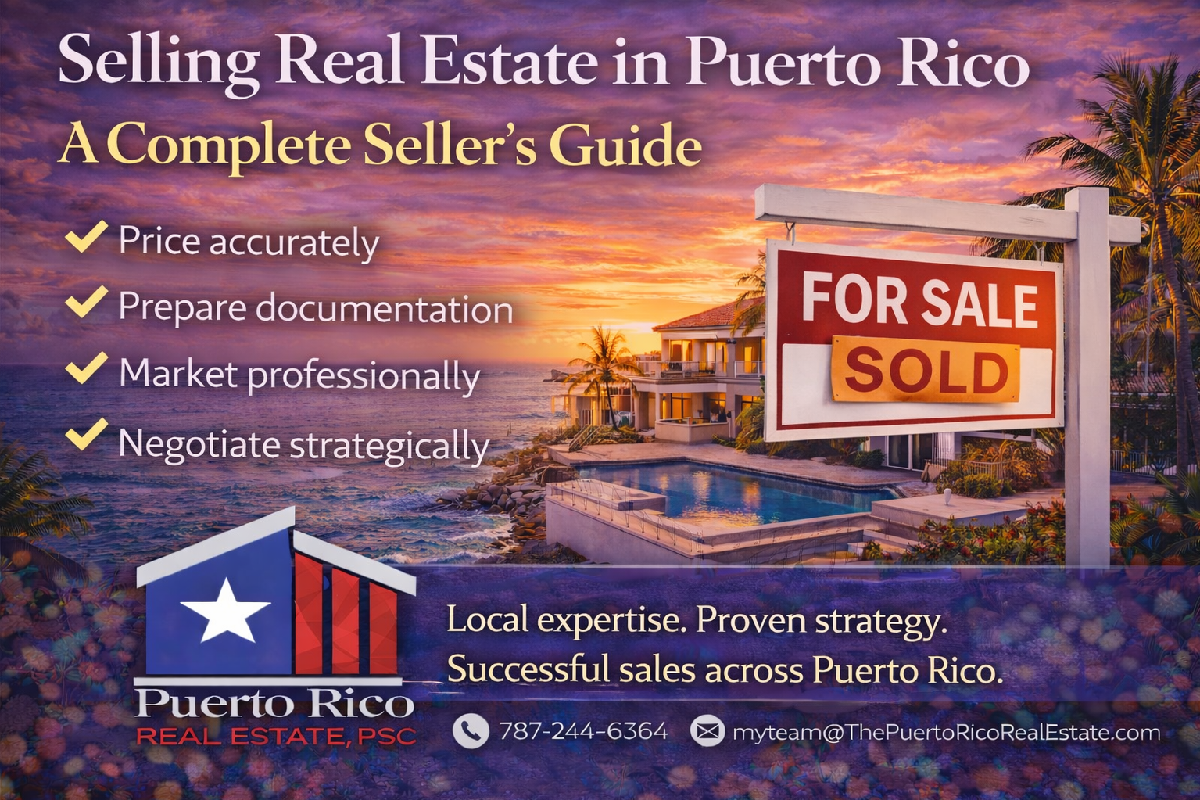
Luxury coastal properties are one of the many types of real estate available throughout Puerto Rico.
Selling property in Puerto Rico involves several steps, from preparing the property and pricing it correctly to navigating the closing process. Understanding how the local real estate system works can help sellers avoid delays and maximize their return.
In this guide, we will cover the key steps involved in selling property in Puerto Rico:
Understanding the Puerto Rico real estate market
Preparing your property for sale
Pricing your property correctly
Marketing your property to buyers
Negotiating offers
The closing process in Puerto Rico
Common mistakes sellers should avoid
Whether you are selling a primary residence, vacation property, or investment property, understanding these steps can help ensure a smoother transaction.
__________________________________________________________________________________________________________________________________________________________________________________
Before listing your property, every seller should review:
👉 [LINK TO: Top Mistakes Sellers in Puerto Rico Make (and How to Avoid Them)]
This guide explains pricing errors, documentation oversights, poor marketing decisions, and agent selection mistakes that often cost sellers thousands of dollars and months of wasted time.
Pricing is the single most important factor in a successful sale. Overpricing often leads to extended time on market, reduced buyer interest, and eventual price drops.
Learn more about pricing your Puerto Rico home correctly here
👉 [LINK TO: What Is My Property in Puerto Rico Worth? How to Price It Right]
Strategic pricing from day one protects value and attracts qualified buyers faster.
Many transactions fail because sellers are unprepared. Knowing what documents are needed to sell a house in Puerto Rico ahead of time can prevent delays and renegotiations
👉 [LINK TO: What Documents Do I Need to Sell My House in Puerto Rico?]
This includes CRIM certifications, Registry status, HOA letters, and inheritance documentation when applicable.
A large percentage of Puerto Rico property owners live in the mainland U.S. or abroad. Selling remotely requires coordination, trusted representation, and constant communication.
If you’re an off-island owner, read this first:
👉 [LINK TO: Selling Your Puerto Rico Property From the U.S. or Abroad]
This guide explains how inspections, negotiations, and closings are handled when you’re not physically on the island.
Not all properties sell the same way. Strategy matters when negotiating the sale of property in Puerto Rico
👉 [LINK TO: How Do I Navigate Buyer Negotiations When Selling Property in Puerto Rico?]
Below are common specialty seller categories we handle:
Selling a vacation or Airbnb-style property involves income documentation, permit verification, and buyer qualification.
Learn more about selling vacation and short-term rental properties in Puerto Rico
👉 [LINK TO: Selling Vacation & Short-Term Rental Properties in Puerto Rico]
For sellers focused on income potential, understanding rental income opportunities in Puerto Rico is key
👉 [LINK TO: Areas in Puerto Rico with Potential for Rental Income or Tourism Expansion]
Luxury homes require elevated marketing, precision pricing, and discretion.
If you own a high-end home, review our guide on luxury real estate in Puerto Rico
👉 [LINK TO: Luxury Real Estate in Puerto Rico: Tips for High-End Sellers]
Tax incentives influence buyer behavior, but sellers must understand the realities.
Learn how Act 60 affects Puerto Rico property sellers
👉 [LINK TO: How Tax Incentives Like Act 60 Affect Puerto Rico Property Sellers]
The highest offer isn’t always the best one. Sellers must evaluate financing, contingencies, timelines, and buyer strength.
This guide explains how to navigate buyer negotiations
👉 [LINK TO: How Do I Navigate Buyer Negotiations When Selling Property in Puerto Rico?]
Understanding current market conditions helps sellers set realistic expectations and strategies.
Stay informed with Puerto Rico real estate market trends for sellers
👉 [LINK TO: Sell Your Puerto Rico Home in 2026: Market Trends You Need to Know]
Selling real estate in Puerto Rico typically follows a structured process. While every transaction is unique, most property sales follow these general steps.
Before listing a property, it is important to understand its current market value. This is usually done by analyzing comparable sales, current listings, and overall market conditions in the area.
A professional real estate agent can help evaluate factors such as location, property condition, amenities, and recent sales in the neighborhood to determine an appropriate listing price.
Preparing the property can significantly impact buyer interest. Sellers often improve the property’s presentation by making small repairs, cleaning thoroughly, and improving curb appeal.
Simple improvements such as fresh paint, landscaping, and decluttering can make a property more attractive to potential buyers.
Once the property is ready, it is listed and marketed to potential buyers. This usually includes professional photography, online listings, social media marketing, and exposure through the Multiple Listing Service (MLS).
Effective marketing ensures that the property reaches both local buyers and buyers relocating from the mainland United States or abroad.
When buyers submit offers, the seller evaluates the price, terms, financing conditions, and closing timeline.
Negotiation may involve adjusting the purchase price, resolving inspection issues, or agreeing on closing dates.
Real estate closings in Puerto Rico are typically conducted by a notary attorney who prepares the final deed and oversees the signing process.
During closing, documents are signed, funds are transferred, and the property is officially transferred to the buyer.
__________________________________________________________________________________________________________________________________________________________________________________
Sellers should consider addressing minor repairs, improving cleanliness, and enhancing curb appeal before listing the property. Simple updates such as repainting walls, fixing small maintenance issues, and improving landscaping can make a property feel more inviting.
In some cases, staging the property or rearranging furniture can help buyers visualize how the space could be used. The goal is to present the property in a way that highlights its strengths and minimizes potential distractions.
__________________________________________________________________________________________________________________________________________________________________________________
Successful real estate sales depend heavily on effective marketing. Today’s buyers typically begin their property search online, which means professional photography and strong online visibility are essential.
Properties are often marketed through multiple channels, including real estate websites, the Multiple Listing Service (MLS), social media platforms, and targeted digital advertising. These tools help ensure the property is seen by both local buyers and those relocating to Puerto Rico.
Marketing may also include virtual tours, video walkthroughs, and detailed property descriptions that highlight the features and benefits of the home.
A well-executed marketing strategy can significantly increase buyer interest and improve the chances of receiving competitive offers.
__________________________________________________________________________________________________________________________________________________________________________________
Selling real estate involves several important decisions, and avoiding common mistakes can help sellers achieve better results.
One common mistake is overpricing the property. While it may seem beneficial to start with a higher price, overpriced properties often stay on the market longer and may ultimately sell for less.
Another mistake is failing to properly prepare the property for showings. Buyers are often influenced by the condition and presentation of a property when making purchasing decisions.
Finally, limited marketing exposure can reduce the number of potential buyers who see the property. A strong marketing strategy helps attract more interest and improves the likelihood of receiving competitive offers.
__________________________________________________________________________________________________________________________________________________________________________________
At Puerto Rico Real Estate, PSC, we don’t just list properties—we manage the entire selling process strategically and professionally.
Our services include:
Accurate pricing based on real market data
Professional photography, video, and SEO marketing
Strong off-island buyer reach
Transaction management from listing to closing
Clear communication and expert negotiation
The timeline varies depending on location, pricing strategy, and market conditions. Properties priced correctly and marketed effectively often attract buyers faster.
Yes. Puerto Rico requires a notary attorney to prepare and certify the public deed during closing.
Typical documents include the property deed, CRIM tax certifications, identification, and sometimes HOA clearances.
Selling property involves many important decisions, from determining the right listing price to navigating the closing process.
The team at Puerto Rico Real Estate, PSC helps property owners throughout Puerto Rico successfully market and sell their homes.
Our services include:
Professional market analysis
Strategic property marketing
Negotiation guidance
Assistance throughout the closing process
If you are considering selling property and would like to learn more about your options, our team would be happy to assist.
Puerto Rico Real Estate, PSC
📞 787-244-6364
📧 [email protected]
🌐 www.ThePuertoRicoRealEstate.com
#PuertoRicoRealEstate
#SellPropertyPR
#PuertoRicoHomeSellers
#SellingInPuertoRico
#PRRealEstateExperts
Your satisfaction guides our every step. Thanks for choosing PRRE. View all.
"Thank you for your service great teamwork I completely appreciate your time and all your effort thanks again"
You were so much help. Thank you for staying on top of things with me.
The closing was straightforward and completed without incident. The buyers were wonderful. Thank you.
The closing was straightforward and completed without incident. The buyers were wonderful. Thank you
I received your listing in email and just wanted to thank you for the EXCELLENT information. You included not only the correct location, but good, quality video/photos, everything. It's not exactly what I need but: A rare thing to get such a quality listing information, just wanted to say thank you.
Everything went smooth and great at closing, you were such a great help in the process. I will refer you to a friend that needs your help. Thanks alot for all you did for me.
Thanks to all of you, super attention, you explained everything very kindly and the Lcda was also super kind. All excellent more than grateful for everything!!
Everything super good, they treated us very well and everything went well with the closing. Everyone was very nice and the Lcda was very kind to us. Thanks to you and your team who treated us very well and never let us go. I will recommend you and hope to call you soon to find a property.
Closing Done, only took an hour.No problems it went smooth. Thanks again for everything! Having a drink to celebrate.
Very Smooth Transaction. Your Team was very supportive and they helped me alot during the transaction.