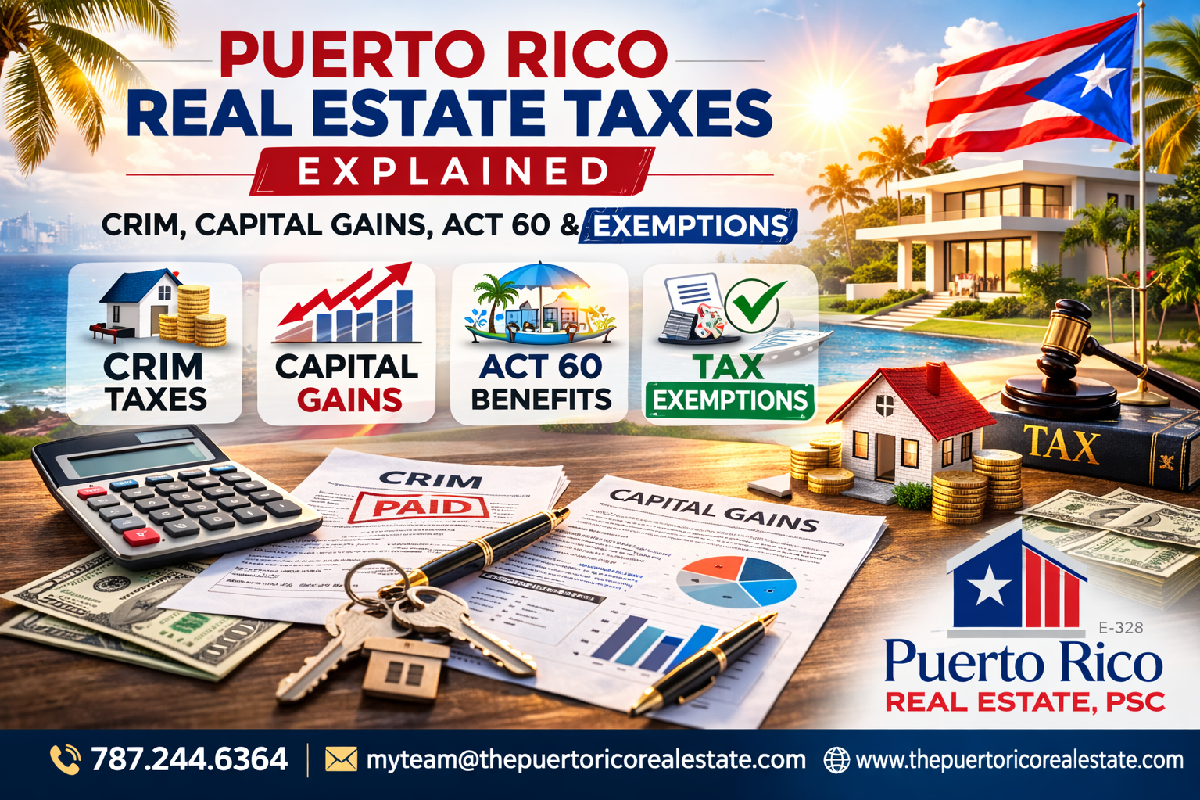
Puerto Rico operates under a civil law system, and its real estate tax structure differs from most U.S. states. The primary property tax authority is CRIM (Centro de Recaudación de Ingresos Municipales), which oversees municipal property tax assessments and collections.
In addition to CRIM property taxes, sellers must consider capital gains implications and how Act 60 may influence both tax exposure and market demand.
Understanding these elements before listing your home can significantly affect your financial outcome.
CRIM is responsible for assessing and collecting property taxes across Puerto Rico.
Unlike many states where property taxes are frequently reassessed based on current market value, CRIM assessments may be based on older valuation systems. This can create confusion because your CRIM assessed value may not reflect what your property would sell for today.
Before a property can close:
CRIM taxes must be current
A debt certification must be obtained
Any outstanding balances must be paid
CRIM taxes are typically prorated between buyer and seller based on the closing date.
One of the most common issues that delays closings in Puerto Rico is unresolved CRIM balances or record discrepancies. At Puerto Rico Real Estate, PSC, we verify CRIM status early in the listing process to prevent last-minute surprises.
If you want to understand how CRIM fits into the total cost of selling, see our related article:
How Much Does It Cost to Sell a House in Puerto Rico?
Capital gains tax is one of the most searched real estate tax topics in Puerto Rico.
Capital gains may apply when you sell a property for more than your adjusted cost basis. Your cost basis generally includes:
The original purchase price
Certain capital improvements
Allowable transaction-related costs
The amount of tax owed depends on several factors including:
Residency status
Whether the property is your primary residence
How long you have owned the property
Applicable tax regulations
If the property is your primary residence, certain exemptions may apply depending on your situation. However, documentation and timing are critical.
Investment properties, second homes, and inherited properties may have different tax implications.
Because capital gains exposure can significantly affect your net proceeds, strategic planning before listing is essential. At Puerto Rico Real Estate, PSC, we encourage sellers to understand their full financial picture before setting a listing price.
Act 60 has significantly influenced Puerto Rico’s real estate market.
Act 60 provides tax incentives to qualifying individuals and businesses relocating to Puerto Rico. While Act 60 does not automatically eliminate capital gains on property sales, it has increased demand in certain property segments and geographic areas.
Increased buyer demand in certain markets
Higher property values in desirable areas
Stronger luxury and investment property activity
However, sellers should not assume that Act 60 changes their personal tax obligations without professional analysis.
The real advantage of Act 60 for sellers is often market-driven rather than tax-driven. Increased demand can result in stronger negotiation leverage and potentially higher sale prices.
If you are selling in a high-demand area influenced by relocation trends, pricing and marketing strategy become even more important.
Puerto Rico offers several potential property tax exemptions, depending on eligibility.
Common exemptions may include:
Primary residence exemptions
Senior citizen exemptions
Disability-related exemptions
Agricultural property classifications
Municipal relief programs
Each exemption requires proper documentation and timely filing.
Failure to verify exemption status can result in unnecessary tax liability or complications during closing.
At Puerto Rico Real Estate, PSC, we help sellers identify potential exemptions and ensure all documentation is prepared before the property goes under contract.
Many sellers focus primarily on the listing price. However, what truly matters is your net proceeds after:
Real estate commissions
Closing costs
Mortgage payoff
CRIM adjustments
Potential capital gains
Without understanding tax exposure, you could overestimate your expected take-home amount.
That is why we prepare a projected seller net sheet before listing your property. This provides a realistic estimate of what you can expect to walk away with at closing.
Understanding taxes is only part of the equation. Execution matters just as much.
Here is why sellers choose Puerto Rico Real Estate, PSC.
We verify CRIM balances and certifications before listing your property, reducing the risk of closing delays.
We do not simply recommend a price based on comparable sales. We analyze:
Market demand
Competition
Buyer behavior
Your estimated net proceeds
If you want to learn more about pricing strategy, read our article:
How to Price Your Home to Sell Fast in Puerto Rico.
Taxes and closing costs affect your bottom line. Strong negotiation can offset potential expenses by:
Securing stronger offers
Reducing seller concessions
Negotiating inspection credits
Structuring favorable timelines
Our goal is to maximize your net profit.
Puerto Rico real estate transactions involve coordination between:
CRIM
Title companies
Notaries
The Property Registry
Lenders
Attorneys
We manage every step so you do not have to.
Before listing, we provide:
Estimated net proceeds
Cost breakdown
Timeline expectations
Market positioning strategy
This level of preparation reduces stress and increases confidence.
Some sellers attempt to sell independently to avoid commission.
However, without understanding:
CRIM requirements
Capital gains exposure
Act 60 market dynamics
Exemption documentation
Civil law closing procedures
They often face unexpected obstacles that reduce their final profit.
Professional representation is not just about marketing. It is about protecting your equity.
Imagine you purchased a property for $350,000 and sell for $700,000.
Without proper planning:
You may underestimate capital gains exposure
You may overlook exemption opportunities
You may misprice the property
You may face CRIM certification delays
Strategic planning before listing allows you to maximize profit and avoid surprises.
Puerto Rico real estate taxes do not have to be overwhelming. With proper planning, they can be managed efficiently and strategically.
The key is preparation and professional guidance.
When you list with Puerto Rico Real Estate, PSC, you gain:
Tax awareness
Strategic pricing
Skilled negotiation
Transaction coordination
Maximum market exposure
Your property deserves expert execution.
Puerto Rico Real Estate, PSC
Phone: 787.244.6364
Email: [email protected]
Website: www.thepuertoricorealestate.com
Schedule your confidential seller consultation today and receive a customized net proceeds analysis.
#PuertoRicoRealEstate
#CRIMTaxes
#Act60
#CapitalGains
#SellInPuertoRico
#PRRealEstate
#PuertoRicoProperty
#RealEstateExperts
Your satisfaction guides our every step. Thanks for choosing PRRE. View all.
"Thank you for your service great teamwork I completely appreciate your time and all your effort thanks again"
You were so much help. Thank you for staying on top of things with me.
The closing was straightforward and completed without incident. The buyers were wonderful. Thank you.
The closing was straightforward and completed without incident. The buyers were wonderful. Thank you
I received your listing in email and just wanted to thank you for the EXCELLENT information. You included not only the correct location, but good, quality video/photos, everything. It's not exactly what I need but: A rare thing to get such a quality listing information, just wanted to say thank you.
Everything went smooth and great at closing, you were such a great help in the process. I will refer you to a friend that needs your help. Thanks alot for all you did for me.
Thanks to all of you, super attention, you explained everything very kindly and the Lcda was also super kind. All excellent more than grateful for everything!!
Everything super good, they treated us very well and everything went well with the closing. Everyone was very nice and the Lcda was very kind to us. Thanks to you and your team who treated us very well and never let us go. I will recommend you and hope to call you soon to find a property.
Closing Done, only took an hour.No problems it went smooth. Thanks again for everything! Having a drink to celebrate.
Very Smooth Transaction. Your Team was very supportive and they helped me alot during the transaction.