Yes.
And homeowners do it every year.
Puerto Rico's Atlantic hurricane season officially runs for several months, which means avoiding real estate activity throughout the entire season simply isn't practical for many sellers.
People relocate.
Families grow.
Properties are inherited.
Investors buy and sell.
Owners decide to downsize.
Job situations change.
Financial priorities change.
Life doesn't stop because the calendar says it's hurricane season.
Neither does real estate.
What does change is the level of preparation that may be necessary.
If you're considering selling during this time of year, the question shouldn't simply be:
"Should I sell during hurricane season?"
A better question is:
"What should I do differently because I'm selling during hurricane season?"
That's where having a strategy matters.
If you're beginning the selling process, our complete guide to selling real estate in Puerto Rico provides a broader overview of what Puerto Rico property owners should consider before listing.
Puerto Rico residents don't need a reminder that tropical weather can change quickly.
We live with that reality.
But selling a property adds another layer.
During an ordinary week, you may have scheduled:
A professional photography appointment.
A property showing.
An inspection.
An appraisal.
A contractor visit.
A meeting with a potential buyer.
Or even a closing.
Then a tropical system begins developing.
Suddenly everyone's attention shifts.
Flights may change.
Businesses may adjust schedules.
Government offices may operate differently.
Inspectors and appraisers may need to reschedule.
Buyers traveling from outside Puerto Rico may change their plans.
None of that necessarily destroys a transaction.
But it can change the timeline.
A prepared seller understands this possibility before it happens.
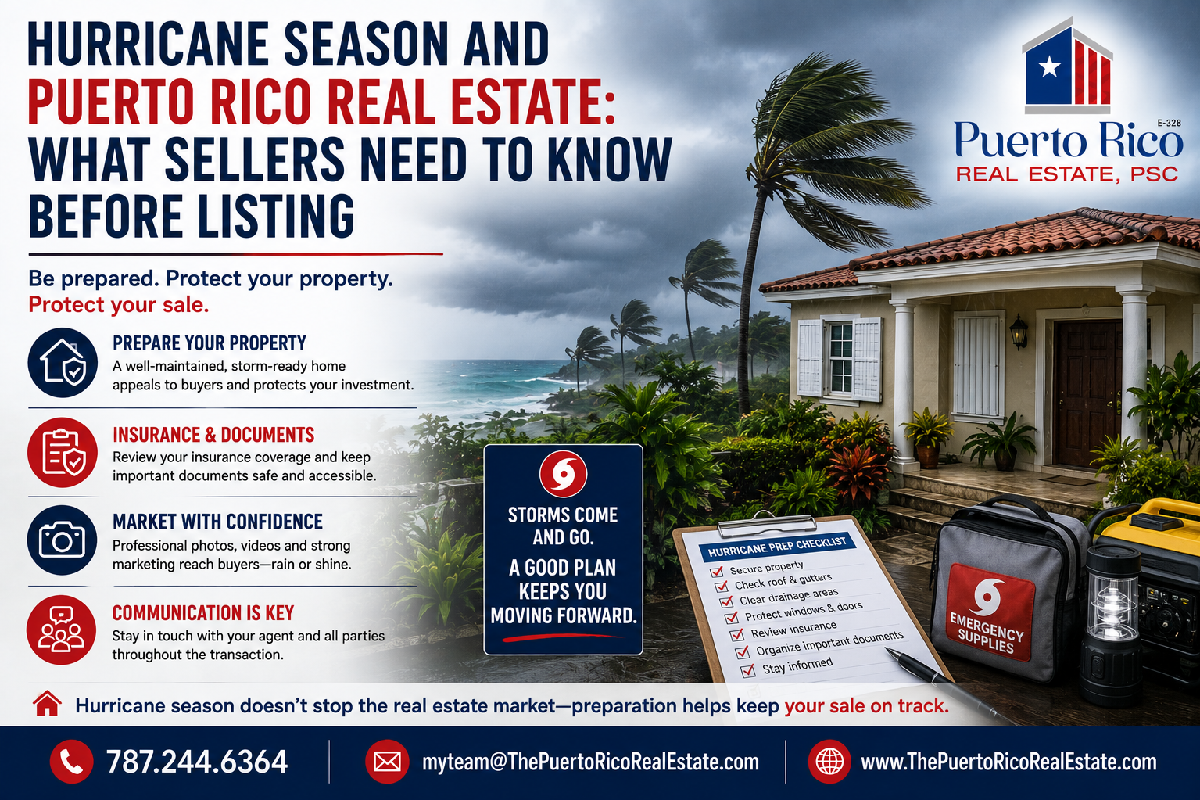
Before worrying about marketing, photographs or open houses, look at the physical condition of your property.
A home being sold should be maintained anyway.
During hurricane season, that becomes even more important.
Walk around the property and ask practical questions.
Are gutters and drainage areas clear?
Are there loose outdoor items?
Are tree branches creating unnecessary risk?
Are windows and doors functioning properly?
If the property has storm shutters, are they accessible and operational?
Does the roof show signs of problems that should be evaluated?
Is water accumulating somewhere after heavy rain?
Are gates and fences secure?
Does the property have a generator, solar system, battery storage, cistern or other resilience-related equipment that should be inspected or maintained?
The objective isn't to turn your home into an impenetrable fortress.
It's to address obvious issues before they become bigger problems.
And many of these improvements can benefit the sale even if no storm ever approaches.
A clean, maintained and organized property simply presents better to buyers.
For additional preparation ideas, see our guide on preparing your Puerto Rico home for sale.
There's another side to hurricane preparation that sellers sometimes overlook.
Certain features may actually matter to buyers.
Consider a home equipped with:
Solar panels.
Battery storage.
A generator.
A cistern.
Storm shutters.
Impact-resistant windows.
Good drainage.
Secure storage.
A reinforced garage or storage area.
For someone relocating to Puerto Rico, these features may be extremely attractive.
An off-island buyer may have heard stories about hurricanes but have little firsthand experience preparing for one.
A property that already includes systems designed to make everyday life more resilient can provide peace of mind.
This doesn't mean making exaggerated claims.
We shouldn't describe any home as "hurricane-proof."
No property should be marketed that way unless there is a legitimate basis for a very specific representation.
Instead, accurately describe what exists.
22 solar modules.
Two Tesla batteries.
A backup generator.
A water cistern.
Storm shutters.
Facts are powerful.
Let the buyer decide what those features are worth to them.
Insurance can become particularly important during hurricane season.
Sellers should know what coverage they currently have and keep relevant documents accessible.
This becomes even more important when a buyer is financing the purchase.
Lenders typically have insurance-related requirements, and significant weather events can sometimes affect the ability to bind or modify policies during certain periods.
Specific requirements vary according to the property, insurer, lender and transaction.
That's why sellers shouldn't wait until the last minute to begin thinking about insurance.
If you're unsure about your current policy or what may be needed during a transaction, speak with a qualified insurance professional.
Your real estate professional can help coordinate the transaction, but questions about specific insurance coverage should be addressed by someone licensed and qualified to provide that advice.
Preparation is the theme here.
Again and again.
This is where homeowners often become nervous.
Suppose you've accepted an offer.
The buyer is moving forward.
Everything appears on schedule.
Then Puerto Rico falls within the potential path of a tropical storm or hurricane.
What happens?
The answer depends on the specific transaction and circumstances.
A storm could affect inspections.
An appraisal might be postponed.
Travel could be interrupted.
Utilities could be affected.
Insurance requirements could change.
A lender may require additional confirmation about the property's condition.
If the property experiences damage, that obviously introduces another set of considerations.
The most important thing is not to make assumptions.
Review the applicable contract.
Communicate with the professionals involved.
Document the property's condition.
And address any new issues appropriately.
A storm doesn't automatically mean a transaction is dead.
But everyone involved needs accurate information.
Here's something sellers may not think about until it's too late.
Suppose your property goes under contract and a storm later affects the area.
Good photographs and videos taken before the event may provide useful documentation of the property's prior condition.
Professional listing photography is primarily intended for marketing, of course.
But having clear, dated records of the home's appearance can also be useful generally.
Take photographs of important areas.
Exterior walls.
Roof areas visible safely from the ground.
Windows.
Doors.
Outdoor structures.
Solar equipment.
Interior rooms.
Major appliances included in the sale.
If a significant event occurs, you'll have a better record of what the property looked like beforehand.
Again, this isn't a substitute for insurance documentation, professional inspections or other formal requirements.
It's simply good organization.
Imagine preparing for a storm and suddenly realizing the only copy of an important property document is sitting inside a filing cabinet in a house you're evacuating.
Not ideal.
Important property documentation should be organized and, where appropriate, securely backed up digitally.
Depending on the transaction, sellers may need documents involving:
The deed.
CRIM.
Mortgage information.
Permits.
Property surveys.
Condominium or HOA information.
Insurance.
Inheritance or estate matters.
Utility accounts.
Other property-specific records.
Our guide to documents needed when selling property in Puerto Rico provides a useful starting checklist.
You don't necessarily need every possible document before calling a real estate professional.
But the earlier you identify what you have—and what may be missing—the better.
Vacant properties deserve special attention during hurricane season.
If you're selling a property while living somewhere else, ask yourself:
Who checks the property?
Who prepares it if severe weather approaches?
Who confirms its condition afterward?
Who removes debris?
Who handles an unexpected leak?
Who can provide access if necessary?
These questions become even more important for sellers living outside Puerto Rico.
A vacant property can develop a small problem that becomes a large problem simply because nobody notices it quickly.
If you're selling remotely, establish a local plan before you need one.
That may involve trusted family, property management, contractors or other appropriate local resources.
Don't wait until a storm is 48 hours away to determine who has the keys.
The experience of hurricanes and power disruptions has changed what some Puerto Rico buyers value.
A beautiful kitchen still matters.
Ocean views still matter.
Location still matters.
But practical systems may carry greater importance than they once did.
Solar energy and battery storage are obvious examples.
Water storage can matter.
Generators can matter.
Storm protection can matter.
Construction quality matters.
Access can matter.
Drainage can matter.
For sellers, this means the property's practical features deserve attention in the marketing.
If you've invested in systems that improve day-to-day reliability or storm preparedness, make sure those systems are accurately documented and communicated.
Don't bury a $30,000 solar-and-battery system in the last sentence of the property description.
That's an important feature.
Treat it like one.
Strong marketing doesn't mean exaggerating.
If the property has solar, say it has solar.
If it has battery backup, explain the system.
If there are storm shutters, describe them.
But avoid claims you can't support.
"Never loses power."
"Hurricane-proof."
"Flood-proof."
"Completely protected."
Those types of statements can create unnecessary problems.
Real estate marketing should make the property sound appealing because the property is appealing—not because we've stretched the truth.
At Puerto Rico Real Estate, PSC, we believe good marketing starts with identifying the strongest truthful story a property has to tell.
Not necessarily.
Imagine you decide in September that you want to sell.
You wait until December simply because hurricane season is ending.
During those three months, you could have been:
Preparing documents.
Addressing repairs.
Evaluating the property.
Building a pricing strategy.
Creating marketing materials.
Speaking with potential buyers.
And perhaps already negotiating an offer.
Waiting has a cost too.
That doesn't mean everyone should list immediately.
If the property isn't ready, don't rush.
If significant documentation issues exist, address them.
If you need time to prepare, take it.
But make the decision based on your actual circumstances—not simply fear of the calendar.
Another reason not to assume September is a dead month is that buyers don't all operate according to Puerto Rico's local calendar.
Someone in New York may be researching a move.
A buyer in Florida may be searching for a vacation property.
A Puerto Rican family living in Texas may be planning to return home.
An investor may be evaluating properties throughout the year.
A retiree may be planning a move six months from now.
Their search often begins online long before they arrive.
This is why strong digital marketing remains important throughout the year.
Professional photography.
Video.
Detailed property descriptions.
Maps.
Community information.
Social media.
Search visibility.
All of these can introduce your property to someone who isn't physically standing in Puerto Rico today.
Our step-by-step guide to selling property in Puerto Rico explains how these pieces work together throughout the selling process.
The first priority is always safety.
Once conditions are safe, evaluate what happened.
Document the damage.
Contact the appropriate insurance professionals if applicable.
Inform the necessary parties involved in the transaction.
Don't try to hide damage from a buyer.
That approach can create much bigger problems later.
Transparency matters.
If repairs are needed, determine what should happen next based on the property, contract, insurance situation and professional advice.
Sometimes repairs can be completed and the transaction continues.
Other situations may be more complicated.
There is no universal answer because the circumstances can vary dramatically.
The important principle is simple:
Communicate early and document everything.
Many of the things that make a property better prepared for severe weather also make it better maintained generally.
Cleaning drainage areas helps during ordinary heavy rain.
Trimming dangerous branches protects the roof year-round.
Maintaining shutters keeps them functional.
Checking the roof may uncover a leak before it becomes serious.
Testing a generator helps ensure it's available when needed.
Maintaining solar and battery systems protects an expensive investment.
Organizing documents helps with the eventual sale.
So even if Puerto Rico goes through the remainder of hurricane season without a major event affecting your area, the work isn't wasted.
You've improved the property's readiness.
And that can improve the selling experience.
Hurricane season doesn't suspend basic real estate economics.
Buyers still compare properties.
They still care about price.
They still evaluate condition.
They still notice how long a home has been listed.
A seller can't compensate for an unrealistic price simply by saying the property has solar panels and hurricane shutters.
Resilience features can add appeal.
They don't eliminate the need for proper pricing.
When preparing to sell, evaluate the property as a complete package:
Location.
Condition.
Size.
Land.
Improvements.
Special features.
Comparable properties.
Competing listings.
Buyer demand.
And the realities of financing.
The goal is to position the property so buyers understand the value.
A real estate transaction involves many people.
Seller.
Buyer.
Real estate professionals.
Lender.
Appraiser.
Inspector.
Insurance professionals.
Attorneys or notaries.
Contractors.
Sometimes condominium associations or other parties.
When weather disrupts normal schedules, communication becomes critical.
If an appointment changes, everyone should know.
If access to the property becomes difficult, communicate it.
If damage occurs, address it.
If the transaction timeline needs to change, discuss it.
Silence creates uncertainty.
And uncertainty makes already stressful situations worse.
One of the roles of an experienced real estate professional is helping keep those moving pieces coordinated.
Selling property in Puerto Rico requires more than putting photographs online and waiting for the phone to ring.
And during hurricane season, preparation and communication become even more important.
At Puerto Rico Real Estate, PSC, we help sellers approach the process strategically.
That includes:
Property Evaluation — Understanding the property's strengths, challenges and likely buyer.
Preparation Guidance — Identifying practical steps to improve presentation and readiness.
Pricing Strategy — Using market information to position the property competitively.
Professional Marketing — Presenting the property through strong photography, video, digital advertising, social media and search-focused content.
Local and Off-Island Exposure — Reaching buyers in Puerto Rico as well as people researching relocation, investment and second homes from elsewhere.
Offer Evaluation — Looking at price, financing, terms, timing and the overall strength of an offer.
Transaction Coordination — Helping everyone stay informed as the sale moves from listing to closing.
And during hurricane season:
Preparation and communication become part of the strategy.
We can't control the weather.
But we can work to make sure your sale isn't being managed without a plan.
Maybe you're ready to sell now.
Maybe you're considering listing later this fall.
Maybe you simply want to know what your property could be worth before making a decision.
That's fine.
You don't have to decide everything today.
But you can start preparing today.
Walk the property.
Check maintenance items.
Review your storm-preparation systems.
Organize your documents.
Understand your insurance.
Think about your timeline.
And talk with a real estate professional about what selling would actually involve.
Information gives you options.
Preparation gives you confidence.
And when circumstances change—as they sometimes do during hurricane season—you'll be in a much better position to respond.
Puerto Rico has always required resilience.
We prepare.
We adjust.
We take care of our homes and our communities.
And then we keep moving forward.
Selling real estate during hurricane season should be approached the same way.
Don't ignore the risks.
Don't exaggerate them either.
Understand them.
Prepare for them.
Build them into your plan.
Then make the decision that's right for you.
If you've been thinking about selling a home, condominium, investment property, multi-unit building, beachfront property, commercial property, farm or vacant land in Puerto Rico, we'd be happy to talk with you.
At Puerto Rico Real Estate, PSC, our goal is to help you understand your options and develop a selling strategy that makes sense for your property and your circumstances.
Hurricane season doesn't stop the real estate market.
And it doesn't necessarily have to stop you.
📞 787-244-6364
🌐 www.ThePuertoRicoRealEstate.com
Thinking about selling your Puerto Rico property? Let's start with a conversation.
#PuertoRicoRealEstate #HurricaneSeason #HurricaneSeasonPuertoRico #SellPropertyPuertoRico #PuertoRicoSellers #SellingInPuertoRico #PuertoRicoHomes #HurricanePreparedness #PuertoRicoProperty #SellMyHome #PuertoRicoRealtor #HomeSellingTips #LivingInPuertoRico #RealEstatePuertoRico #ThePuertoRicoRealEstate
Your satisfaction guides our every step. Thanks for choosing PRRE. View all.
"Thank you for your service great teamwork I completely appreciate your time and all your effort thanks again"
You were so much help. Thank you for staying on top of things with me.
The closing was straightforward and completed without incident. The buyers were wonderful. Thank you.
The closing was straightforward and completed without incident. The buyers were wonderful. Thank you
I received your listing in email and just wanted to thank you for the EXCELLENT information. You included not only the correct location, but good, quality video/photos, everything. It's not exactly what I need but: A rare thing to get such a quality listing information, just wanted to say thank you.
Everything went smooth and great at closing, you were such a great help in the process. I will refer you to a friend that needs your help. Thanks alot for all you did for me.
Thanks to all of you, super attention, you explained everything very kindly and the Lcda was also super kind. All excellent more than grateful for everything!!
Everything super good, they treated us very well and everything went well with the closing. Everyone was very nice and the Lcda was very kind to us. Thanks to you and your team who treated us very well and never let us go. I will recommend you and hope to call you soon to find a property.
Closing Done, only took an hour.No problems it went smooth. Thanks again for everything! Having a drink to celebrate.
Very Smooth Transaction. Your Team was very supportive and they helped me alot during the transaction.