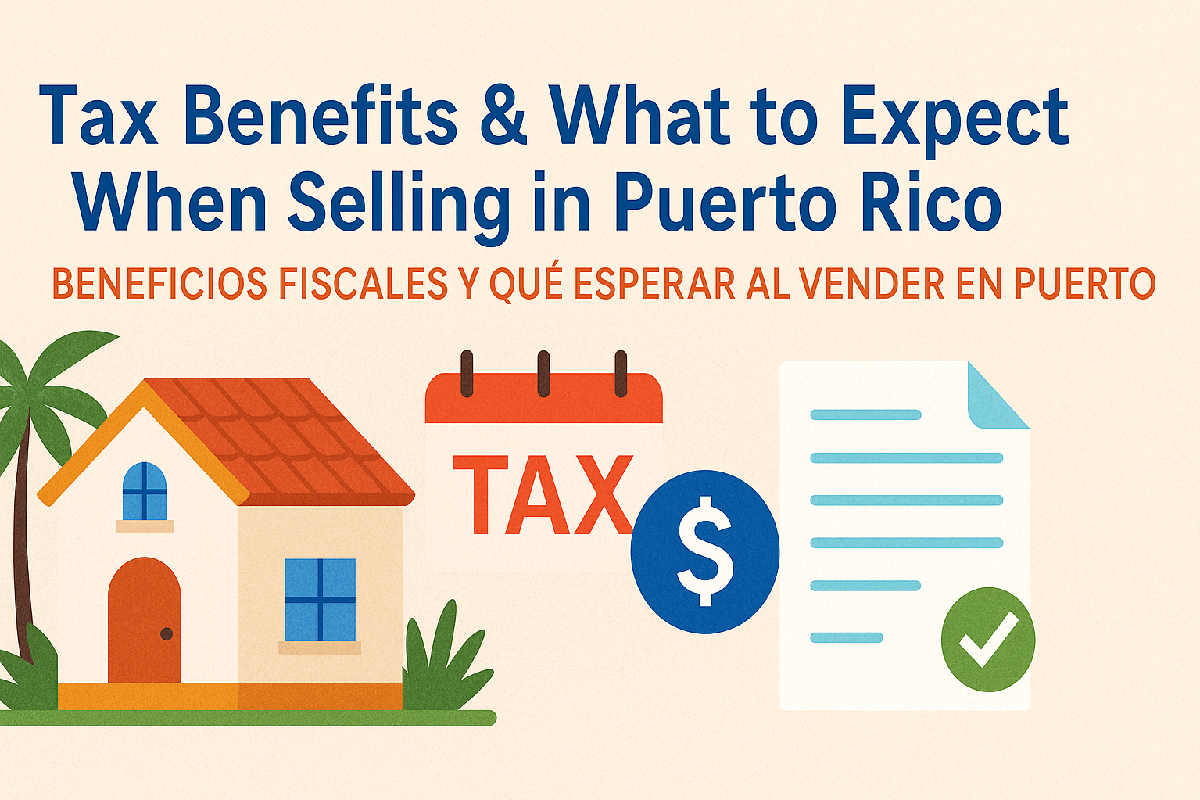
Selling property in Puerto Rico involves more than finding the right buyer and signing the contract. It also means navigating a unique tax and regulatory environment — one that blends local and U.S. laws, requiring careful handling to ensure compliance and maximize profits.
At Puerto Rico Real Estate, PSC, we guide sellers through every step — from understanding capital gains taxes and CRIM certifications to evaluating Act 60 benefits and preparing the right documentation for a seamless closing.
Here’s a comprehensive breakdown of what to expect when selling real estate in Puerto Rico, and how we make the process easier for you.
When you sell your property, any profit earned is considered a capital gain, which may be subject to taxation. However, Puerto Rico’s tax structure offers unique advantages — especially for long-term property owners or those who meet specific local residency criteria.
Short-Term Gains: If you owned the property for one year or less before selling, the profit is taxed as ordinary income, based on Puerto Rico’s individual tax rates (up to 33%).
Long-Term Gains: If you’ve owned the property for more than a year, your profit is typically taxed at a 15% capital gains rate, one of the lowest in the U.S. and its territories.
If the property was your primary residence, you might qualify for exemptions that reduce or eliminate capital gains taxes. Documentation showing you lived there — such as utility bills and CRIM records — is often required.
If you live outside Puerto Rico but own property on the island, you’re still subject to Puerto Rico’s capital gains tax — but not U.S. federal capital gains taxes (since Puerto Rico is treated as a separate tax jurisdiction).
Puerto Rico Real Estate, PSC works closely with accountants and tax professionals to help sellers calculate and minimize these liabilities.
The Centro de Recaudación de Ingresos Municipales (CRIM) is Puerto Rico’s municipal tax authority. It collects property taxes that fund local municipalities. Before selling, you must ensure your CRIM account is current and paid in full.
During the sale process, your closing attorney or notary public will request a “Certificación de No Deuda de Contribución sobre la Propiedad” (Certificate of No Debt) from CRIM. This document verifies that there are no outstanding property tax balances.
Without it, the closing cannot proceed.
Confirming CRIM bills are up to date.
Ensuring the property is properly registered under your name.
Providing the Número de Catastro (Cadastral Number) to your real estate agent and attorney.
Our team at Puerto Rico Real Estate, PSC ensures that all these details are verified early, avoiding costly closing delays.
The Puerto Rico Incentives Code (Act 60) offers significant tax advantages to individuals and businesses relocating to Puerto Rico. Although primarily geared toward buyers and investors, understanding Act 60 can benefit you as a seller.
Increased Buyer Pool: Many Act 60 residents are high-income professionals looking for luxury or investment properties on the island. Marketing your property to this demographic can increase exposure and value.
Investment Appeal: Properties that meet Act 60 residency or commercial criteria are often in higher demand — especially in areas like Dorado, Guaynabo, Rincón, and San Juan.
Tax-Friendly Transactions: Sellers relocating off-island may qualify for partial exemptions on capital gains earned while living in Puerto Rico.
At Puerto Rico Real Estate, PSC, we understand how to market properties to Act 60 buyers effectively, ensuring your listing attracts serious, qualified investors.
In addition to capital gains and CRIM, a few other tax considerations apply to most Puerto Rico real estate transactions.
In Puerto Rico, all real estate transactions must be formalized by a licensed notary public (attorney). Sellers typically share closing costs, which include government stamps and filing fees — averaging 1% to 2% of the sale price.
If the sale includes personal property (like furniture or appliances) as part of the transaction, an 11.5% IVU (Impuesto sobre Ventas y Uso) may apply.
If you’re a non-resident seller, the buyer or closing attorney may withhold a percentage of the proceeds for potential tax liabilities until final filings are complete.
Our team ensures you understand each obligation and helps coordinate with legal and accounting professionals to ensure accurate filings.
Selling real estate in Puerto Rico involves various legal documents that must be gathered before listing your property. Working with a professional real estate agency ensures all paperwork is handled correctly.
Essential Documents Include:
Title deed (Escritura)
Property survey (Planimetría or Mensura)
CRIM certification of no debt
ID and marital status documentation
HOA or condominium dues clearance
Property tax and utilities paid receipts
At Puerto Rico Real Estate, PSC, we organize these details from the start, saving time and ensuring a smooth transaction when you reach the closing table.
Timing plays a major role in your financial outcome. For example:
Selling before the end of the fiscal year may affect your capital gains liability.
CRIM payments are due semi-annually, so closing after a payment date might entitle you to a pro-rated refund.
Act 60-qualified buyers may be more active during certain seasons when relocation deadlines approach.
Our experienced agents analyze your situation and help you identify the optimal window to sell for the best financial result.
Real estate transactions in Puerto Rico are complex — especially when it comes to taxes and documentation. That’s where we come in.
When you list with Puerto Rico Real Estate, PSC, you gain access to:
Comprehensive Market Analysis (CMA): To price your home accurately and competitively.
Tax & CRIM Guidance: Assistance gathering certifications, receipts, and clearances before closing.
Network of Professionals: We work closely with notaries, accountants, and attorneys specializing in Puerto Rican real estate.
Tailored Marketing for Qualified Buyers: Including Act 60 investors and relocation clients.
Seamless Transaction Management: From listing to closing, our team handles all logistics and paperwork.
We ensure your sale is not just successful — but compliant, profitable, and stress-free.
Here’s why so many property owners trust us to sell their homes and investments across the island:
Local Expertise: Decades of experience navigating Puerto Rico’s real estate laws and tax system.
Bilingual Service: We bridge communication between local authorities and off-island buyers.
Professional Integrity: Transparent, ethical, and client-focused representation.
Personalized Support: We tailor our approach to your property, location, and financial goals.
When you choose Puerto Rico Real Estate, PSC, you’re partnering with professionals who understand both the market and the law — ensuring your sale is in good hands.
Selling real estate in Puerto Rico offers incredible opportunities — but also important responsibilities. From capital gains and CRIM obligations to Act 60 tax advantages, every detail matters.
With the right guidance, you can sell your property quickly, avoid costly mistakes, and maximize your profit.
Contact Puerto Rico Real Estate, PSC to navigate taxes and paperwork correctly.
Contact Information:
Puerto Rico Real Estate, PSC
📞 787.244.6364
📧 [email protected]
🌐 www.ThePuertoRicoRealEstate.com
#PuertoRicoRealEstate #SellYourHomePR #CapitalGainsPR #TaxesPR #Act60 #CRIM #HomeSellingTips #RealEstatePR #PuertoRicoProperty #PRRealEstate
Your satisfaction guides our every step. Thanks for choosing PRRE. View all.
"Thank you for your service great teamwork I completely appreciate your time and all your effort thanks again"
You were so much help. Thank you for staying on top of things with me.
The closing was straightforward and completed without incident. The buyers were wonderful. Thank you.
The closing was straightforward and completed without incident. The buyers were wonderful. Thank you
I received your listing in email and just wanted to thank you for the EXCELLENT information. You included not only the correct location, but good, quality video/photos, everything. It's not exactly what I need but: A rare thing to get such a quality listing information, just wanted to say thank you.
Everything went smooth and great at closing, you were such a great help in the process. I will refer you to a friend that needs your help. Thanks alot for all you did for me.
Thanks to all of you, super attention, you explained everything very kindly and the Lcda was also super kind. All excellent more than grateful for everything!!
Everything super good, they treated us very well and everything went well with the closing. Everyone was very nice and the Lcda was very kind to us. Thanks to you and your team who treated us very well and never let us go. I will recommend you and hope to call you soon to find a property.
Closing Done, only took an hour.No problems it went smooth. Thanks again for everything! Having a drink to celebrate.
Very Smooth Transaction. Your Team was very supportive and they helped me alot during the transaction.