Many sellers assume:
The buyer pays most costs
Taxes are minimal
Fees are standardized
In Puerto Rico, that is not always true.
Costs vary based on:
Property value
Ownership history
Capital gains exposure
Municipality
Financing vs. cash transaction
Legal readiness of the property
Understanding these variables before listing is critical to a smooth sale.
Capital gains tax applies when you sell a property for more than your adjusted cost basis (what you paid plus improvements).
Puerto Rico has its own capital gains tax structure, separate from the U.S. federal system.
While rates can change and vary by situation, capital gains in Puerto Rico are commonly:
15% for long-term gains (most cases)
Higher if the property was held short-term or under special circumstances
⚠️ Always consult a CPA for your specific situation.
Length of ownership
Inherited property (step-up basis may apply)
Primary residence exemptions
Property improvements
Act 60 or other tax incentive status
At Puerto Rico Real Estate, PSC, we encourage sellers to review tax exposure before accepting offers, not after.
In many Puerto Rico transactions, 4% of the sales price may be withheld at closing and remitted to the Department of Treasury as a prepayment toward capital gains taxes.
This applies most commonly when:
The seller is not a Puerto Rico resident
The transaction meets certain criteria
If your actual tax liability is lower, you may be entitled to a refund.
Sellers who are unaware of this withholding often experience unexpected reductions in net proceeds at closing.
We ensure sellers understand this early and plan accordingly.
Unlike most U.S. states, notaries in Puerto Rico are attorneys, and they play a central legal role in real estate transactions.
Notary fees are:
Regulated by law
Based on the sales price
Typically paid by the seller, unless negotiated otherwise
While exact amounts vary, notary fees often range between:
0.5% to 1% of the sales price
This includes:
Drafting the deed
Legal certifications
Formal execution of the transaction
After closing, the transaction must be recorded at the Puerto Rico Registry of Property.
These costs cover:
Recording the deed
Updating ownership records
While sometimes overlooked, registry fees are mandatory and are commonly paid by the seller unless otherwise negotiated.
Before closing, sellers must provide several municipal clearances, including:
Confirms property taxes are paid and current.
Confirms there are no outstanding municipal taxes or fees.
Depending on the municipality, additional documentation may be required.
Unpaid municipal balances must be cleared before closing.
If the property is part of a condominium or homeowners association:
All HOA dues must be current
A clearance letter is required
Outstanding HOA balances are paid at or before closing and are the seller’s responsibility unless negotiated.
Real estate commission is one of the largest selling costs — and also one of the most important.
Pricing strategy
Professional marketing
Buyer screening
Negotiation
Transaction management
Closing coordination
At Puerto Rico Real Estate, PSC, our commission reflects full-service representation, not just listing exposure.
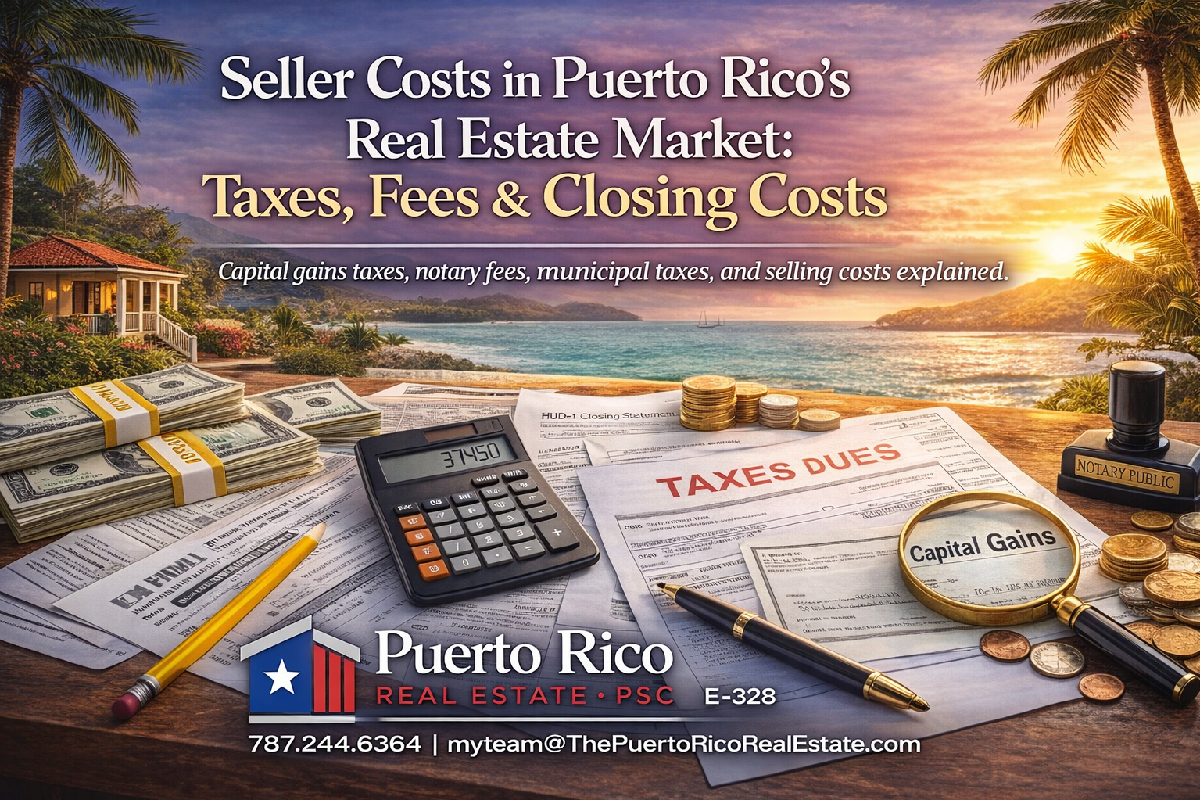
Capital gains taxes
Withholding (if applicable)
Notary fees
Registry fees
Municipal certifications
HOA balances
Brokerage commission
Loan fees
Appraisal
Buyer’s inspections
Buyer’s legal costs
Some costs can be negotiated, depending on market conditions and offer strength.
Inherited properties may involve:
Lower capital gains due to stepped-up basis
Additional legal work
Heir declarations
Registry corrections
These factors can increase legal costs but often reduce tax exposure.
We specialize in helping sellers navigate inherited property sales efficiently.
Many sellers are surprised by:
Withholding taxes
Notary costs
Registry delays
Unpaid municipal balances
These surprises cause:
Closing delays
Renegotiations
Failed transactions
This is why working with a local expert brokerage matters.
We provide:
Net proceeds estimates
Cost breakdowns
Tax awareness
Legal readiness checks
We coordinate with:
Attorneys
Notaries
Accountants
Municipal offices
So sellers don’t have to navigate the system alone.
Initial financial overview
Tax exposure discussion
Municipal verification
HOA review (if applicable)
Net proceeds estimate
Offer analysis with costs in mind
Closing coordination
Selling property in Puerto Rico isn’t just about the price you accept — it’s about what you walk away with.
Understanding taxes, fees, and closing costs allows sellers to:
Price correctly
Negotiate confidently
Avoid surprises
Close successfully
Puerto Rico Real Estate, PSC ensures sellers are prepared, protected, and positioned for the best possible outcome.
Puerto Rico Real Estate, PSC
📞 787.244.6364
📧 [email protected]
🌐 https://www.ThePuertoRicoRealEstate.com
#PuertoRicoRealEstate
#SellPropertyPR
#ClosingCostsPR
#PuertoRicoRealEstatePSC
#RealEstateTaxes
Your satisfaction guides our every step. Thanks for choosing PRRE. View all.
"Thank you for your service great teamwork I completely appreciate your time and all your effort thanks again"
You were so much help. Thank you for staying on top of things with me.
The closing was straightforward and completed without incident. The buyers were wonderful. Thank you.
The closing was straightforward and completed without incident. The buyers were wonderful. Thank you
I received your listing in email and just wanted to thank you for the EXCELLENT information. You included not only the correct location, but good, quality video/photos, everything. It's not exactly what I need but: A rare thing to get such a quality listing information, just wanted to say thank you.
Everything went smooth and great at closing, you were such a great help in the process. I will refer you to a friend that needs your help. Thanks alot for all you did for me.
Thanks to all of you, super attention, you explained everything very kindly and the Lcda was also super kind. All excellent more than grateful for everything!!
Everything super good, they treated us very well and everything went well with the closing. Everyone was very nice and the Lcda was very kind to us. Thanks to you and your team who treated us very well and never let us go. I will recommend you and hope to call you soon to find a property.
Closing Done, only took an hour.No problems it went smooth. Thanks again for everything! Having a drink to celebrate.
Very Smooth Transaction. Your Team was very supportive and they helped me alot during the transaction.