"We're thinking about selling, but maybe we'll wait until next year."
Fair enough.
There are plenty of legitimate reasons to wait.
Maybe you're still using the property.
Perhaps a family member lives there.
You may need time to resolve title or inheritance matters.
Maybe you're completing necessary repairs.
Perhaps selling simply doesn't fit your life right now.
There is nothing wrong with deciding not to sell.
What can become problematic is postponing the decision repeatedly without understanding what that delay is actually costing.
Six months becomes a year.
A year becomes three years.
And all the while, the property continues to exist.
It needs maintenance.
It has expenses.
It ages.
The market changes.
Your life changes.
So this article isn't about convincing every Puerto Rico property owner to sell immediately.
It's about helping owners answer a more useful question:
If you're going to wait, what are you waiting for?
Our Complete Puerto Rico Seller Guide can also help you understand the broader selling process before making that decision.
Sometimes doing nothing feels neutral.
It isn't.
Suppose you own a property worth approximately $300,000.
You decide not to sell this year.
That's a decision to continue owning a $300,000 asset—with all of the benefits, risks and expenses associated with it.
Maybe that's exactly what you want.
Great.
But it should ideally be intentional.
The problem begins when owners say:
"We'll deal with it later."
without ever deciding what “later” actually means.
If you're postponing a sale, give the decision a reason.
And perhaps even a date to revisit it.
Before trying to predict what the property may be worth next year, calculate something much easier:
What does it cost you to own it today?
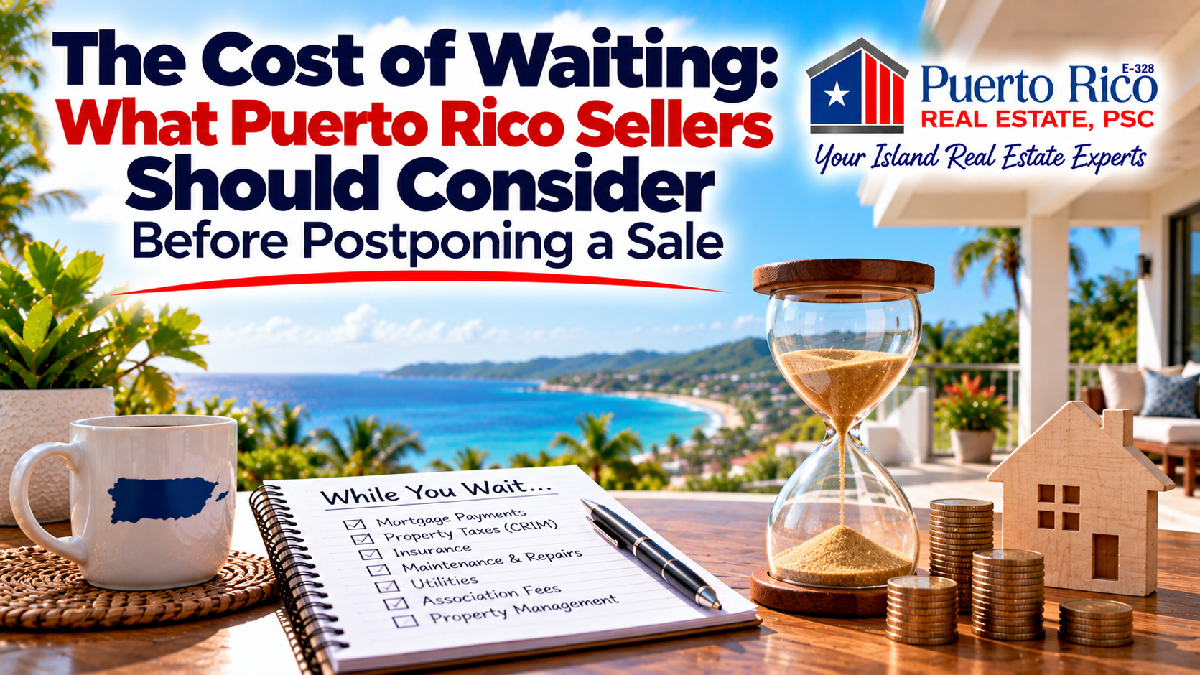
Potential carrying costs may include:
Not every property has every expense.
But most properties cost something to maintain.
Let's use a simple hypothetical example.
Suppose a property costs an average of $1,000 per month between various ownership expenses.
Waiting another year costs approximately:
$12,000.
If it costs $1,500 per month:
$18,000.
At $2,000 per month:
$24,000.
That doesn't mean you should sell.
But if you're waiting because you hope the property will be worth more next year, those costs belong in the calculation.
This is where owners can accidentally fool themselves.
Imagine your property could sell for approximately $350,000 today.
You decide to wait because you believe it may be worth $365,000 next year.
If that happens, the property's value increased by $15,000.
Sounds good.
But what if you spent $18,000 carrying the property during that year?
The increase in value doesn't exist in isolation.
And that's before considering selling costs, taxes, repairs or other circumstances.
Of course, the opposite could happen.
The property might appreciate substantially.
It could remain roughly flat.
Or market conditions could become less favorable.
Nobody can guarantee what your property will be worth next year.
That's why the decision should not be based solely on the assumption that waiting automatically produces a higher sale price.
How much?
If you're waiting for a higher price, define what you're waiting for.
Five percent?
Ten percent?
$25,000?
$100,000?
And why do you believe that increase will occur?
This doesn't mean you need to become a market economist.
But there should be more behind the decision than:
"Real estate always goes up."
Real estate markets don't move uniformly.
Puerto Rico itself isn't one single real estate market.
San Juan can behave differently from Mayagüez.
Dorado can behave differently from Moca.
Rincón can behave differently from Cabo Rojo.
Even two neighborhoods within the same municipality can attract different buyers and experience different levels of demand.
Before waiting for a future price, first understand today's price.
Our Puerto Rico property pricing strategy guide explains why local comparable properties matter more than broad assumptions about “the market.”
You can't intelligently compare selling today with selling later if you don't know your starting point.
And an online estimate may not provide enough information.
As we discussed in Article #5, “What Is My Puerto Rico Property Worth? Why Online Estimates Don't Tell the Whole Story,” properties in Puerto Rico can be difficult to evaluate using an algorithm alone.
Condition matters.
Exact location matters.
Land matters.
Views matter.
Improvements matter.
Solar systems can matter.
Generators can matter.
Access can matter.
Comparable sales matter.
Current competing listings matter.
Buyer demand matters.
A Comparative Market Analysis can help you understand where the property may currently sit within its local market.
Knowing today's probable market position gives you something concrete against which to compare the future.
This deserves special attention.
An occupied property receives regular attention.
Someone notices when:
A faucet leaks.
The air conditioner stops working.
A strange smell appears.
A window begins allowing water inside.
Vegetation becomes overgrown.
An electrical problem develops.
A vacant property may not have that advantage.
A small issue can sit unnoticed for weeks or months.
Then the owner returns and discovers a much larger problem.
Puerto Rico's tropical environment doesn't stop working because nobody is home.
Heat.
Humidity.
Rain.
Vegetation.
Salt air near the coast.
Storms.
Insects.
Time.
If you're keeping a vacant property solely because you haven't gotten around to selling it, the risk of deferred maintenance belongs in the cost-of-waiting calculation.
Suppose you live in New York and own a house in Puerto Rico.
You visit twice a year.
Each visit includes another list.
Cut the vegetation.
Fix the water issue.
Check the generator.
Clean the property.
Pay someone to inspect the roof.
Replace an appliance.
Handle another problem.
Then you fly home.
Six months later, repeat.
At some point, the property can begin managing you instead of the other way around.
Our guide to selling Puerto Rico property while living off-island explains how owners can begin evaluating a sale even when they don't live on the Island.
We also covered this directly in Article #4, “Selling a Home in Puerto Rico From the Mainland: What Owners Need to Know.”
Waiting may still be worthwhile.
But the inconvenience, travel and remote-management burden should be part of the decision.
This connects directly with our previous article.
Maybe you own a vacation home in Puerto Rico.
You love it.
But you used it only twice this year.
You're paying to maintain an entire property for a few weeks of use.
Our Article #10, “Selling a Vacation Home or Second Home in Puerto Rico: What Owners Should Know,” asked owners to consider whether the property still fits their lives.
If you're waiting because:
"Maybe we'll use it more next year,"
look honestly at the last several years.
Are you actually using it more?
Or is “next year” becoming a recurring explanation for maintaining a property you no longer need?
Again, there is nothing wrong with keeping a vacation home because you love owning it.
That's a perfectly legitimate reason.
The important thing is knowing why you're keeping it.
Inherited property is another common example.
A family inherits Mom's house.
Nobody wants to make a decision immediately.
Understandably.
Six months pass.
Then a year.
The house sits.
Everyone is busy.
One sibling lives in Florida.
Another lives in Puerto Rico.
Another wants to keep the property but isn't using it.
Meanwhile:
Vegetation grows.
Utilities continue.
Maintenance is delayed.
Property issues may develop.
Family members may disagree about expenses.
The emotional difficulty of selling can unintentionally turn into years of carrying a property nobody is actually using.
Our Article #6, “Selling an Inherited Property in Puerto Rico: What Families Should Know,” discusses why families should first clarify ownership, condition and goals before deciding what happens next.
Waiting can be appropriate.
But indefinite waiting can make both the property and the family decision more complicated.
Sometimes owners aren't simply waiting.
They're preparing.
"We'll sell after we remodel the kitchen."
Then the kitchen becomes the bathrooms.
Then the bathrooms become flooring.
Then exterior painting.
Then landscaping.
Six months later, the property still isn't listed.
And the seller has spent $40,000.
That's why our Article #9, “Should You Renovate Before Selling Your Puerto Rico Home—or Sell It As-Is?”, encouraged owners to speak with a real estate professional before beginning major improvements.
Some work may absolutely make sense.
Other work may simply delay the sale and increase the seller's investment without generating an equivalent increase in market value.
Preparation should have a purpose.
Sellers naturally want the best possible market.
Who wouldn't?
But how will you know when it arrives?
Imagine prices rise 5%.
Do you sell?
Or think:
"Maybe they'll rise another 5%."
They rise again.
Now what?
"Maybe I'll wait one more year."
At some point, trying to identify the absolute top of a market becomes speculation.
A more practical question is:
Does selling under today's conditions accomplish what I need it to accomplish?
If yes, that deserves consideration.
If no, waiting may be reasonable.
The decision doesn't require perfectly predicting the future.
It's important to be balanced.
Waiting is not automatically bad.
There are circumstances where postponing a sale may make sense.
Perhaps you're completing necessary title work.
Maybe the property is currently occupied under an arrangement that makes immediate selling impractical.
Perhaps you need time to organize an inherited estate.
Maybe you're actively using the property.
Perhaps you're completing a limited improvement that has a clear purpose.
You may simply not be emotionally or financially ready.
Or maybe today's market doesn't align with your goals.
Those can all be legitimate reasons.
The point isn't:
“Sell immediately.”
The point is:
“Know why you're waiting.”
Instead of saying:
"Maybe we'll sell next year."
try:
"We'll reassess the property in January after we complete the roof repair and obtain a current market analysis."
That's a plan.
Or:
"We're keeping the property for another year because our family will use it for three extended trips."
That's a reason.
Or:
"We need six months to resolve the inheritance documentation before deciding."
That's a process.
Compare those with:
"We're just waiting."
Waiting without a goal can continue indefinitely.
If you aren't ready to sell today, put a date on the calendar to reevaluate.
Three months.
Six months.
January 1.
After the holidays.
After a family meeting.
After a specific repair.
When that date arrives, ask again:
Do we still want this property?
How much did it cost us to keep?
How much did we use it?
Has the property's condition changed?
Has the market changed?
What is it worth now?
Are we closer to selling—or simply postponing again?
That creates accountability without forcing a decision today.
This is more personal than strictly real estate.
Suppose selling the property would free substantial equity.
What would you do with that money?
Pay down debt?
Buy another property?
Invest elsewhere?
Fund retirement?
Help your children?
Start a business?
Travel?
Keep it in cash?
There isn't one correct answer.
And we're not financial advisers.
But capital tied up in a property is still capital tied up in a property.
If you are no longer using the asset and have another purpose for the equity, that belongs in your broader conversation with the appropriate financial and tax professionals.
The decision isn't only:
“What might this house be worth next year?”
It can also be:
“What could I do with the equity if I sold it this year?”
This is difficult to put into numbers.
Every few weeks:
"We need to figure out what we're doing with that house."
Every family gathering:
"Are we selling Mom's property?"
Every storm:
"Did someone check the house?"
Every bill:
"Why are we still paying for this?"
Every repair:
"How much more are we going to put into it?"
A property can become unfinished business.
Sometimes owners underestimate how much mental space that consumes.
Selling isn't always the answer.
But making a decision—either to keep the property intentionally or begin preparing to sell—can remove uncertainty.
Tax considerations can absolutely affect the timing of a sale.
Depending on the property and owner, relevant issues may involve acquisition history, improvements, ownership structure, residency, property use, capital gains and other factors.
These circumstances can be complicated, particularly when Puerto Rico and U.S. tax considerations interact.
A general real estate article cannot tell you whether selling this year or next year produces the better tax result for your specific situation.
That conversation belongs with a qualified CPA, tax attorney or other appropriate tax professional.
If tax timing is one of the reasons you're considering waiting, get actual professional advice rather than assuming next year will automatically be better.
Our guide to taxes, fees and closing costs when selling Puerto Rico property provides a useful general starting point, but individual advice should come from the appropriate professional.
This is one of the most useful things sellers can do.
You can prepare without listing.
Gather documents.
Find the deed.
Organize property information.
Review outstanding maintenance.
Determine ownership.
Speak with family members.
Create a list of improvements.
Understand selling costs.
Get a Comparative Market Analysis.
Talk with your tax professional.
Ask questions.
None of those actions require you to place the property on the market tomorrow.
But if you eventually decide to sell, you'll be far better prepared.
Our step-by-step Puerto Rico seller guide can help you understand the process before you're ready to begin it.
Take a piece of paper.
Or open a spreadsheet.
Write down:
Estimated current property value
Then:
Monthly ownership costs
Multiply those costs by 12.
Add:
Expected repairs.
Planned improvements.
Travel.
Property management.
Other likely expenses.
Now ask:
What would need to happen over the next 12 months for keeping the property to make sense to me?
Notice the wording.
Not:
"Will prices go up?"
But:
“What would need to happen for waiting to be worthwhile for me?”
Maybe your answer is financial.
Maybe it's personal.
Maybe your family wants one more year together at the property.
That's okay.
Not every real estate decision has to be reduced to a spreadsheet.
But understanding the numbers helps you make the emotional decision with your eyes open.
Before saying “next year,” ask yourself:
1. Why am I waiting?
Can you state the reason clearly?
2. What will it cost me to wait another year?
Include more than the mortgage.
3. What am I expecting to be different next year?
Price? Family situation? Repairs? Documentation?
4. What happens if that change never occurs?
Would you wait another year?
5. If I knew I could sell at a price that worked for me today, would I still want to keep the property?
That final question can reveal a lot.
You don't need to be 100% certain that you want to sell before speaking with us.
In fact, sometimes the most useful conversation happens before you've decided.
At Puerto Rico Real Estate, PSC, we can help you better understand:
We're not here to tell every owner:
"You need to sell now."
That's your decision.
Our job is to help you understand the real estate side well enough to make that decision intelligently.
Maybe you sell.
Maybe you wait.
Maybe you decide to keep the property for another five years.
But at least you'll know why.
There may never be a perfect time.
The market changes.
Interest rates change.
Buyer demand changes.
Your property changes.
Your finances change.
Your family changes.
Your plans change.
Trying to make every variable perfect can keep you waiting indefinitely.
A more useful question may be:
“Does selling this property now make sense for my situation?”
If the answer is no, waiting may be completely reasonable.
If the answer is yes, waiting simply because “maybe it'll be worth more next year” deserves a closer look.
Because waiting has a cost.
Sometimes that cost is worth paying.
Sometimes it isn't.
The important thing is knowing the difference.
You don't have to make the decision today.
Start with information.
Let's look at the property.
Let's discuss its condition.
Let's examine comparable properties.
Let's estimate where it may currently sit within the market.
Then compare that information with what it costs you to keep the property and what you hope to accomplish by waiting.
From there, you decide.
Puerto Rico Real Estate, PSC
Lic. E-328
📞 787-244-6364
📧 [email protected]
🌐 ThePuertoRicoRealEstate.com
Your Island Real Estate Experts
This article provides general real estate information and is not financial, tax, legal, appraisal or investment advice. Property values and market conditions can change, and future appreciation or sale prices cannot be guaranteed. Consult the appropriate qualified professionals regarding your individual financial, legal and tax circumstances.
Complete Puerto Rico Seller Guide
Selling Real Estate in Puerto Rico – Complete Seller Guide
Puerto Rico Property Pricing Strategy
How Do I Price My Property Right in Puerto Rico?
Comparative Market Analysis
Using a CMA to Price Your Home Effectively
Selling While Living Off-Island
Sell Your Puerto Rico Home While Living Off-Island
Cost to Sell Property in Puerto Rico
How Much Does It Cost to Sell Property in Puerto Rico?
Taxes, Fees and Closing Costs
Taxes, Fees & Closing Costs When Selling Property in Puerto Rico
Step-by-Step Puerto Rico Seller Guide
How to Sell Property in Puerto Rico Step-by-Step
#PuertoRicoRealEstate #SellPropertyPuertoRico #PuertoRicoProperty #HomeSellingTips #PuertoRicoSellers #SellYourHome #PropertyValue #PuertoRicoHomes #SellingPuertoRico #PuertoRicoRealtor #RealEstatePuertoRico #PuertoRicoRealEstatePSC
Your satisfaction guides our every step. Thanks for choosing PRRE. View all.
"Thank you for your service great teamwork I completely appreciate your time and all your effort thanks again"
You were so much help. Thank you for staying on top of things with me.
The closing was straightforward and completed without incident. The buyers were wonderful. Thank you.
The closing was straightforward and completed without incident. The buyers were wonderful. Thank you
I received your listing in email and just wanted to thank you for the EXCELLENT information. You included not only the correct location, but good, quality video/photos, everything. It's not exactly what I need but: A rare thing to get such a quality listing information, just wanted to say thank you.
Everything went smooth and great at closing, you were such a great help in the process. I will refer you to a friend that needs your help. Thanks alot for all you did for me.
Thanks to all of you, super attention, you explained everything very kindly and the Lcda was also super kind. All excellent more than grateful for everything!!
Everything super good, they treated us very well and everything went well with the closing. Everyone was very nice and the Lcda was very kind to us. Thanks to you and your team who treated us very well and never let us go. I will recommend you and hope to call you soon to find a property.
Closing Done, only took an hour.No problems it went smooth. Thanks again for everything! Having a drink to celebrate.
Very Smooth Transaction. Your Team was very supportive and they helped me alot during the transaction.