Selling a property in Puerto Rico is different from selling real estate in the mainland United States. The island operates under a civil law system that places heavy importance on documentation, notarial oversight, and proper registration within the Property Registry. For many sellers — especially those who purchased property years ago or inherited it — the legal requirements can feel overwhelming.
This is where working with an experienced local brokerage like Puerto Rico Real Estate, PSC becomes essential. Our team understands how to prepare sellers ahead of time, avoid costly delays, and ensure that every document required for closing is organized properly.
If you are planning to sell your property, understanding three key areas is critical:
The documents required to sell a home
The role of attorneys and notaries in Puerto Rico
Special considerations for non-resident or off-island sellers
Let’s break each one down so you know exactly what to expect.
Selling Real Estate in Puerto Rico: A Complete Seller's Guide
One of the most common questions sellers ask is: “What paperwork do I need before I can sell?” The answer depends on your property type, ownership structure, and tax status — but there are several core documents that almost every transaction requires.
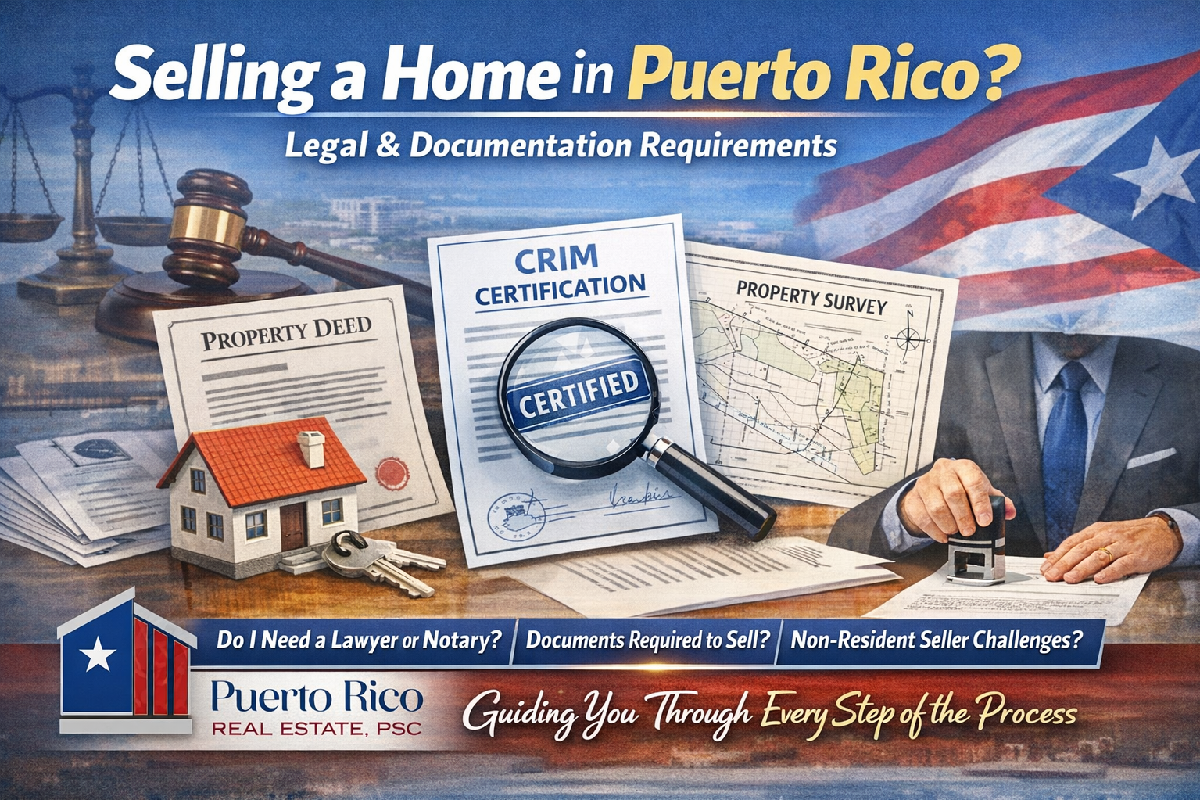
Your property deed is the foundation of the sale. It proves ownership and contains legal descriptions of the property. In Puerto Rico, deeds must match the information recorded in the Property Registry. If there are discrepancies — such as outdated names or missing information — they must be resolved before closing.
The CRIM (Centro de Recaudación de Ingresos Municipales) certification verifies property tax status. Buyers and lenders typically require proof that taxes are current and that no outstanding balances exist. Preparing CRIM documents early prevents last-minute delays.
If you’ve already read our article “What Documents Do I Need to Sell My House in Puerto Rico?”, you know that CRIM compliance is one of the most important steps — and one of the most common causes of closing delays when overlooked.
While not always required, surveys are often requested to confirm boundaries and square meters — especially for land sales or rural properties. Having an updated survey can significantly strengthen buyer confidence.
For condominiums or gated communities, sellers must provide proof that association fees are current. These clearances are mandatory for many closings.
If the property has a mortgage or any registered liens, documentation showing balances and payoff instructions must be prepared in advance.
Transparency builds trust. Providing accurate information about the property’s condition, improvements, and any known issues protects both the seller and buyer.
For sellers who cannot attend closing — especially those living abroad — a Power of Attorney may be required. This allows a designated person to sign documents on your behalf.
At Puerto Rico Real Estate, PSC, we help sellers assemble these documents early in the process so that when an offer arrives, the transaction moves forward smoothly without unnecessary stress.
Another frequent question we hear is: “Do I really need a lawyer or notary?”
The short answer is yes — because Puerto Rico’s legal system is very different from the mainland United States.
In Puerto Rico, a notary is not just someone who stamps documents. Notaries are licensed attorneys with specialized authority to draft and certify legal deeds. They prepare the final sales deed, verify identities, and ensure that the transaction complies with local laws.
Without a notary, a real estate closing cannot legally take place.
In many U.S. states, title companies manage closings and attorneys may be optional. In Puerto Rico, however, the notary plays a central role in transferring ownership and registering the sale in the Property Registry.
Because of this difference, sellers who move from the mainland often find the process unfamiliar. Our team works closely with trusted attorneys and notaries to make sure every detail is handled correctly.
If you want a deeper understanding, you can also read our related hub article:
“Do I Need a Lawyer or Notary for Closing on My Real Estate in Puerto Rico?”
Puerto Rico attracts many buyers and sellers who live off-island. Whether you moved away years ago, inherited property, or purchased as an investment, selling remotely introduces additional legal considerations.
Non-resident sellers must provide valid identification and may need additional certifications depending on their residency status.
While Puerto Rico has its own tax system, certain transactions involving non-resident sellers may require additional withholding or documentation. Working with professionals familiar with these requirements helps prevent unexpected surprises at closing.
Many off-island properties have older deeds or registry entries that require updates. Common examples include:
Inherited properties where ownership was never fully transferred
Name changes after marriage or divorce
Missing heirs or unresolved succession processes
Our brokerage regularly assists sellers in navigating these challenges by coordinating with attorneys, notaries, and registry offices.
One advantage of working with Puerto Rico Real Estate, PSC is that we help structure transactions so you don’t always need to travel to Puerto Rico to sell your property. Through powers of attorney and coordinated signing processes, many sellers successfully close from the mainland or abroad.
For more information, you may also want to read:
“Selling Your Puerto Rico Property from the U.S. or Abroad: Here’s How We Make it Easy.”
Legal and documentation requirements can feel overwhelming — but you don’t have to navigate them alone.
Here’s why sellers consistently choose our team:
We understand the unique legal framework of Puerto Rico real estate transactions, including registry requirements, CRIM certifications, and notarial processes.
Our connections with attorneys, notaries, surveyors, and lenders help streamline every stage of the sale.
Instead of waiting until closing, we help sellers prepare documentation early — reducing delays and increasing buyer confidence.
Whether you live on the island or abroad, we provide consistent updates so you always know what’s happening with your sale.
Beyond legal guidance, we also provide comprehensive marketing strategies designed to attract serious buyers and help your property sell faster.
Many sellers unintentionally create delays by overlooking small but important details. Some of the most common issues include:
Outdated registry information
Missing CRIM certifications
Unpaid HOA balances
Incorrect property descriptions
Incomplete inheritance paperwork
By addressing these issues early, you protect your timeline and avoid last-minute complications.
If you haven’t already, we recommend reading our related guide:
“Top 10 Mistakes Homeowners Make When Selling Property in Puerto Rico (and How to Avoid Them).”
Once you accept an offer, the legal process moves quickly. Having your documents ready allows the notary to prepare the deed efficiently and ensures the buyer’s lender can finalize financing without delays.
At Puerto Rico Real Estate, PSC, our goal is to make this stage feel organized and predictable — not stressful.
We believe that an informed seller is a confident seller, and understanding the legal requirements is one of the most powerful steps you can take before listing your property.
If you’re thinking about selling, the best first step is working with a local team that understands both the legal system and the real estate market.
Puerto Rico Real Estate, PSC is here to guide you from preparation to closing — ensuring your documents are complete, your property is marketed effectively, and your transaction stays on track.
📞 787.244.6364
📧 [email protected]
🌐 www.ThePuertoRicoRealEstate.com
#PuertoRicoRealEstate #SellYourHomePR #PuertoRicoLegalProcess #RealEstatePR #CRIMCertification #PRNotary #HomeSellingTipsPR #PuertoRicoSellers #RealEstateExpertsPR #PuertoRicoProperty
Your satisfaction guides our every step. Thanks for choosing PRRE. View all.
"Thank you for your service great teamwork I completely appreciate your time and all your effort thanks again"
You were so much help. Thank you for staying on top of things with me.
The closing was straightforward and completed without incident. The buyers were wonderful. Thank you.
The closing was straightforward and completed without incident. The buyers were wonderful. Thank you
I received your listing in email and just wanted to thank you for the EXCELLENT information. You included not only the correct location, but good, quality video/photos, everything. It's not exactly what I need but: A rare thing to get such a quality listing information, just wanted to say thank you.
Everything went smooth and great at closing, you were such a great help in the process. I will refer you to a friend that needs your help. Thanks alot for all you did for me.
Thanks to all of you, super attention, you explained everything very kindly and the Lcda was also super kind. All excellent more than grateful for everything!!
Everything super good, they treated us very well and everything went well with the closing. Everyone was very nice and the Lcda was very kind to us. Thanks to you and your team who treated us very well and never let us go. I will recommend you and hope to call you soon to find a property.
Closing Done, only took an hour.No problems it went smooth. Thanks again for everything! Having a drink to celebrate.
Very Smooth Transaction. Your Team was very supportive and they helped me alot during the transaction.