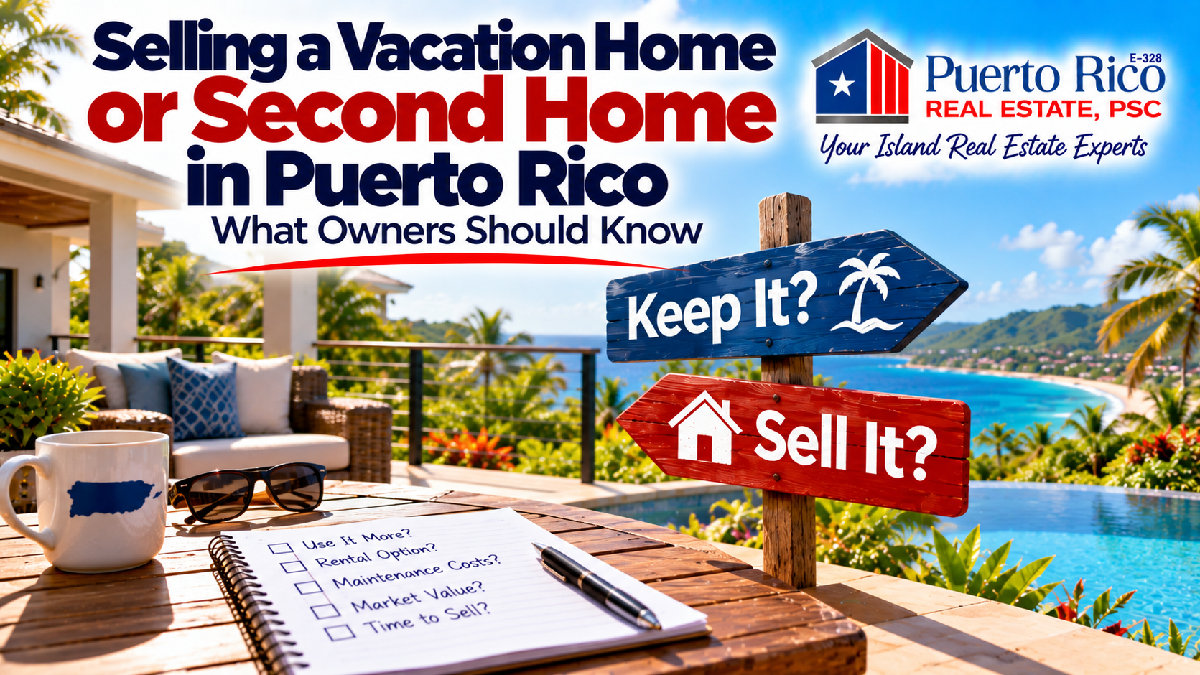
The first few years were easy.
You couldn't wait to get back to Puerto Rico.
Every vacation was planned around the house.
Friends visited.
Family stayed over.
You spent mornings drinking coffee outside and evenings talking about how lucky you were to have a place on the Island.
Then life changed.
Maybe the children got older.
Work became busier.
Flights became another expense.
You started traveling to other places.
Perhaps you retired somewhere else.
Or maybe you simply realized you were spending thousands of dollars each year maintaining a property you were only using for a few weeks.
You still love the house.
But now you're asking:
“Are we really using this enough to keep it?”
If that question has crossed your mind, you're not alone in facing the decision.
Owning a second home can be wonderful.
It can also become expensive, time-consuming and emotionally complicated.
And sometimes the property that once represented freedom begins to feel more like an obligation.
That doesn't automatically mean you should sell.
But it may mean it's time to evaluate the property honestly.
Before deciding whether to sell, go back to the beginning.
Why did you buy it?
Was it supposed to be:
A winter home?
A retirement property?
A place for family vacations?
An investment?
A short-term rental?
A future primary residence?
A place to eventually pass down to your children?
Your original reason matters because your life may no longer match the plan you had when you purchased the property.
Maybe you bought the home ten years ago expecting to retire in Puerto Rico.
Now your grandchildren live near you in Florida, and leaving them for several months every year doesn't feel as appealing.
Perhaps you bought the property when your children were young.
Now they're adults with families and schedules of their own.
The house hasn't changed.
Your life has.
And that's a perfectly reasonable reason to reevaluate ownership.
This can be an uncomfortable question.
You tell yourself:
"We'll use it more next year."
But what happened this year?
And last year?
If you're maintaining a property for 12 months but using it for three weeks, look at the numbers.
That doesn't automatically mean selling is the right decision.
A vacation home can have emotional and lifestyle value far beyond the number of nights you sleep there.
But owners should understand what they're paying for that experience.
If the property costs $12,000, $20,000, $30,000 or more per year to maintain and you're barely using it, the question deserves attention.
Many owners think only about the mortgage.
But the actual carrying cost may include much more.
Potential expenses can include:
One expense may not feel significant.
But add everything together over 12 months.
Then multiply it by five years.
Suddenly the conversation looks different.
This is one reason our guide to the cost of selling property in Puerto Rico is useful when owners begin comparing the cost of keeping a property with the cost of selling it.
You lock the door.
Board the flight.
Go home.
The property stays behind.
Puerto Rico's climate continues working on it.
Sun.
Rain.
Humidity.
Salt air in coastal areas.
Vegetation.
Insects.
Storms.
A tiny leak that appears two days after you leave doesn't care that you won't return for four months.
A vacation property that isn't regularly checked can develop problems without the owner knowing.
Our recent Article #8, “Preparing Your Puerto Rico Home for the End of Hurricane Season,” discussed why regular property checks can be especially important for owners who spend significant time away from the Island.
This may be one of the most important questions for second-home owners.
Do you have someone reliable locally?
A family member?
Neighbor?
Property manager?
Caretaker?
Who notices if:
A pipe leaks?
Electricity goes out?
A window is damaged?
Vegetation becomes overgrown?
The air conditioner stops working?
A storm causes damage?
Someone attempts to enter the property?
A water issue develops?
The longer a property sits without attention, the more likely a small problem can become an expensive one.
If maintaining that local support system has become increasingly difficult, that should be part of your ownership decision.
Not every cost appears on a spreadsheet.
There's also mental cost.
You may be sitting at home in Pennsylvania while a tropical system approaches Puerto Rico.
You're checking weather reports.
Calling neighbors.
Wondering whether the shutters were installed.
Thinking about the roof.
Thinking about the generator.
Wondering if the electricity is on.
You may realize you're spending a surprising amount of emotional energy worrying about a property you're rarely using.
Again, this doesn't mean you should sell.
But it belongs in the conversation.
Ownership should ideally add something positive to your life.
If the property has become primarily a source of worry, it may be time to reconsider what role it should play in your future.
This is a common alternative.
And for some owners, renting the property can make sense.
But turning a second home into a rental is not the same as eliminating responsibility.
Now you may have:
Guests or tenants.
Cleaning.
Repairs.
Scheduling.
Property management.
Insurance considerations.
Tax considerations.
Permitting or registration requirements where applicable.
Condominium or community restrictions.
Local regulations.
Wear and tear.
Emergency calls.
The property may generate income.
But it may also become a small business.
Before deciding that renting is automatically better than selling, understand what operating the property as a rental actually involves.
And if short-term rental use is being considered, verify the rules that currently apply to the specific property and location rather than assuming the use is permitted.
Before deciding whether to keep or sell a vacation property, you need another important piece of information:
What might it realistically be worth in today's market?
Maybe you bought the property for $200,000 years ago.
Maybe you've invested in improvements.
Perhaps the neighborhood has changed.
Maybe comparable properties are selling differently than you expected.
Or perhaps the online estimate you found isn't capturing what makes your property different.
Our Article #5, “What Is My Puerto Rico Property Worth? Why Online Estimates Don't Tell the Whole Story,” was created specifically around this question.
You can also review our guide to using a Comparative Market Analysis to price a Puerto Rico property.
Knowing the property's likely market position doesn't force you to sell.
It simply gives you better information.
Sellers naturally remember what they paid.
They also remember every dollar spent afterward.
"We paid $275,000."
"Then we spent $35,000 on the kitchen."
"The solar system cost another $25,000."
"We furnished the entire house."
All of that matters to you.
But the market doesn't calculate value by simply adding up everything you've spent.
Current value depends on factors such as:
Location.
Condition.
Land.
Living area.
Improvements.
Views.
Amenities.
Comparable properties.
Current competition.
Buyer demand.
Financing considerations.
The price you paid is part of the property's history.
It isn't automatically today's market value.
This question becomes especially relevant with vacation homes.
Maybe the house has looked essentially the same for 15 years.
You visit and think:
"Before we sell, we should redo everything."
Not necessarily.
Our previous Article #9, “Should You Renovate Before Selling Your Puerto Rico Home—or Sell It As-Is?”, explains why sellers should understand the property's likely value and buyer before committing to major renovations.
A vacation property may need:
Cleaning.
Decluttering.
Landscaping.
Minor maintenance.
Paint touch-ups.
Pressure washing.
Removal of old personal belongings.
But a complete remodel?
That requires a much more careful analysis.
Before spending $30,000 or $50,000, determine what the property may be worth without that investment.
Vacation homes are often sold with another complication:
Furniture.
Beds.
Sofas.
Televisions.
Outdoor furniture.
Kitchenware.
Decorations.
Beach equipment.
Tools.
Maybe 15 years of personal belongings.
Sellers need to decide what happens to everything.
Some buyers may appreciate a furnished property.
Others won't want the furniture at all.
Some items may have sentimental value but very little resale value.
Others may need to be removed before marketing.
This is something to discuss early.
Don't wait until the week before closing to discover you need to empty an entire house while living 1,500 miles away.
For a second-home buyer, the ability to purchase a furnished or partially furnished property may be convenient.
Imagine someone flying into Puerto Rico and being able to use the property immediately.
Beds are there.
Living room furniture is there.
Kitchen basics are there.
That convenience may be attractive.
But sellers should be clear about what is actually included.
Don't assume:
"Everything stays."
Create clarity.
Which furniture?
Which appliances?
Which electronics?
Which artwork?
Which outdoor items?
Which personal belongings are excluded?
Clear expectations can prevent misunderstandings later.
A vacation property is often about more than the structure itself.
Maybe the real attraction is:
Five minutes from the beach.
Walking distance to restaurants.
Mountain views.
Ocean views.
A large terrace.
Proximity to BQN.
Access to SJU.
Golf.
A quiet rural setting.
A gated community.
A marina.
A town plaza.
Surfing.
Fishing.
Hiking.
A large parcel of land.
When marketing a second home, we want buyers to understand not only what the property is, but what owning it could allow them to experience.
That's especially important when reaching buyers who currently live outside Puerto Rico.
This creates an interesting cycle.
Perhaps you live in Florida and own a vacation home in Puerto Rico.
You're ready to sell.
Your eventual buyer may live in New York.
Or New Jersey.
Texas.
Pennsylvania.
Massachusetts.
Or somewhere else entirely.
Our Article #7, “Why Fall Can Be a Great Time to Attract Mainland Buyers to Your Puerto Rico Property,” explains why photography, video, digital marketing and location storytelling become particularly important when the buyer is searching from far away.
The buyer may first experience your property through a phone.
That's why the marketing needs to do more than simply list bedrooms and bathrooms.
A vacation property is partly an emotional purchase.
Buyers want to understand the physical property.
But they may also be imagining:
Morning coffee on the balcony.
Walking to the beach.
Family visiting during Christmas.
Escaping winter.
Retiring.
Spending summers with the grandchildren.
Working remotely.
That's why photography should communicate both property and lifestyle without becoming misleading.
If there's an ocean view, show the actual view.
If the beach is nearby, accurately describe the distance.
If the property has a terrace, show how it relates to the house.
If the yard is one of the strongest features, don't hide it behind ten photographs of the kitchen.
Good marketing identifies what makes the property special and builds the presentation around it.
A mainland buyer can't always jump on a plane tomorrow.
Video allows that buyer to understand:
Layout.
Room connections.
Outdoor space.
Property flow.
Views.
Street appearance.
Lot characteristics.
Surroundings.
At Puerto Rico Real Estate, PSC, video is an important part of how we market properties because today's buyer can begin evaluating a Puerto Rico home from almost anywhere.
The goal isn't to make a property look like something it isn't.
It's to help the right buyer understand why it may deserve a closer look.
One of the biggest reasons second-home owners postpone selling is logistics.
"We live in the States. How are we supposed to handle everything?"
This is exactly why we created Article #4, “Selling a Home in Puerto Rico From the Mainland: What Owners Need to Know.”
You can also review our guide to selling Puerto Rico property while living off-island.
You may not need to fly to Puerto Rico simply to begin exploring a sale.
A local real estate professional can help evaluate the property, discuss its condition, coordinate marketing and showings, communicate with buyers and help organize the real estate side of the process while other appropriate professionals handle legal, tax, title and closing matters.
Specific closing requirements depend on the transaction and should be confirmed with the appropriate professionals.
There's an interesting pattern with second homes.
Owners sometimes wait until they're frustrated.
They've paid another insurance bill.
Something broke.
The yard needs work again.
A storm caused damage.
They haven't visited in 18 months.
Suddenly they say:
"Just get rid of it."
That's not necessarily the best emotional position from which to make a major financial decision.
If you're beginning to question whether you still want the property, evaluate your options before frustration takes over.
Find out what it's worth.
Understand the selling costs.
Review potential tax implications with the appropriate professional.
Look at the condition.
Consider the carrying costs.
Then make a decision calmly.
Selling a second home or vacation property can have tax consequences.
The specific result may depend on factors including ownership structure, residency, how the property was used, acquisition history, improvements, sale price and other circumstances.
Puerto Rico and U.S. tax considerations can also be complex.
This is not an area where sellers should rely on a general real estate article or assumptions from a friend.
Before making significant tax decisions, consult the appropriate CPA, tax attorney or other qualified tax professional familiar with your circumstances.
Real estate professionals can help sell the property.
We don't replace your tax adviser.
Some second homes and investment properties may be held through a legal entity rather than directly by an individual.
That can affect the documentation and professionals involved in the transaction.
If your property is owned by an LLC, corporation, trust or other entity, identify that early.
Don't wait until a buyer is ready to close before discovering that additional documentation, authorizations or professional review may be required.
The earlier these questions are identified, the more time you have to address them appropriately.
Maybe the vacation house belongs to siblings.
Or cousins.
Perhaps it began as Mom and Dad's property and eventually became a family second home.
Now five people have opinions.
One wants to keep it.
One wants to sell.
One wants to rent it.
One hasn't visited in ten years.
One says:
"Whatever everyone else wants."
Shared ownership can make a decision more complicated.
Before marketing the property, understand who owns it and who has authority to make decisions regarding the sale.
If the property came through inheritance, our Article #6, “Selling an Inherited Property in Puerto Rico: What Families Should Know,” addresses this situation in greater detail.
Legal questions about ownership and authority should be addressed with the appropriate Puerto Rico attorney/notary or other qualified professional.
This may be the most important question.
Forget the market for a moment.
Forget what you paid.
Forget what your neighbor sold for.
Ask yourself:
If I didn't already own this property, would I buy it today?
That's an interesting test.
Would you willingly take on:
The expenses?
Maintenance?
Travel?
Responsibility?
Worry?
Time?
If the answer is yes, keeping it may still make sense for you.
If the answer is:
"Probably not."
then it may be worth understanding what selling would look like.
Not because you have to sell.
But because sometimes we continue owning something simply because we've owned it for a long time.
You don't need to put the property on the market tomorrow.
Start with information.
First: Determine the property's likely market value.
Second: Calculate what it costs you to keep the property each year.
Third: Evaluate its current physical condition.
Fourth: Decide whether any maintenance or improvements are actually necessary.
Fifth: Gather property documents.
Sixth: Discuss tax or legal questions with the appropriate professionals.
Seventh: Understand the likely costs of selling.
Eighth: Think honestly about whether the property still fits your life.
Then make the decision.
That's very different from selling because you're frustrated after receiving another repair bill.
Second-home sellers often need more than someone to place a listing online.
They may need a local professional who can help bridge the distance between the owner, the property and the buyer.
At Puerto Rico Real Estate, PSC, we can help with:
We understand that selling a second home can be different from selling the house you live in every day.
You may not be here.
The property may have sentimental value.
You may be uncertain whether you even want to sell.
That's okay.
The first conversation doesn't have to begin with:
"When can we list it?"
It can begin with:
“Here's my property. Help me understand my options.”
This deserves to be said.
Selling your vacation home doesn't mean you stopped loving Puerto Rico.
It doesn't erase the mornings on the terrace.
The family dinners.
The trips to the beach.
The holidays.
The neighbors.
The memories.
A property can be part of an important chapter of your life without needing to remain part of every chapter that follows.
Sometimes circumstances change.
And sometimes selling a property allows another family to begin creating their own memories there.
That's not necessarily an ending.
It can simply be the next chapter.
You don't have to make the decision today.
Start by finding out what the property may realistically be worth, what condition it's in, what the selling process could involve and whether keeping it still makes sense for your life.
Then decide.
Puerto Rico Real Estate, PSC
Lic. E-328
📞 787-244-6364
📧 [email protected]
🌐 ThePuertoRicoRealEstate.com
Your Island Real Estate Experts
This article provides general real estate information and does not constitute legal, tax, accounting, insurance or financial advice. Ownership, residency, entity, rental and tax circumstances vary. Consult the appropriate Puerto Rico attorney/notary, CPA, tax professional, insurance professional or other qualified adviser regarding your specific circumstances.
Complete Puerto Rico Seller Guide
Selling Real Estate in Puerto Rico – Complete Seller Guide
Selling While Living Off-Island
Sell Your Puerto Rico Home While Living Off-Island
Comparative Market Analysis
Using a CMA to Price Your Home Effectively
Pricing Your Puerto Rico Property
How Do I Price My Property Right in Puerto Rico?
Determine the Right Asking Price
How to Determine the Right Asking Price for Puerto Rico Property
Preparing Your Home for Sale
How to Prepare Your Puerto Rico Home for Sale
Cost to Sell Property
How Much Does It Cost to Sell Property in Puerto Rico?
Taxes, Fees and Closing Costs
Taxes, Fees & Closing Costs When Selling Property in Puerto Rico
#PuertoRicoRealEstate #VacationHome #SecondHome #SellPropertyPuertoRico #PuertoRicoProperty #PuertoRicoHomes #SellingPuertoRico #VacationProperty #PuertoRicoRealtor #SellYourHome #RealEstatePuertoRico #PuertoRicoRealEstatePSC
Your satisfaction guides our every step. Thanks for choosing PRRE. View all.
"Thank you for your service great teamwork I completely appreciate your time and all your effort thanks again"
You were so much help. Thank you for staying on top of things with me.
The closing was straightforward and completed without incident. The buyers were wonderful. Thank you.
The closing was straightforward and completed without incident. The buyers were wonderful. Thank you
I received your listing in email and just wanted to thank you for the EXCELLENT information. You included not only the correct location, but good, quality video/photos, everything. It's not exactly what I need but: A rare thing to get such a quality listing information, just wanted to say thank you.
Everything went smooth and great at closing, you were such a great help in the process. I will refer you to a friend that needs your help. Thanks alot for all you did for me.
Thanks to all of you, super attention, you explained everything very kindly and the Lcda was also super kind. All excellent more than grateful for everything!!
Everything super good, they treated us very well and everything went well with the closing. Everyone was very nice and the Lcda was very kind to us. Thanks to you and your team who treated us very well and never let us go. I will recommend you and hope to call you soon to find a property.
Closing Done, only took an hour.No problems it went smooth. Thanks again for everything! Having a drink to celebrate.
Very Smooth Transaction. Your Team was very supportive and they helped me alot during the transaction.