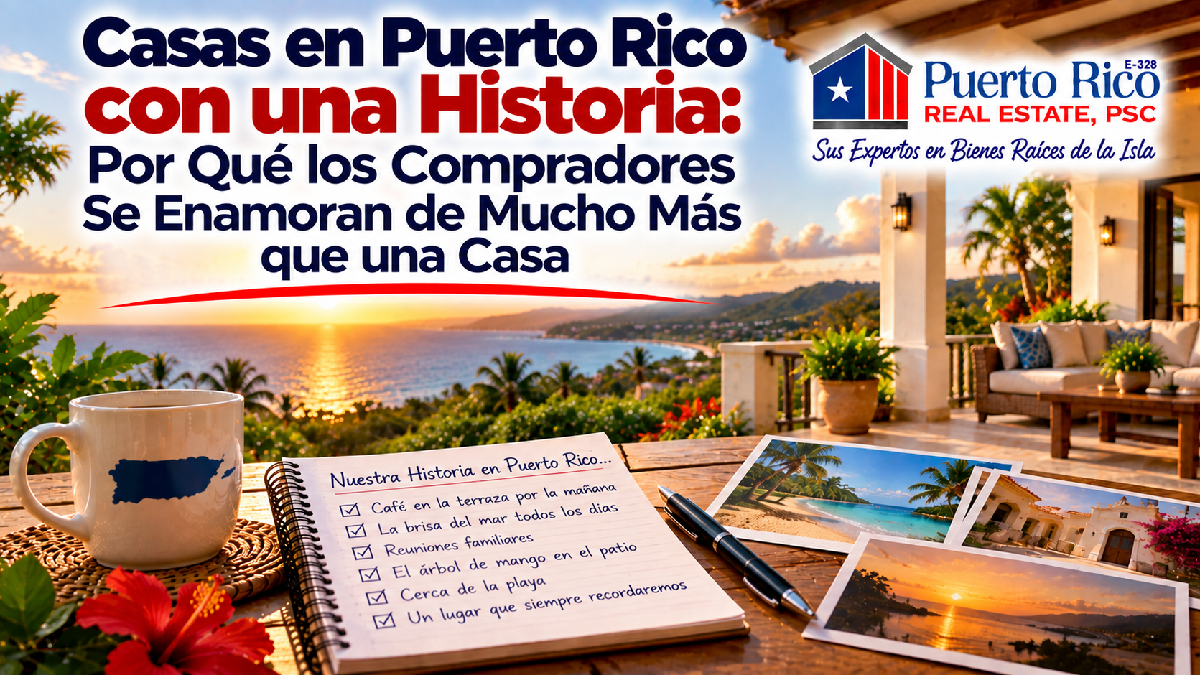
Ask ten people why they want to live near the ocean and you'll probably receive ten different answers.
Some want to surf before work.
Others want to retire somewhere they can walk along the beach every morning.
Some buyers want a second home where their family can escape during the winter.
Others dream about owning a vacation property they can enjoy themselves while potentially generating rental income when they're away, subject to applicable laws, permits and community restrictions.
Some simply want to slow down.
And then there are Puerto Ricans living outside the island who dream about coming home—and when they imagine that return, they may picture themselves living closer to the water.
These motivations are emotional.
But they're also powerful drivers of real estate decisions.
Puerto Rico offers something difficult to duplicate elsewhere: tropical coastal living combined with established communities, infrastructure, culture and tremendous geographic variety within a relatively small island.
From the Atlantic coastline along the north to the Caribbean waters of the south, every coastal area has its own personality.
That's why sellers need to understand something very important:
You aren't simply competing with another three-bedroom house. You're competing for a buyer's dream.
If you're beginning to consider selling, our complete guide to selling real estate in Puerto Rico is a good place to understand how pricing, preparation, marketing and closing all work together.
This may sound obvious, but it matters tremendously when marketing coastal real estate.
A property directly touching the beach is different from a property across the street from the beach.
An oceanfront condominium is different from a condominium with a partial ocean view.
A house where you can walk to the beach in three minutes is different from one requiring a fifteen-minute drive.
All of them may be desirable.
But they shouldn't be marketed as though they're identical.
Buyers searching specifically for coastal property often pay close attention to these distinctions.
They want to know:
Can I walk directly onto the sand?
Can I actually see the ocean from inside the home?
Is the view protected or could something eventually block it?
How far is the beach?
Is the property elevated?
Is there public beach access nearby?
What does the surrounding neighborhood feel like?
Is the area busy or quiet?
The more accurately we describe the relationship between the property and the ocean, the more confidence we create.
Good marketing doesn't need to exaggerate.
The truth, presented well, is powerful enough.
When someone says they want to live near the beach in Puerto Rico, that still doesn't tell us exactly what they're looking for.
Consider the difference between coastal communities.
A buyer attracted to Rincón may be looking for surf culture, sunsets, restaurants and a relaxed west-coast lifestyle.
Someone considering Isabela may want beaches, surfing, larger properties and convenient access to Rafael Hernández International Airport in Aguadilla.
A buyer looking in Aguadilla may value proximity to beaches such as Crash Boat along with airport access, shopping and everyday services.
Someone interested in Dorado may be seeking a different combination of luxury, resort-style amenities and accessibility to the San Juan metropolitan area.
A buyer considering Condado or Isla Verde may want urban coastal living with restaurants, nightlife, condominium amenities and proximity to the airport.
Cabo Rojo attracts buyers for another combination of beaches, boating, recreation and southwest Puerto Rico lifestyle.
Arecibo's coastline can appeal to buyers searching for dramatic oceanfront settings, surfing, larger parcels and opportunities outside the island's more heavily marketed resort areas.
These aren't interchangeable markets.
And that's precisely why local knowledge matters.
When you've lived somewhere for years, extraordinary things can begin to feel ordinary.
You stop noticing them.
The beach five minutes away?
You've driven past it a thousand times.
That view from the balcony?
You've seen it every morning for twelve years.
The sound of the waves at night?
It's just part of life.
The marina nearby?
You've forgotten that someone moving from the mainland may consider that an enormous lifestyle benefit.
Sellers sometimes become so familiar with their surroundings that they fail to recognize what an outsider will find special.
This is where storytelling becomes important.
If the property is three minutes from a popular surfing beach, say so.
If you can watch the sunset from the balcony, show it.
If the buyer can walk to restaurants, explain that.
If there's space to store surfboards, kayaks or beach equipment, that's relevant.
If an airport is conveniently nearby, that's valuable to a second-home buyer.
If the community feels quiet even though major attractions are close, explain the contrast.
These aren't meaningless details.
They're reasons someone chooses your property instead of another one.
Real estate is financial.
But it is also deeply emotional.
Think about how people shop for beachfront property.
They see a photograph of the ocean.
They imagine themselves standing there.
They picture breakfast on the balcony.
They think about their children playing on the beach.
They imagine friends visiting.
They picture escaping February weather somewhere else.
Then they start studying the numbers.
Price.
HOA.
Taxes.
Insurance.
Financing.
Maintenance.
Potential rental income.
This doesn't mean financial considerations are unimportant.
Quite the opposite.
But emotion often creates the initial connection.
That's why the first few photographs and opening lines of a coastal property listing matter so much.
We need to answer:
“Why should I want to be here?”
before expecting the buyer to spend twenty minutes studying every property detail.
Coastal properties have a natural marketing advantage.
They're visually interesting.
But that advantage can easily be wasted.
A dark photograph of the living room isn't going to communicate coastal living.
Neither will a photograph where the ocean is technically visible as a tiny blue strip through a window.
If the view is important, show the view.
If there's direct beach access, show the path from the property to the beach.
If the balcony is where someone will spend their mornings, photograph it in a way that communicates that experience.
If the property has a beautiful sunset orientation, capture it.
If the exterior spaces are designed for entertaining, show how they relate to the ocean.
The goal isn't to manipulate the buyer.
It's to accurately communicate what makes the property special.
Photographs capture moments.
Video captures movement.
And the ocean moves.
Waves breaking.
Palm trees moving in the breeze.
Sunlight reflecting across the water.
A balcony door opening to reveal the coastline.
A walk from the condominium to the beach.
Those things are difficult to communicate through photographs alone.
Video can also help an off-island buyer understand the property's layout before scheduling a trip.
How does the living room connect to the balcony?
How close does the ocean actually feel?
What does the surrounding community look like?
How far is the walk to the water?
For someone considering flying to Puerto Rico specifically to see properties, that information can make the difference between:
“Maybe.”
and
“I need to see this one.”
This is one of the most important differences in marketing Puerto Rico real estate.
The eventual buyer may not currently live here.
They may be in Florida.
New York.
Texas.
New Jersey.
Pennsylvania.
California.
Or somewhere else entirely.
That buyer can't casually drive past the property on Saturday afternoon.
Your online presentation becomes their first showing.
They may zoom into every photograph.
Watch the property video repeatedly.
Open Google Maps.
Measure the distance to the airport.
Look up nearby beaches.
Search for supermarkets.
Check restaurants.
Research hospitals.
Study the neighborhood.
That's why detailed digital marketing is particularly important when selling coastal and lifestyle-oriented properties.
At Puerto Rico Real Estate, PSC, we want an off-island buyer to understand enough about a property to become genuinely interested before they ever arrive in Puerto Rico.
Beautiful ocean views attract attention.
But serious buyers eventually ask practical questions.
How is the property constructed?
What condition is the roof in?
Are there storm shutters or impact-resistant windows?
Is there a generator?
Solar?
Battery backup?
A cistern?
How is drainage?
What maintenance does the property require?
If it's a condominium, what does the HOA cover?
Are there community rules?
What are the parking arrangements?
How is insurance handled?
Are there rental restrictions?
Not every question applies to every property.
But sellers should be prepared.
A buyer considering coastal real estate understands that living near saltwater can bring additional maintenance considerations.
Pretending those realities don't exist doesn't build confidence.
Being prepared to discuss them does.
Anyone who has owned property close to the ocean knows this.
Salt air can affect metal.
Gates.
Railings.
Outdoor fixtures.
Air-conditioning equipment.
Vehicles.
Fasteners.
Windows.
Painted surfaces.
This doesn't mean buyers won't want coastal property.
Clearly, they do.
But maintenance matters.
Before listing, take a close look at exterior areas.
Are there obvious signs of corrosion that can be easily addressed?
Do railings need attention?
Does exterior paint need touch-up?
Are fixtures functioning?
Are doors and windows operating properly?
Small maintenance items can influence the overall impression of how the property has been cared for.
Our guide to preparing your Puerto Rico home for sale includes practical preparation ideas that can be especially valuable before professional photographs and showings.
Buyers relocating to Puerto Rico frequently ask about hurricanes.
That's understandable.
Instead of avoiding the subject, help them understand how the property is prepared.
Does the home have storm shutters?
Impact windows?
A generator?
Solar panels with battery storage?
A cistern?
A transfer switch?
Secure storage for outdoor furniture?
Has the roof received recent maintenance?
Are important systems elevated or protected?
These features aren't glamorous in the traditional sense.
But to someone learning how to live in Puerto Rico, they can provide tremendous peace of mind.
A beautiful ocean view creates desire.
Practical resilience can create confidence.
Energy independence has become an important consideration for many Puerto Rico homeowners.
If your coastal property has solar panels and batteries, provide accurate details.
How many panels?
How many batteries?
What brand?
How old is the system?
Is it owned?
Financed?
Leased?
Is there an outstanding balance?
Can the agreement transfer to the buyer?
Don't simply write “has solar.”
Give buyers enough information to understand what they're looking at.
A properly documented energy system can add meaningful appeal, particularly for buyers relocating from places where power reliability isn't something they've had to think about very often.
This is an important distinction.
Sellers sometimes assume:
Near beach = Airbnb.
That isn't necessarily true.
Short-term rental use can depend on applicable Puerto Rico requirements, local rules, condominium regulations, deed restrictions and other considerations.
If the property currently operates as a rental and there is legitimate historical information available, that can be relevant.
But don't advertise hypothetical income as though it's guaranteed.
And don't promise a buyer that a property can legally be operated in a particular way unless that has been properly verified.
A coastal property can be valuable even without becoming a short-term rental.
It may be an incredible primary residence.
Second home.
Retirement property.
Long-term rental.
Family gathering place.
Or simply an asset someone wants to hold for the future.
Good marketing presents possibilities without turning possibilities into promises.
An investor may appreciate the same ocean view as everyone else.
But they'll also ask different questions.
What's the acquisition price?
What are the carrying costs?
What repairs are needed?
What are the insurance costs?
What are the HOA fees?
What rental restrictions exist?
What's the expected maintenance?
How frequently will the property need attention?
What comparable properties are available?
Investors tend to evaluate opportunity through numbers.
That's why the same property may require multiple layers of marketing.
Emotion for the lifestyle buyer.
Practical information for the owner-occupant.
Financial context for the investor.
The property hasn't changed.
The buyer's motivation has.
Two 1,200-square-foot homes can have dramatically different values.
One is inland.
The other is across the street from the ocean.
Or one has a partial ocean view while the other has unobstructed frontage.
One has direct beach access.
Another requires driving fifteen minutes.
One sits in a highly desirable tourism area.
Another is in a quieter coastal community.
Square footage alone cannot explain those differences.
When evaluating coastal property, we may need to consider:
Exact location.
Proximity to the water.
View quality.
Beach access.
Lot size.
Elevation.
Property condition.
Parking.
Additional structures.
Rental history when relevant.
Community characteristics.
Comparable competition.
And buyer demand for that specific area.
This is why automated online valuations can struggle with unique Puerto Rico properties.
Location isn't simply a ZIP code.
Sometimes a few hundred feet can make a meaningful difference.
This can be difficult.
Perhaps your children grew up in the house.
Maybe you've celebrated twenty Christmases there.
Your father built the terrace.
Your family spent every Sunday at the beach.
Those memories are priceless.
But unfortunately, buyers can't pay for them.
The buyer will create their own memories.
Our job when selling is to take the emotional story that makes the property special and translate it into benefits a new buyer can understand—while still pricing the property based on the market.
That's one of the hardest parts of selling a longtime family home.
You don't have to stop loving the property.
You simply need to separate sentimental value from market value.
Not automatically.
A dated beachfront property may still be extremely desirable because the buyer is primarily purchasing the location.
In fact, some buyers would rather renovate according to their own taste.
Before spending substantial money, determine whether the improvement is likely to increase your net proceeds.
Sometimes basic preparation is enough.
Cleaning.
Decluttering.
Exterior maintenance.
Repairing obvious problems.
Fresh paint where necessary.
Improving lighting.
Making outdoor spaces presentable.
Our recent article about whether to repair or sell your Puerto Rico home as-is discusses why sellers should evaluate the likely return before beginning major renovation projects.
Don't spend $30,000 creating someone else's dream kitchen unless the market gives you a compelling reason to do it.
September in Puerto Rico doesn't look like September in much of the mainland United States.
While people elsewhere are beginning to think about colder weather, Puerto Rico still offers warm temperatures, beaches and outdoor living.
That contrast can be powerful.
A potential buyer sitting somewhere where autumn is beginning may see a video of turquoise water, palm trees and a beachfront balcony and think:
“Why don't we live there?”
That's an emotional reaction.
And emotional reactions begin real estate searches every day.
September also gives sellers time to reach buyers considering a move, second-home purchase or investment before the end of the year or during the upcoming winter season.
As we discussed in our article about whether September is a good time to sell your Puerto Rico property, the best selling time depends less on a generic calendar and more on your property, buyer, price and personal goals.
The ocean doesn't solve title problems.
A beautiful beach doesn't replace missing documentation.
And a million-dollar view doesn't make unresolved ownership issues disappear.
Before listing, sellers should begin organizing relevant property records.
Depending on the property, that may include:
Deed information.
CRIM records.
Mortgage information.
Permits.
Surveys.
Condominium documents.
HOA information.
Solar agreements.
Insurance information.
Inheritance documentation when applicable.
Rental-related documentation when relevant.
Our guide to documents needed to sell property in Puerto Rico provides a useful starting point.
The goal is simple:
Discover problems before the buyer does.
A coastal listing deserves more than:
“2 bedrooms, 2 bathrooms, ocean view. Call for showing.”
That's information.
It isn't marketing.
At Puerto Rico Real Estate, PSC, we believe the property needs a story supported by accurate details and broad digital exposure.
Our approach includes:
Property Evaluation — Understanding the home, land, location, condition and characteristics that influence value.
Pricing Strategy — Looking beyond basic square footage to understand how the property competes.
Property Preparation — Helping identify what should be addressed before photographs and showings.
Photography and Video Strategy — Showing buyers what makes the property and location special.
Lifestyle Marketing — Connecting features with the experience they provide.
Digital Exposure — Using online real estate marketing, search-focused content and social media to expand visibility.
Off-Island Buyer Marketing — Recognizing that a strong potential buyer may currently live thousands of miles from Puerto Rico.
Offer Evaluation and Negotiation — Looking beyond price to evaluate terms, financing and likelihood of closing.
Transaction Coordination — Helping guide the process from listing through closing.
We're not simply trying to put another property online.
We're trying to connect the right property with the right buyer.
This is one of the biggest missed opportunities in real estate marketing.
The seller knows the area.
The buyer may not.
You know the beach around the corner is beautiful.
Show them.
You know the airport is convenient.
Explain it.
You know the restaurants nearby.
Mention them.
You know the balcony catches the evening breeze.
Communicate that.
You know there's a marina ten minutes away.
That's valuable to the right buyer.
You know the neighborhood becomes peaceful after sunset.
Tell the story.
Never assume a buyer knows why your location is special.
Help them understand it.
If you own a beachfront home, oceanfront condominium, coastal investment property, beach-adjacent residence, ocean-view home or vacant coastal land in Puerto Rico, the first step doesn't have to be putting it on the market tomorrow.
Start by understanding what you have.
What might it be worth?
Who is likely to buy it?
What should be prepared?
How should it be positioned?
What features should receive the most attention?
What makes your location different?
And how do we reach buyers who are specifically searching for that lifestyle?
Those questions create the foundation for a stronger selling strategy.
Because when someone buys coastal real estate in Puerto Rico, they're often purchasing much more than a property.
They're purchasing mornings by the ocean.
They're purchasing weekends at the beach.
They're purchasing warm evenings outside.
They're purchasing the sound of waves.
They're purchasing the version of their life they've been imagining.
Your job isn't simply to sell the house.
Our job is to help the right buyer see the life that comes with it.
Thinking about selling your coastal property in Puerto Rico?
Let's talk about its value, its potential and how we can position it in front of the buyers most likely to appreciate what makes it special.
📞 787-244-6364
🌐 www.ThePuertoRicoRealEstate.com
Puerto Rico Real Estate, PSC — Helping sellers turn exceptional properties into opportunities buyers can see themselves living.
#PuertoRicoRealEstate #PuertoRicoBeachfront #CoastalLivingPuertoRico #BeachfrontProperty #OceanfrontPuertoRico #PuertoRicoHomesForSale #SellPropertyPuertoRico #PuertoRicoSellers #BeachHousePuertoRico #OceanViewHomes #MoveToPuertoRico #LivingInPuertoRico #InvestInPuertoRico #CaribbeanRealEstate #ThePuertoRicoRealEstate
Your satisfaction guides our every step. Thanks for choosing PRRE. View all.
"Thank you for your service great teamwork I completely appreciate your time and all your effort thanks again"
You were so much help. Thank you for staying on top of things with me.
The closing was straightforward and completed without incident. The buyers were wonderful. Thank you.
The closing was straightforward and completed without incident. The buyers were wonderful. Thank you
I received your listing in email and just wanted to thank you for the EXCELLENT information. You included not only the correct location, but good, quality video/photos, everything. It's not exactly what I need but: A rare thing to get such a quality listing information, just wanted to say thank you.
Everything went smooth and great at closing, you were such a great help in the process. I will refer you to a friend that needs your help. Thanks alot for all you did for me.
Thanks to all of you, super attention, you explained everything very kindly and the Lcda was also super kind. All excellent more than grateful for everything!!
Everything super good, they treated us very well and everything went well with the closing. Everyone was very nice and the Lcda was very kind to us. Thanks to you and your team who treated us very well and never let us go. I will recommend you and hope to call you soon to find a property.
Closing Done, only took an hour.No problems it went smooth. Thanks again for everything! Having a drink to celebrate.
Very Smooth Transaction. Your Team was very supportive and they helped me alot during the transaction.