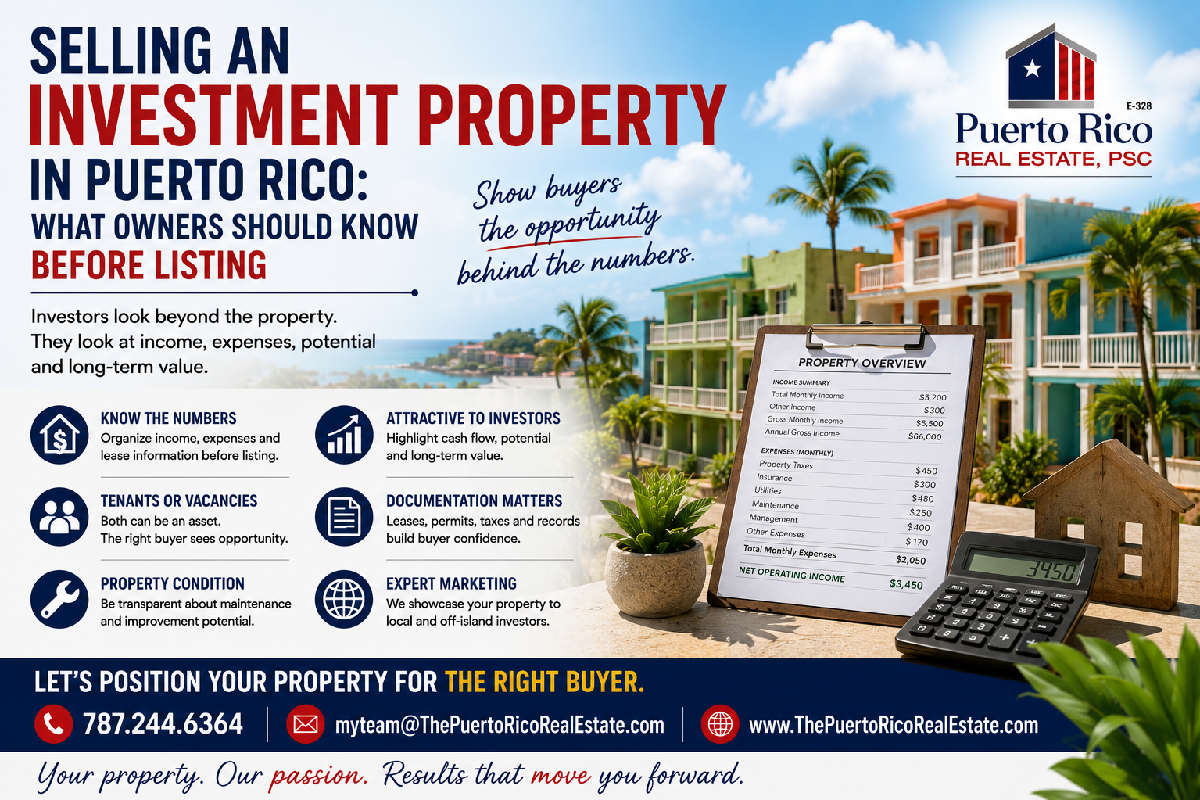
Every property has a story.
With an investment property, however, that story often includes numbers.
Income.
Expenses.
Occupancy.
Maintenance.
Utilities.
Taxes.
Insurance.
Potential improvements.
Possible future uses.
An investor isn't necessarily buying your decorating choices or imagining where the Christmas tree will go.
They're evaluating what the property can do for them financially.
That's why simply listing:
“Four units. Eight bedrooms. Great investment opportunity.”
isn't enough.
Why is it a great investment opportunity?
What does the property currently produce?
What are the expenses?
What condition are the units in?
Are they occupied?
Are rents below, at or potentially above current market levels?
Are utilities separately metered?
Is there unused space?
Are there additional structures?
What improvements have already been made?
These details can dramatically change how an investor views the property.
If you're just beginning to explore selling, our complete guide to selling real estate in Puerto Rico provides an overview of the process from preparation and pricing through marketing and closing.
“How much money does it make?”
It sounds simple.
Sometimes it isn't.
Let's say you own a three-unit property.
One unit rents for $800.
Another rents for $900.
The third is currently vacant.
That information alone doesn't tell the complete story.
Why is the third unit vacant?
Is it being renovated?
Was the previous tenant paying $850?
Could it potentially rent for more after improvements?
What utilities does the owner pay?
What maintenance expenses are typical?
What does insurance cost?
What property-related expenses exist?
An investor needs enough information to begin understanding the property's financial picture.
That doesn't mean you need to promise future profits.
You shouldn't.
It means providing accurate historical and current information when available and allowing the buyer to conduct their own analysis.
Good investment-property marketing provides facts—not fantasies.
If the property currently has tenants, begin organizing the relevant information before the first serious buyer asks for it.
Depending on your situation, that could include:
Current rental amounts.
Lease terms.
Security deposits.
Lease expiration dates.
Which utilities are included.
Payment history when appropriate and available.
Information regarding any vacant units.
Recent improvements.
Known maintenance items.
The goal isn't to overwhelm buyers with paperwork on day one.
It's to avoid discovering halfway through a transaction that nobody knows what the lease actually says.
An organized seller creates confidence.
And confidence matters when someone is considering investing a substantial amount of money.
Sellers sometimes assume tenants make an investment property more difficult to sell.
Not necessarily.
For the right buyer, existing tenants can be attractive.
The investor may appreciate acquiring a property where income already exists.
They don't necessarily need to begin marketing vacant units immediately after closing.
They can see that people are actually willing to rent there.
But the quality and structure of those tenancies matter.
Are there written leases?
Are the rental amounts clearly documented?
How long have the tenants occupied the property?
What responsibilities belong to the tenant versus the owner?
An occupied property isn't automatically better than a vacant one.
But properly documented occupancy can help an investor understand what they're purchasing.
Here's the interesting part:
Vacancy isn't automatically bad either.
Suppose a two-unit property has one occupied apartment and one vacant unit.
A traditional investor may see lost rental income.
Another buyer may see something completely different:
“I can live in one unit and rent the other.”
That could dramatically expand your buyer pool.
A family may purchase a multi-unit property so parents live downstairs and adult children upstairs.
Someone relocating to Puerto Rico may want to occupy one unit while using the other for income.
An investor may prefer a vacant unit because they want to renovate it immediately.
This is why understanding the likely buyers matters.
The same characteristic can be a disadvantage to one person and an opportunity to another.
Language matters.
If a property currently generates income, we can accurately describe that.
If it has multiple units but none are currently rented, calling it an “income-producing property” could create the wrong impression.
Instead, we can talk about:
Income potential.
Flexible multi-unit configuration.
Owner-occupant possibilities.
Potential rental use subject to applicable requirements.
There's nothing wrong with selling potential.
Real estate buyers purchase potential every day.
But potential should be presented as potential.
Accuracy creates credibility.
Sellers naturally want to talk about income.
Investors want to talk about expenses.
A property generating $4,000 per month sounds attractive.
But that number means very little without understanding what it costs to operate.
Depending on the property, expenses may include:
Insurance.
Property taxes.
Common-area electricity.
Water.
Landscaping.
Maintenance.
Pest control.
HOA fees.
Management.
Repairs.
Cleaning.
Utilities included in rent.
An investor may calculate net operating income, capitalization rate, cash flow and other metrics.
You don't necessarily need to perform every calculation for them.
But accurate expense information can make their analysis much easier.
And easier analysis can help serious buyers make decisions faster.
This is one of those details that sellers sometimes forget to mention.
If each unit has separate electric and water meters, tell buyers.
Why?
Because investors immediately understand the potential operational benefit.
Separate utilities can simplify tenant billing and reduce ambiguity about consumption.
Likewise, if there is shared electricity or water, be prepared to explain how those expenses are currently handled.
Small operational details can have a surprisingly large influence on an investor's perception of the property.
Suppose you've owned a property for fifteen years.
You have excellent tenants.
You like them.
You haven't increased their rent in seven years.
That's admirable.
But the current rental income may not necessarily represent what another investor believes the property could eventually produce, subject to existing leases, applicable laws and market conditions.
This creates two different numbers:
Current income.
and
Potential future income.
They should not be confused.
If discussing potential rents, those numbers should be supported by reasonable market information rather than wishful thinking.
Saying:
“These units could probably rent for $2,000 each because I saw an Airbnb nearby charging $300 per night”
isn't meaningful analysis.
Long-term rent and short-term vacation-rental revenue are not the same thing.
Different expenses, occupancy patterns, regulations and management requirements can apply.
Present the opportunity responsibly.
Puerto Rico attracts vacation travelers, so naturally some investors search specifically for properties they believe could work as short-term rentals.
But sellers and agents need to be careful.
A property being near the beach doesn't automatically mean it can or should become an Airbnb.
A condominium may have restrictions.
A community may have rules.
Different registrations, tax responsibilities and regulatory requirements may apply.
The property itself may not be suited for that use.
So rather than making guarantees, describe verified facts.
If the property already has an established short-term rental history and reliable documentation exists, that's useful information.
If it doesn't, then potential short-term rental use should be presented appropriately and subject to the buyer verifying all applicable requirements.
Never turn a possibility into a promise just to make a listing sound better.
Here's where investment-property marketing can become much more interesting.
Not every buyer for a duplex, triplex or multi-unit property considers themselves an investor.
Imagine a family where:
Mom and Dad live upstairs.
Their adult daughter lives downstairs.
Grandparents occupy a separate small unit.
Everyone has privacy.
Everyone stays close.
Or perhaps a buyer wants to live in the main house while renting an additional apartment to help offset housing expenses.
This type of buyer may care less about capitalization rates and more about flexibility.
That's why marketing a multi-unit property exclusively to “INVESTORS ONLY” can sometimes unnecessarily reduce the audience.
The property's configuration may appeal to investors, owner-occupants and multi-generational families.
The broader the legitimate use cases, the broader the potential buyer pool.
Puerto Rico has many interesting properties that don't fit neatly into one category.
A commercial space downstairs with a residence upstairs.
A neighborhood colmado with residential units.
A house with an office.
Several homes within one gated compound.
A warehouse combined with residential space.
These properties can be incredibly useful.
But they can also be more difficult for buyers to understand from a basic listing.
That's where detailed marketing becomes especially important.
Explain the configuration.
Show the different spaces.
Clearly identify which portions are residential and which are commercial.
Explain separate entrances.
Mention separate meters.
Describe parking.
Show storage areas.
Provide accurate measurements when available.
The more unusual the property, the more important it becomes to help buyers understand it.
A traditional buyer might walk into an older property and say:
“I don't like this kitchen.”
An investor might say:
“How much will it cost me to replace three kitchens?”
That's a very different perspective.
Investors often mentally calculate repairs while walking through the property.
Roof.
Plumbing.
Electrical.
Paint.
Bathrooms.
Kitchens.
Windows.
Air-conditioning.
Exterior maintenance.
Every visible issue becomes part of the acquisition calculation.
This doesn't mean you should renovate everything before selling.
In many cases, that would make little financial sense.
But understand that condition affects investor pricing.
Our article on whether to repair your Puerto Rico property or sell it as-is discusses why sellers should evaluate the likely return before spending substantial money on renovations.
Sometimes the smartest move is to repair.
Sometimes it's to sell as-is.
The numbers should help make that decision.
This might sound strange, but it's important.
Suppose you own a three-unit building.
Two units are beautiful.
The third needs significant work.
Don't photograph only the beautiful units and hope the buyer somehow forgets the third one exists.
Serious investors will find out.
Instead, show the reality.
Then explain the opportunity.
“Two units are currently functional and the third provides a value-add opportunity for renovation.”
That's much stronger than creating a surprise during the showing.
Experienced investors aren't necessarily afraid of work.
They're afraid of unknown problems.
Investment properties are especially susceptible to unnecessary pre-sale renovations.
You may be considering spending $20,000 renovating a vacant apartment.
But perhaps the eventual buyer plans to reconfigure it entirely.
Now you've spent $20,000 creating something they intend to tear apart.
Instead, determine whether the property will likely generate a better return:
As-is.
With basic repairs.
With cosmetic improvements.
Or after renovation.
There's no universal answer.
But there should be a reason behind the decision.
Comparable sales still matter.
Location still matters.
Condition still matters.
Square footage still matters.
But income-producing properties may add another layer:
What financial performance does the property offer?
An investor may compare your property not only with another building nearby, but with entirely different investment opportunities.
If they can invest $500,000 elsewhere and achieve a stronger return with less risk, they'll consider that.
That doesn't mean every investment property should be priced solely using capitalization rate.
Puerto Rico's property types and markets vary tremendously.
But it does mean we need to understand the investor's perspective.
A beautiful building isn't automatically a good investment at every price.
This happens frequently.
A seller says:
“I could rent each apartment for $1,500.”
Okay.
Are similar apartments actually renting for $1,500?
How long does it take to find tenants?
What condition are those comparable units in?
Do they include utilities?
Are they furnished?
Do they have parking?
Air conditioning?
Backup power?
Location differences?
The word “could” can hide a lot of assumptions.
Potential rental income can absolutely be part of the story.
But it needs context.
Investors will do their homework.
We should too.
The more complicated the property, the more important documentation becomes.
A single-family residence may be relatively straightforward.
A property with three residences, a commercial space, multiple meters, tenants and different structures may require much more organization.
Depending on the situation, buyers may want to understand:
Ownership.
Catastro information.
Permits.
Property tax records.
Leases.
Utility arrangements.
Surveys.
Commercial-use information.
Existing financing.
Insurance.
Income and expense records.
Our guide to documents commonly needed when selling property in Puerto Rico is a good starting point.
Don't wait until you're under contract to begin looking for everything.
This is exactly the kind of information that needs to be identified early.
Some Puerto Rico properties include multiple lots or structures that may not all fall under the same catastro information.
That doesn't automatically mean there's a problem.
But buyers need to understand what they're purchasing.
Which structures sit on which parcel?
What's included in the sale?
Are everything and everyone referring to the same property?
Clear information prevents confusion later.
If you're selling a complex investment property, gathering these details before marketing can make the process significantly smoother.
There's an old assumption that investors don't care what a property looks like.
They only care about numbers.
That's not completely true.
Investors are still human.
Strong photography helps them understand the property.
Good images can communicate:
Condition.
Layout.
Parking.
Unit separation.
Outdoor spaces.
Commercial areas.
Storage.
Land.
Access.
Views.
Renovation opportunities.
Professional presentation also sends a subtle message:
This is a serious property being marketed seriously.
Video is especially useful for complicated properties.
Imagine trying to explain a compound containing:
A commercial space.
A three-bedroom residence upstairs.
A separate two-bedroom rental house.
Another building with a residence upstairs.
Storage downstairs.
Multiple parking areas.
A gated entrance.
Try explaining that with ten photographs.
Now imagine walking the buyer through the property on video.
Suddenly, the relationship between the structures makes sense.
For off-island investors, this can be incredibly valuable.
They may be deciding whether the property deserves a flight to Puerto Rico.
A detailed video can help them make that decision.
Investment property buyers can come from anywhere.
Some already own properties here.
Others are Puerto Ricans living in the mainland who want to invest back home.
Some are relocating.
Others are researching Puerto Rico as part of a broader investment strategy.
That means digital visibility matters.
At Puerto Rico Real Estate, PSC, we don't want to rely solely on someone driving past a “Se Vende” sign.
Depending on the property, marketing may include online real estate exposure, video, social media, search-focused content and outreach designed to help local and off-island buyers discover the opportunity.
Our step-by-step guide to selling property in Puerto Rico explains how preparation, pricing and marketing work together throughout the selling process.
Why discuss investment properties in September?
Because we're entering the final quarter of the year.
Investors may be reviewing their portfolios.
Owners may be evaluating whether they want to continue managing a property into another year.
Buyers may be planning future acquisitions.
Some owners are beginning to think:
“Do I really want to deal with this property for another year?”
If you've been asking yourself that question, September is a good time to begin evaluating your options.
You don't necessarily need to sell.
But you should understand what selling might look like.
What could the property be worth?
Who might buy it?
What should be organized first?
Should you make repairs?
Should you renew leases?
Should you leave a unit vacant?
How long might a sale take?
Those are strategic decisions.
And they're easier to make before you're under pressure.
Selling an investment property isn't simply about uploading photographs and waiting for someone to call.
We need to understand the asset.
At Puerto Rico Real Estate, PSC, our approach focuses on helping sellers position the complete opportunity.
Property Evaluation — Understanding the structures, condition, location and configuration.
Buyer Identification — Determining whether the strongest audience may include investors, owner-occupants, multi-generational families or other buyers.
Pricing Strategy — Evaluating market competition while considering the property's income-producing characteristics when appropriate.
Pre-Listing Preparation — Identifying what information, documentation and property preparation should be addressed before launch.
Professional Marketing — Using photography, video and detailed descriptions to make complex properties easier to understand.
Digital Exposure — Reaching beyond the immediate neighborhood to buyers searching throughout Puerto Rico and beyond.
Offer Evaluation — Looking at price, financing, terms, contingencies and likelihood of closing.
Negotiation — Helping protect your position while working toward a transaction that makes sense.
Transaction Coordination — Managing the details from accepted offer through closing.
The objective isn't simply to find someone willing to buy.
It's to position the property so serious buyers can understand why they should.
Maybe you've owned it for twenty years.
Maybe you've owned it for two.
Maybe it's producing good income but you're ready for something different.
Maybe it needs more management than you want to provide.
Maybe you're sitting on significant equity.
Maybe you've inherited it.
Maybe you want to reinvest elsewhere.
Or maybe you're simply curious what the property could be worth in today's market.
You don't need to make the decision today.
But you can start gathering information today.
Because the best selling decisions usually aren't made under pressure.
They're made after understanding the property, the numbers, the market and your options.
If you own a rental property, duplex, multi-unit residence, mixed-use building, commercial/residential property or another income-producing asset in Puerto Rico, we'd be happy to help you evaluate your next move.
Your investment property has a story.
Let's make sure potential buyers understand both the property and the opportunity behind it.
Thinking about selling an investment or income-producing property in Puerto Rico? Let's talk.
📞 787-244-6364
🌐 www.ThePuertoRicoRealEstate.com
Puerto Rico Real Estate, PSC — Helping Puerto Rico property owners prepare, position, market and sell their real estate with a strategy built around the property and the buyer.
#PuertoRicoRealEstate #PuertoRicoInvestmentProperty #InvestmentProperty #IncomePropertyPuertoRico #PuertoRicoInvestors #RentalPropertyPuertoRico #MultiFamilyPuertoRico #SellPropertyPuertoRico #PuertoRicoSellers #RealEstateInvestingPuertoRico #PuertoRicoProperty #InvestInPuertoRico #IncomeProducingProperty #PuertoRicoRealEstateInvesting #ThePuertoRicoRealEstate
Your satisfaction guides our every step. Thanks for choosing PRRE. View all.
"Thank you for your service great teamwork I completely appreciate your time and all your effort thanks again"
You were so much help. Thank you for staying on top of things with me.
The closing was straightforward and completed without incident. The buyers were wonderful. Thank you.
The closing was straightforward and completed without incident. The buyers were wonderful. Thank you
I received your listing in email and just wanted to thank you for the EXCELLENT information. You included not only the correct location, but good, quality video/photos, everything. It's not exactly what I need but: A rare thing to get such a quality listing information, just wanted to say thank you.
Everything went smooth and great at closing, you were such a great help in the process. I will refer you to a friend that needs your help. Thanks alot for all you did for me.
Thanks to all of you, super attention, you explained everything very kindly and the Lcda was also super kind. All excellent more than grateful for everything!!
Everything super good, they treated us very well and everything went well with the closing. Everyone was very nice and the Lcda was very kind to us. Thanks to you and your team who treated us very well and never let us go. I will recommend you and hope to call you soon to find a property.
Closing Done, only took an hour.No problems it went smooth. Thanks again for everything! Having a drink to celebrate.
Very Smooth Transaction. Your Team was very supportive and they helped me alot during the transaction.